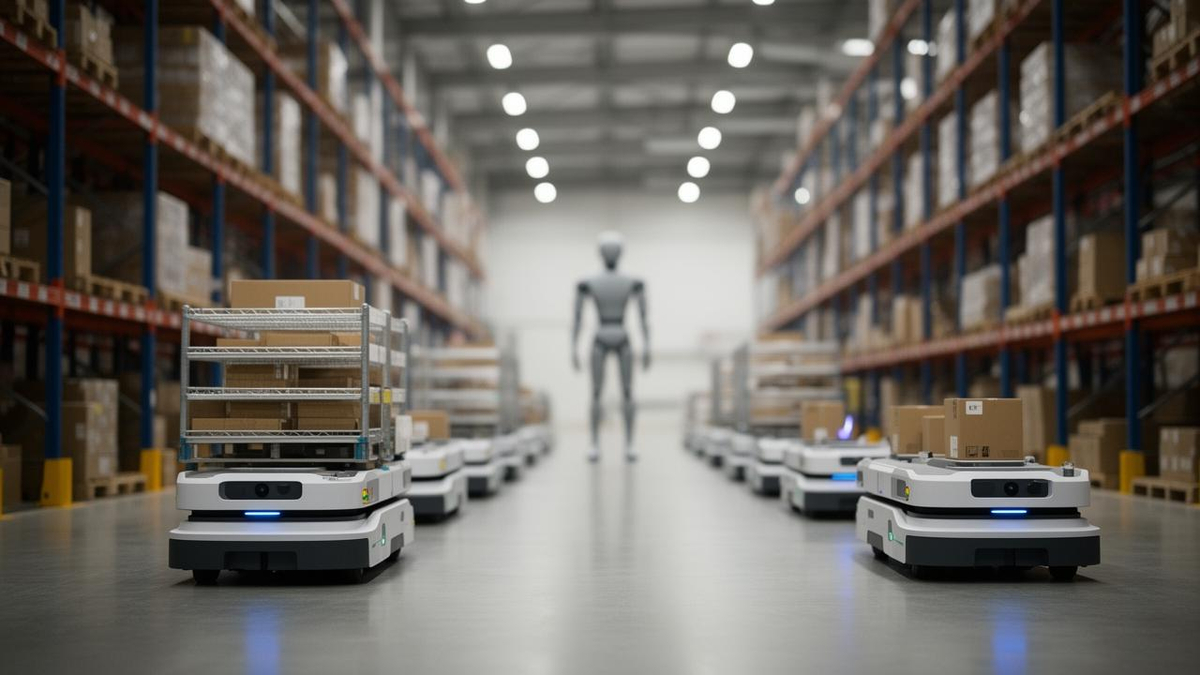
As the market remains exuberant about humanoid robot prospects, Barclays delivered a sobering assessment in its latest research note published on September 18: large-scale deployment of fully autonomous general-purpose humanoid robots may have to wait until around 2035, rather than the 2030 timeline the market has broadly anticipated. The firm also pointed out that the first wave of Physical AI disruption will most likely not take humanoid form at all.
Barclays structured its analysis around the three questions investors care most about—scale, compute, and form factor—and its core conclusion points to an overlooked reality: the bottleneck is not hardware, but intelligence.
The report notes that many humanoid robot capabilities currently showcased in the industry still rely on pre-programming, teleoperation, or narrow-domain automation tailored to specific scenarios, leaving a significant gap from true general-purpose autonomy. The AI model capabilities required for perception, reasoning, and action remain immature—and that is the fundamental obstacle holding back the industry’s leap forward.
On the hardware side, the industry is caught in a “chicken-and-egg” dilemma among scale, cost, and capability: without scale there is no low cost, and without sufficient intelligence there is no way to prove commercial value—all three are difficult to break through simultaneously. Barclays believes this dynamic closely mirrors the decade-plus commercialization cycle that autonomous driving has traversed: between technology demonstrations and scaled commercial deployment lies a long and expensive chasm.
Compute demand precedes hardware deployment
On the compute front, Barclays’ framework splits demand into two dimensions: centralized data center compute and distributed edge AI compute.
Data center-side compute primarily serves simulation and synthetic data generation, as well as foundation model training and post-training. But the inference workloads that truly determine robot performance—perceiving, deciding, and acting in real time in the physical world—must run on specialized edge processors inside the robots themselves, given stringent constraints on latency, power consumption, reliability, and safety.
This means humanoid robot inference workloads will not translate directly into incremental hyperscale data center demand the way Agentic AI does. For data centers, humanoid robots represent only a modest incremental driver; for edge computing, they could be a major one.
Yet even a “modest increment” carries weight in an industry context where AI data center capacity is already tight. The more critical timing gap is this: compute demand precedes hardware deployment expansion. Developers need massive compute for simulation and model training well before robots are deployed at scale.
Figure’s partnership with emerging cloud service provider Nscale is a textbook example of this logic. The multi-year agreement involves an initial commitment of approximately $3.5 billion, with a target scale exceeding $6 billion, supporting up to 100,000 NVIDIA (NVDA) Vera Rubin GPUs. At roughly 3.0 to 3.3 kilowatts of fully configured rack capacity per GPU, that corresponds to approximately 300 to 330 megawatts of IT capacity.
At a stage when humanoid robots have yet to be deployed at scale, merely developing the “brain” already constitutes a meaningful incremental demand driver for data centers. Barclays therefore concludes that earlier investment opportunities lie in the compute, data, and model layers—the underlying infrastructure needed to unlock the “GPT moment” for humanoid robots. Large-scale economic deployment of hardware will have to wait for the intelligence layer to break through first.
Specialized robots are already moving ahead
Barclays’ “still too early” assessment refers specifically to fully autonomous general-purpose humanoid robots. Before that point arrives, task-specific AI robots are already making moves across multiple industries.
Collaborative robots (cobots), autonomous mobile robots (AMRs), AI drones, quadruped robots—these varied form factors are entering “dirty, dull, dangerous” job categories, spanning commercial, industrial, and defense scenarios.
Amazon (AMZN) provides the most compelling evidence. The company has deployed more than one million robots in its operations, encompassing mobile drive units, AMRs, and AI manipulation systems, organized by task and form factor—and not a single one is humanoid.
Atoms, the venture backed by Uber founder Travis Kalanick, recently raised $1.7 billion, and its direction is likewise not humanoid, but rather specialized industrial robots and Physical AI systems for mining and transportation.
So why pursue the humanoid form at all? Barclays offers two core rationales.
First, the human world is built around the human body. Stairs, doors, tools, workbenches, production lines—all are designed to human scale. Humanoid robots can enter existing environments directly, without requiring infrastructure to be rebuilt for robots.
Second, general-purpose humanoid robots offer the possibility of a multi-task platform—the same robot can move materials, operate tools, and inspect equipment. The value lies in one platform covering multiple scenarios, rather than outperforming specialized robots on any single task.
But when tasks and environments are well-defined, specialized solutions are often faster, cheaper, and safer. Wheels are more practical than bipedal locomotion in flat warehouses; four legs are more stable than two on uneven terrain; specialized grippers are more precise than five-fingered hands for repetitive operations. Form factor selection is ultimately determined by the specific scenario.
Barclays’ report provides an important risk-calibration framework for the current humanoid robot investment frenzy: there is a significant timing gap between the appeal of the technology narrative and the pace of commercial deployment. For investors, distinguishing between “early infrastructure opportunities in the intelligence layer” and “the timing of large-scale hardware deployment” may prove more critical than chasing the humanoid concept itself.