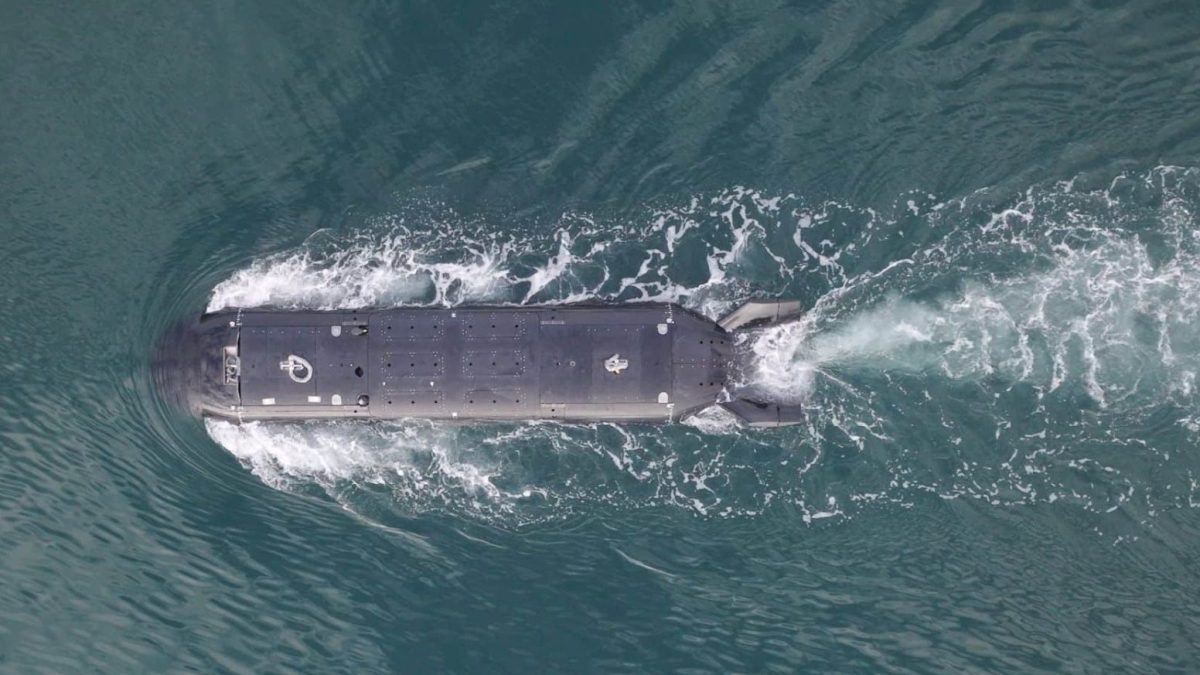
Britain has fired a heavyweight torpedo from a uncrewed, underwater drone for the first time as part of efforts to counter the growing threat from Russia.
The torpedo was fired last week in UK waters from the Navy’s 12-metre undersea drone known as Excalibur.
The weapon, jointly developed by the US and Australia, is designed to sink ships and deep-diving submarines.
Shorts
Scroll to previous short
Scroll to next short

news
PM to meet Trump for first time this week – what to expect

Prime Minister Andy Burnham set off for New York on Monday for the United Nations General Assembly.
It will be Burnham’s first foray into global diplomacy, as well as his first opportunity to meet his US counterpart Donald Trump.
Fraught UK-US relations
Burnham is expected to meet Trump on Tuesday, at a time when the UK’s special relationship with the US is particularly fraught.
 The President has gone out of his way to unnerve the Burnham government (Photo: Evan Vucci/Reuters)
 Prime Minister Andy Burnham meets with Canadian Prime Minister Mark Carney, not shown, at Hill Dickinson Stadium in Liverpool (Photo: AP)
From the war in Iran, to Israel and the Falklands, there are a string of issues that could lead to conflict. Though there are hopes for co-operation too.
PM to set out vision for Britain
For Burnham, who Trump has described as the “mayor of a town”, an array of flashpoints may crop up in their 30-minute meeting.
The meeting will happen the same day the PM plans to set out his vision for Britain’s place on the world stage.
 Caption: Annalena Baerbock, president of the 80th General Assembly, speaks during the General Debate of the United Nations General Assembly at the UN headquarters in New York City on September 23, 2025. (Photo by TIMOTHY A. CLARY / AFP) (Photo by TIMOTHY A. CLARY/AFP via Getty Images)
Photographer: TIMOTHY A. CLARY
Provider: AFP via Getty Images
Source: AFP
Copyright: AFP or licensors

3 min read
What could be on the agenda?
 Caption: TOPSHOT – Explosions erupt following strikes at Tehran Oil Refinery in Tehran on March 7, 2026. The United States and Israel launched strikes against Iran on February 28, sparking swift retaliation by the Islamic republic which responded with missile attacks across the region. The war has dragged in global powers, upended the world’s energy and transport sectors, and brought chaos to even usually peaceful areas of the volatile region. (Photo by ATTA KENARE / AFP via Getty Images)
Photographer: ATTA KENARE
Provider: AFP via Getty Images
Source: AFP
Copyright: AFP or licensors
Iran
Britain has not endorsed the wider Iran war, which is driving up energy costs.
Ukraine
Burnham is expected to press Trump for more support for Ukraine.
 A damaged multi-storey residential building hit by what authorities described as a Ukrainian drone strike, amid the Russia-Ukraine conflict in Kotelniki in the Moscow region, Russia, September, 20, 2026. REUTERS/Stringer
Photographer: Stringer
Provider: REUTERS
Source: REUTERS
 Labour’s 2024 manifesto ruled out granting new North Sea oil and gas licences, but the Rosebank and Jackdaw fields are being treated as separate cases because they already hold existing licences (Photo: Danny Lawson/PA)
North Sea drilling
Trump has pressed former PMs to expand North Sea drilling and welcomed Burnham’s pledge to do so.
What could be on the agenda?
Digital services tax
Trump has threatened trade deals over the UK’s £1bn digital tax and has concerns over its under-16 social media ban.
 US President Donald Trump on 12 September (Photo: AP)
 Andy Burnham has promised to crack down on illegal migration (Photo: Jack Taylor/PA Wire)
Trade deals
Burnham may press Trump to fully revive the £31bn tech prosperity deal.
Falkland Islands
Trump has declined to commit to defending the Falklands, stoking fears that he could treat the islands’ sovereignty as negotiable.
 Even great powers struggle to act alone – and Britain’s comparative advantage lies less in its size than in its ability to convene, persuade and build coalitions (Photo: Peter Hazell/Getty Images)
Watch more from The i Paper
Opinion | “When the time comes to render a verdict on Donald Trump’s second presidency, there are plenty of crises that could damage his score,” writes James Ball. “Having promised to solve Russia’s war on Ukraine on “day one” of his presidency, Trump’s actions have only led to escalations from both sides of the conflict. In the Middle East, Trump took more than a year to secure an uneasy ceasefire in Gaza, only to ignite the whole region with a fresh war against Iran, for which he seems to have no exit strategy.” “Trump’s failures in these areas, though, might not be what he is remembered for. Instead, it could be the handling of another looming crisis that defines his presidency: what did Trump do about the rise of artificial intelligence?” Read James’ full piece on @theipaper website.
♬ original sound – The i Paper – The i Paper
Cash ISA cut to go ahead in April – everything we know
A cut to the tax-free amount savers can deposit in a cash ISA will go ahead next April, The i Paper has learned.
Here is everything we know about the changing rules so far.

2 min read

3 min read
What you need to know
The Government will press ahead with reforms to the cash ISA on 6 April 2027.
Former chancellor Rachel Reeves proposed the change in 2025 so that only £12,000 of the £20,000 annual ISA allowance could be held in cash, in a bid to encourage more people to invest in stocks and shares, which can offer higher long-term returns and boost businesses and the economy.
 Economists say that the Bank of England is still likely to reduce rates at least once later this year (manassanant pamai/Getty Images)

3 min read
Uninvested cash subject to new tax
The amount savers under 65 can deposit into a cash ISA tax-free each year will fall from £20,000 to £12,000 in April.
 (Photo: Getty).
 Photographer: Andrew Brookes
Provider: Getty Images/Image Source
Source: Image Source
Copyright: Andrew Brookes, AB Still Ltd, www.andrewbrookes.co.uk
Savers in that age bracket will still be able to invest a further £8,000 tax-free in a stocks and shares ISA or the rarely used innovative finance ISA. Any interest earned on uninvested cash held inside stocks and shares ISAs will also face a new 22 per cent tax charge.
Finance industry calls for delays to new rules
With less than seven months to go, the finance industry is demanding clarity on how the change will work – with some calling for a delay.
Yorkshire Building Society described the timetable for implementing the changes as “challenging”.
The Treasury has said officials are working “at pace” to put the necessary rules in place ahead of its launch next April.

3 min read
 Joumana Medlej didn’t start a pension until she was in her forties. Now she’s playing catch-up (Photo: Sakchai Vongsasiripat/Getty )
read the full story
Customers face confusion about new rules
Bryan Byrnes, director of personal finance at savings provider Moneybox, said that customers were already confused about how the new rules will work.
He added: “Helping customers navigate these changes will therefore be just as important as implementing them.”
NEWS
How baby girls are more sociable than boys from birth
 Decisions on childbirth should prioritise safety, say campaigners (Photo: Petri Oeschger/Getty Images/Moment RF)
Baby girls tend to be more people-focused than boys from when they are first born, a study suggests.
Researchers found that when newborns were shown side-by-side videos of a face and a toy, girls spent proportionally more time watching the face than boys did, suggesting that differences in attention may emerge from birth.
Biological factors at play
Because the babies were only a day or so old, it is unlikely that cultural or social experiences had influenced the effect.
It instead points to biological factors, including genetics and differing levels of testosterone exposure in the womb.
However, it is worth noting that the findings, based on tests with 130 babies at the Rosie Hospital in Cambridge, do not apply to all girls and all boys.
There was still plenty of variation and overlap between each sex.

3 min read
‘A very heated debate’
This is a very active and heated debate in the field of sex differences: what are the causes behind sex differences and how early in life are they present? What our research shows is that at least some differences are present at a small scale very early on in life.
Yumnah Khan, a PhD student at the Autism Research Centre at the University of Cambridge
 (Photo: Thanasis Zovoilis/Getty).
What does it tell us?
 Mother and her happy toddler girl having fun while splashing with water outdoor. – stock photo. (Photo: Getty)
Small differences at birth may play a role in long-observed trends.
For example, girls typically learn to talk earlier than boys, and develop certain social skills younger too.
2 min read
The expert view
If they’re showing heightened social interest from birth onwards, that might facilitate the development of these skills.
Although only a hypothesis, Khan said that greater social interest from birth could help facilitate verbal and social skills.
 Caption: Relatable image of real life siblings comically messing about. The little girl sticks her feet in the boy’s face, which distorts his face into a funny expression. She giggles as she does so. Window provides a space for copy.
Photographer: Catherine Falls Commercial
Provider: Getty Images
Source: Moment RF
However, she said further studies that follow the babies until they are toddlers would be required to support that idea.
news
Everything you need to know about the Russian elections
 Caption: TOPSHOT – Russian President Vladimir Putin walks down the steps to address troops from the defence ministry, National Guard, FSB security service and interior ministry gathered on the Sobornaya (Cathedral) Square from the porch of the the Palace of the Facets on the grounds of the Kremlin in central Moscow on June 27, 2023. (Photo by Sergei GUNEYEV / SPUTNIK / AFP via Getty Images)
Photographer: SERGEI GUNEYEV
Provider: SPUTNIK/AFP via Getty Images
Source: AFP
The pro-Putin ruling United Russia party retained its decisive majority in the national parliament, near-complete election results showed on Monday, while the anti-war Yabloko party appeared to have won a tiny foothold in one regional parliament.
The background
Vladimir Putin had cast the three-day election to the State Duma – the first since Russia launched its full-scale war in Ukraine in February 2022 – as a test of support for the war.
Elections for some regional parliaments and governors were held at the same time.
In a tightly controlled political system, which critics say does not tolerate genuine dissent, few surprises were expected.

Exclusive
3 min read
A closer look at the results
With over 95 per cent of the vote counted, Ella Pamfilova, chair of the Central Electoral Commission, said United Russia had won a resounding victory with 57.83 per cent, up from the 49.8 per cent that it won in the last parliamentary election, in 2021.

Analysis
4 min read

4 min read
What else you need to know
United Russia was set to control 355 seats or nearly 80 per cent of the 450-seat Duma, a total that includes results in individual constituencies.
That would maintain its constitutional majority – enabling it to pass laws and initiate amendments to the constitution without support of other parties.
Pamfilova said three other parties had made it into parliament – the Communists with 13.81 per cent, the ultra-nationalist LDPR with 8.98 per cent, and the New People party with 7.96 per cent.

read the i paper’s latest analysis
What Putin’s paranoia will lead him to do next

“Stalin knew how to run Russia and how to get respect. Vladimir Putin could learn something from him.”
 Caption: Television programme: That Mitchell and Webb Look.
Picture shows: Captain Good (Robert Webb) and Monsieur Voirons (David Mitchell)
TX BBC Two Thursday 11th June 10.00pm
Photographer: BBC
Provider: BBC
Copyright: BBC PICTURE ARCHIVES
news
BBC removes That Mitchell and Webb Look sketches from iPlayer
The BBC has removed several sketches from That Mitchell and Webb Look on iPlayer after deciding some of the comedy show’s material “no longer works today”.
Controversial material removed
The sketch comedy show, starring comedians David Mitchell and Robert Webb, originally ran for four seasons between 2006 and 2010.
 Caption: TELEVISION PROGRAMMES: THAT MITCHELL AND WEBB LOOK.
PICTURE SHOWS: ROBERT WEBB AND DAVID MITCHELL
Sir Walter Raleigh (David) names his latest discovery Virginia. His First Mate wonders if it’s “a bit personal, to name a new land after the fact that our Queen’s never done it”.
BBC Two: Thursday 21st Feb 2008
BBC WARNING: Use of this copyrighted image is subject to Terms of Use of BBC Digital Picture Service. In particular, this image may only be used during the publicity period for the purpose of publicising ‘That Mitchell and Webb Look’ and provided the BBC is credited. Any use of this image on the internet or for any other purpose whatsoever, including advertising or other commercial uses, requires the prior written approval of the BBC.
Photographer: BBC
Provider: BBC
Copyright: BBC PICTURE ARCHIVES
 Caption: Television programme, ‘THAT MITCHELL AND WEBB LOOK’. BBC Picture shows: Rob Webb and David Mitchell as Phillips (a scientist) and Monsieur Garnier TX BBC TWO TUESDAY 12TH JULY 2010
Photographer: BBC/Sue Foll
Provider: BBC
Copyright: BBC PICTURE ARCHIVES
However, some material has been removed, including scenes featuring war re-enactors in Blackface, a joke about Jimmy Savile and a sketch about a contestant on a makeover show wearing a burka, The Times reported.
What did the BBC say?
This is a 20-year-old sketch show; in consultation with the programme makers, we have included the ones that still work today and not the ones that don’t.
bbc spokesperson

news
Flights disrupted across north of UK – what you need to know
 Caption: LONDON, UNITED KINGDOM – SEPTEMBER 08: Passengers wait inside and around London Heathrow Airport following widespread flight delays and cancellations caused by a technical failure in National Air Traffic Services’ (NATS) flight processing system in London, United Kingdom, on September 08, 2026. Technical issues are causing disruptions in flight departures at UK airports, Britain’s air traffic control service said Wednesday. (Photo by Rasid Necati Aslim/Anadolu via Getty Images)
Photographer: Anadolu
Provider: Anadolu via Getty Images
Source: Anadolu
Flights across the UK – particularly Scotland, Northern Ireland and the north of England – are facing disruption due to a “technical issue” with air traffic control.
Here is everything you need to know – including the airports affected.
What caused the problem?
Nats, which runs air traffic control, has said the issue at its Prestwick centre in Ayrshire is “now fixed”, and that it is working to “safely lift air traffic regulations as quickly as we can”. It said the glitch was a “connectivity issue with part of our systems network”.
 Aviation analytics company Cirium said as of 5.30pm, 357 flights had been cancelled or not taken off at UK airports on Wednesday (Photo: Dan Kitwood/Getty)
 Caption: Travellers lay on the floor with their luggage at the South Terminal of London Gatwick airport near Crawley, southern England on September 9, 2026, following second day of major disruption due an issue affecting the NATS air traffic control systems. UK travellers faced more misery on September 9, with more than 150 flights scrapped across the country, as Britain’s air traffic control service scrambled to recover from a technical glitch that sparked chaos. (Photo by JUSTIN TALLIS / AFP via Getty Images)
Photographer: JUSTIN TALLIS
Provider: AFP via Getty Images
Source: AFP
Copyright: AFP or licensors
Second failure in two weeks
This is the second failure at Nats in less than a fortnight.
But it said this most recent disruption has “nothing to do” with the software defect that led to the cancellation of 2,000 flights across the UK earlier this month.
 Europe has just six weeks of jet fuel supplies, experts have warned (Photo by JEFF PACHOUD / AFP via Getty Images)
 Caption: TOPSHOT – Cancelled flights are pictured on an electronic check-in display board at Terminal 3 of London Heathrow airport, west of London on September 8, 2026, following major disruption due an issue affecting the NATS air traffic control systems. Flights to and from the UK were cancelled on on September 8, due to a “technical issue” affecting UK’s National Air Traffic Services (NATS), which says it is working to resolve the situation. (Photo by Henry NICHOLLS / AFP via Getty Images)
Photographer: HENRY NICHOLLS
Provider: AFP via Getty Images
Source: AFP
Copyright: AFP or licensors
EasyJet said this “once again calls into questions the resilience of Nats’ systems”.
Airports report disruption
Airports across the UK have reported varying degrees of disruption. They include:
Glasgow and Aberdeen – Arrivals and departures.
Manchester – Issue causing some delays.
Newcastle – Experiencing “some delays”.
Liverpool – Urging passengers to contact their airline.
Bristol – Experiencing some delays and cancellations similar to other airports.
London City – Experiencing “some disruption” and “working closely” with Nats to resolve the issue.
Belfast City – Warns that there “will be disruption” to both arrivals and departures.
The test was carried out by Britain and the US under the landmark AUKUS defence partnership with Australia, which is developing next-generation submarine, artificial intelligence and autonomous undersea capabilities.
It is the first time either country has fired a torpedo from an uncrewed, underwater vessel rather than a crewed submarine.
The Excalibur drone, which is currently carrying out sea trials, was built in Plymouth and can be remote operated from nearly 10,000 miles away.
The test forms part of a wider drive to protect Britain’s vital seabed cables and pipelines from hostile powers.
Russia has been waging a form of “hybrid warfare” at sea by using spy vessels and covert underwater capabilities to gather intelligence about the UK’s critical underwater cables and pipelines, raising fears of sabotage.
The Government has hailed the successful test as a “significant breakthrough” for Euro-Atlantic security and Nato’s undersea capabilities.
The Prime Minister will be in New York on Tuesday for the UN General Assembly (UNGA), where he will hold his first face-to-face meeting with US President Donald Trump.
The conflict in Ukraine, security in the Middle East and artificial intelligence are expected to dominate talks among world leaders over the coming days.
European intelligence officials have warned that Russia could step up its operations against Nato countries in the coming months. One Czech intelligence chief told The Guardian earlier this week that a possible escalation could come in “months, not years”. Baltic intelligence chiefs cautioned that there was no evidence of an imminent attack.
Ukrainian President Volodymyr Zelensky is also expected to meet Trump on the sidelines of UNGA. The US President has been pressing Zelensky to halt Ukraine’s strikes on Russian oil refineries over fears of fuel shortages and rising prices.
The Navy’s supersized undersea drone
 The Royal Navy’s XV Excalibur (Photo: Ministry of Defence)
Official name: XV Excalibur
Significance: Navy’s largest uncrewed, underwater vessel
Unveiled: May 2025
Status: Carrying out extensive sea trials
Size: 12 metres long, 2.2 metres in diameter and displacing about 19 tonnes
Capability: Can be controlled from a remote operating centre nearly 10,000 miles away
Purpose: To help the Navy understand how large, autonomous submarines could operate alongside crewed submarines and surface ships in future conflicts.
Speaking ahead of the summit, the Prime Minister’s spokesperson said the UK must take a leadership role against “a darkening global picture” of conflict, climate change and hostile states using disinformation to sow division.
Burnham will use his first visit to the US as Prime Minister to push for greater international co-operation on AI and discuss global issues affecting people at home, including Ukraine and Britain’s G20 presidency.
He will argue that AI technology should be harnessed to improve lives while strengthening security.
Britain and the US will also launch a new AI and Autonomy Partnership, bringing together defence officials from both countries to develop trusted artificial intelligence systems that can protect critical infrastructure, from sea lanes to airspace, while detecting threats and deterring adversaries.
The work will build on technology already being developed through AUKUS, including next-generation attack submarines and autonomous undersea capabilities.
 The XV Excalibur is currently carrying out sea trials (Photo: Ministry of Defence)
Burnham said Britain was “at our strongest when we work with our partners” to tackle shared challenges, and said the country would show the same leadership on AI that it did during the global financial crisis.
He said he would also make the case at the UN for “a just and lasting peace” in Ukraine and renewed efforts to end the conflict in the Middle East, arguing that “what happens abroad impacts each and every one of us at home”.
Burnham will also confirm that Manchester will host the G20 leaders’ summit, which brings together the world’s major economies, next November.