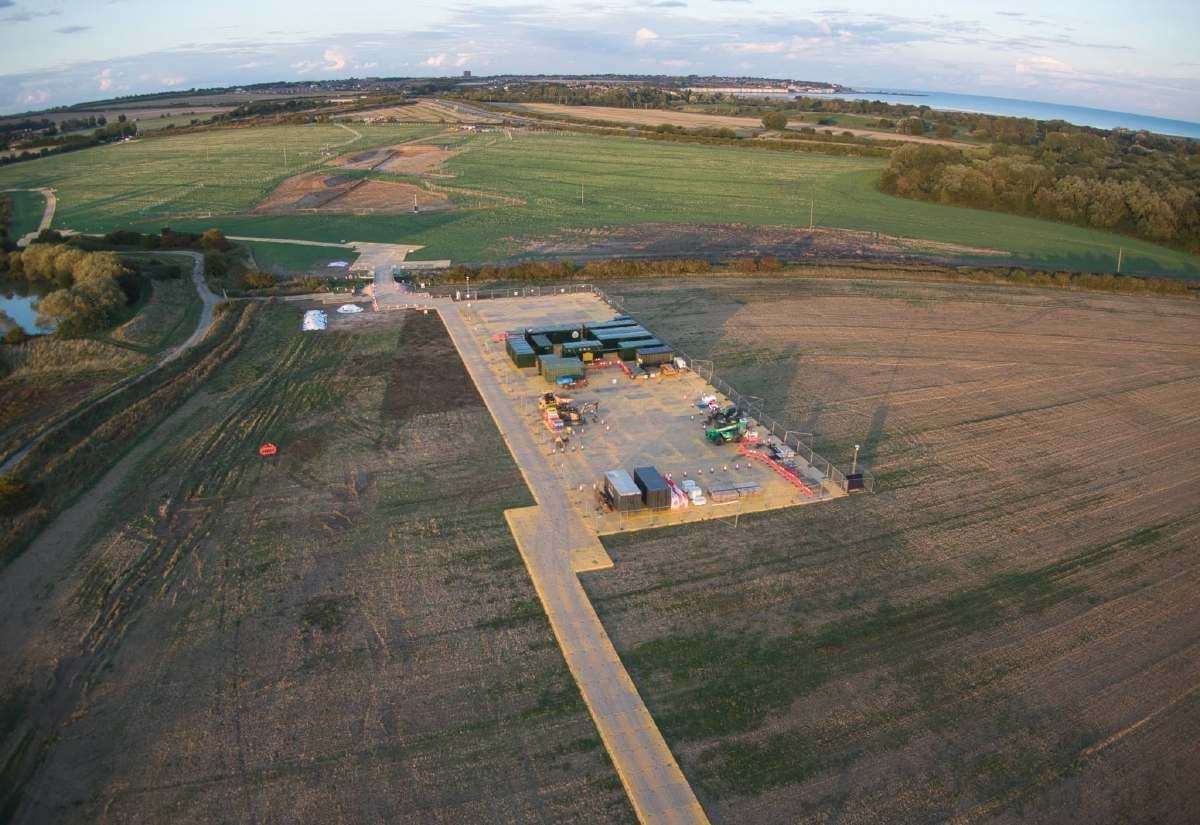
The countdown has begun for a decision on one of Kent’s most controversial green energy projects, which campaigners say will decimate vital wildlife habitats.
For three years, they have been fighting National Grid’s scheme for a 100ft-tall converter station and substation on a sprawling new industrial site covering more than 22 acres on the Minster Marshes near Ramsgate.

 Drone footage of the Minster Marshes near Ramsgate reveals National Grid’s ‘preparatory’ work for its controversial converter station. Photo: Nik Mitchell – Get Wild
The energy company says it is vital infrastructure for its Sea Link project and part of its ‘Great Grid Upgrade’.
One of the largest of its kind in Europe, it is being built to support an offshore high-voltage electricity link between a substation in Minster and one in Suffolk, via undersea cables.
Now a decision on whether it gets the government go-ahead is fast approaching. It will be announced by Miatta Fahnbulleh, the Secretary of State for Energy Security and Net Zero (DESNZ), by the end of October.
But the project has come under fire from thousands of objectors, including Herne Bay and Sandwich Conservative MP Sir Roger Gale, who has branded National Grid “predatory” and the proposal “an act of environmental vandalism”.
He and others also fear the company has “pre-empted” the planning permission with its ongoing works on site.
“What I find particularly unacceptable is the commencement of so-called ‘preparatory works’ before the Secretary of State has even determined the Development Consent Order,” Sir Roger said.
“That appears to me to put the cart some considerable distance before the horse.
“So on Parliament’s return, I raised the matter directly with the new Prime Minister and asked him to intervene.
“I am grateful that Mr Burnham undertook to look at the issue and I have written to him to seek to make certain that he does.
“National infrastructure may be necessary, but that does not give large organisations carte blanche to ride roughshod over local communities.”
 Herne Bay and Sandwich MP Sir Roger Gale has accused National Grid of “environmental vandalism”.
 An impression of how the National Grid converter and substation on Minster Marshes would look. Picture: National Grid
East Thanet Labour MP Polly Billington also previously called for a rethink on the project because of the ecological damage. In July, she was appointed Parliamentary Under-Secretary of State for DESNZ – the department deciding on the project.
But National Grid bosses deny allegations that it is already developing the site, saying: “The current work near Minster is limited to archaeological excavation and other early investigative activity, approved separately by the local authority.
“Any permanent Sea Link infrastructure would still need development consent from the Secretary of State before it could be built.
“We recognise there is interest in our Sea Link proposals and have sought to develop them responsibly, taking account of the local environment and feedback from communities shared through the planning process.”
Since 2023, almost 17,000 people have signed a petition started by the Save Minster Marshes group, calling on the Secretary of State to pause the project to allow time for research into alternative sites for the southern landfall of the Sea Link in Kent.
 Drone footage of the Minster Marshes near Ramsgate reveals National Grid’s ‘preparatory’ work for its controversial converter station. Photo: Nik Mitchell – Get Wild
 Drone footage of the Minster Marshes near Ramsgate reveals National Grid’s ‘preparatory’ work for its controversial converter station. Photo: Nik Mitchell – Get Wild
 Drone footage of the Minster Marshes near Ramsgate reveals National Grid’s ‘preparatory’ work for its controversial converter station. Photo: Nik Mitchell – Get Wild
The objectors say the development will destroy a “critical ecological superhighway”, home to hundreds of bird species, many of which are on the endangered list
But National Grid has pushed ahead and now a decision from Ms Fahnbulleh on whether to grant the company a development consent order is expected shortly.
It will follow a recommendation by the Planning Inspectorate, which has been considering the evidence for and against and has submitted its currently confidential report to the minister
At the heart of campaigners’ concerns is the decimation of the marshes with heavy industry which, they say, will require 40,000 lorry loads of aggregate, a 1km haul road with 27 water crossings, and deep foundation piles in a high water table environment.
The marshes also sit adjacent to a site of special scientific interest, support 37 red-listed species, and contain some of the most significant archaeology in Britain – including the likely landing site of St Augustine in 597AD and Caesar’s marching camp.
Wildlife campaigner Nik Mitchell, who runs the Get Wild Facebook page in Thanet with 128,000 followers, has captured the latest scenes of the site with his drone.
 Environmental campaigner Nik Mitchell of Get Wild, fears National Grid’s plans will cause huge damage to the Minster Marshes
He says the area could suffer the “largest amount of environmental destruction” he has seen locally in his lifetime.
“It is an unbelievable amount of heavy industrial construction slated for an extremely wildlife-sensitive area,” he says.
“To make matters worse, these marshes are functionally linked to the land and nature reserves at Pegwell Bay – another vital ecosystem that they plan to tear up as part of the same development.”
The Save Minster Marshes Facebook campaign has been led by George Cooper, who first discovered National Grid’s plans back in December 2022, “quite by accident”.
“I saw two people doing bird surveys and asked them what for,” he said.
 Campaign organiser George Cooper says National Grid’s massive converter plant will destroy a precious wildlife habitat
“Then I phoned a friend who leases the ground, and then it became clear what it was all about.”
Mr Cooper says that at high tide during the winter, wading birds at Pegwell Bay “get pushed out and need somewhere to roost, wash in fresh water, and to feed” – and Minster Marshes is the “perfect” location.
“It’s teeming with wildlife,” he said.
 Minster marshes are a precious refuge for wildlife
“We do bird-ringing there, and have recorded probably over 180 species on Minster Marshes.
“The turtledoves have declined, but there are just hundreds of different species of birds, including long-eared owls and marsh harriers.
“Then there are water voles, beavers and critically endangered European eels that are in the ditches on the converter site. So it’s an amazing place for wildlife.
“Out of any site National Grid could have picked, it’s the most environmentally damaging.”
Mr Cooper worked in the construction industry for 48 years, including on the Channel Tunnel Terminal in Folkestone.
 Minster marshes are a haven for wildlife
“No one in their right mind would build a huge, great big electrical infrastructure project on a marsh,” he says. “It’s just ludicrous.”
Mr Cooper does not accept National Grid’s claim that it is only doing archaeological work and preliminary surveys.
“What they’re doing now is a full archaeological dig to remove the archaeology from where they want to put the cable,” he said.
“So it’s predetermining the outcome of the Secretary of State’s decision.”
He argues the government would not be spending tens of thousands of pounds for an archaeological dig and a temporary road “just to do surverys”.
“We’ve had the wool pulled over our eyes and now feel this had already been determined from day one,” Mr Cooper added.
“It’s just been lip service to the communities of Thanet and east Kent, just so they can say ‘we’ve done the proper process’.”
A DESNZ spokesman said: “We are reversing decades of under-investment to upgrade the grid, building an energy system that can bring down bills for good.
“All projects are subject to a rigorous planning process in which the views and interests of the local community are considered.”