
The unpredictability of life is what makes existence daunting and/or exciting, depending on whether the surprise hits you pleasing in the heart or roughly in the teeth. No one really knew what would happen to the car industry if the UK went through with its legal separation from the rest of Europe. For now, what it means is that Chinese-owned brands are flourishing in Britain.
Back in Texas, we like to joke that if you don’t like the weather you should just wait five minutes. I was surprised to discover when I left Texas that this same joke exists in many other North American regions; most prominently in New England. The Morning Dump is all about the change, too. Remember that note above about China’s big moves in Britain? The UK may try to use tariffs to reverse it.


Tesla had a better-than-expected Q3, and some of it was based on Canada allowing more Chinese-built cars into the country. In fact, Tesla is the biggest beneficiary of the change. Everyone is talking about affordability, sure, and GMC is here to help. Just kidding! GMC is becoming the king of trimflation.
The Temu Range Rover Rules Britannia
 Photo: Jaecoo
If the Bayeux Tapestry stretched longer, it would record a seemingly endless cycle of invasion, alliance, and intrigue between mainland Europe and the UK, up until the point in early 2020 when a narrow majority of British voters agreed to separate themselves in what everyone just calls Brexit.
As I wrote in 2023, Brexit didn’t necessarily portend good things for the British car industry, though it did seem to benefit Chinese automakers. I think if you’d have told me then that by the end of 2026 nearly 1-in-4 cars sold in the UK came from Chinese-owned brands I’m not sure I’d have believed you.
Alas, that’s what happened. The king’s loyal subjects (and the Scots) seem to absolutely adore the Jaecoo 7–the so-called Temu Ranger Rover.
According to the British industry group SMMT, the Jaecoo 7 outsold the Tesla Model 3 (also built in China), the Ford Puma, and the Kia Sportage. The only other vehicle from a Chinese-owned brand in the top 10 was the MG HS, but when you add it all up you end up with 23% of sales in September coming from Chinese companies as Autocar points out:
Despite having few individual models with large sales, Chinese manufacturers accounted for 23% of the UK market last month. BYD was the second-best-selling brand, with 20,140 registrations, putting it ahead of Kia, which recorded 18,399. Volkswagen took first place, with 25,972.
Meanwhile, several long-established brands experienced significant drops in September. Hyundai’s 10,002 registrations represented a fall of 31.9% year on year and Renault’s result of 6721 cars was down by 29.7%.
Omoda-Jaecoo managing director Victor Zhang said the twin brands are “here to stay” following their unprecedented rise in the UK. He added that the ambition is now to go from “the fastest-growing brand to a firmly established one”.
Why are Chinese-owned brands doing so well in Britain? Some of it is because Chinese companies purchased a bunch of British brands. When I talked to consumers at the MG display at Goodwood they seemed unconcerned that MG had a Chinese parent.
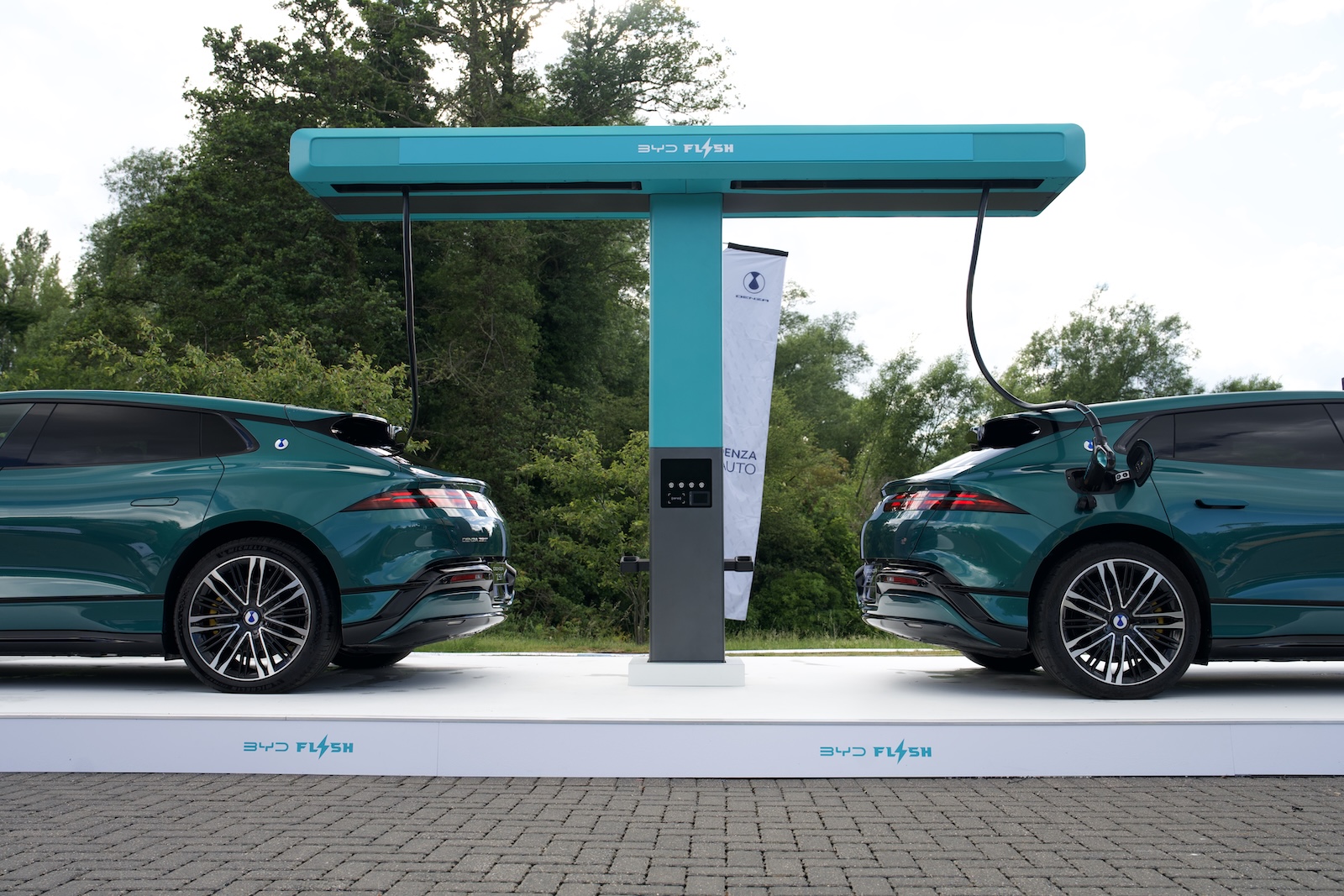 Photo credit: BYD
Cost is obviously a big factor, with the government there heavily subsidizing the overcapacity of China’s car industry. The Temu Range Rover? It costs ways less than what you’d pay for a comparable Range Rover (the cheapest Jaecoo 7 is about $20,000 cheaper than the lowest cost Evoque).
This is where Brexit’s effects are on full display. The European Union has taken a firmer stance when it comes to combating unnaturally deflated car prices by forcing higher tariffs on Chinese-built cars from certain brands. As it is no longer a part of Europe, the UK has so far resisted tossing new levies against Chinese cars.
Will that last forever? The French allowed the Bayeux Tapestry to be transported to the UK in order to mend the rip, and the British may respond in-kind with its own levies.
How ‘Made In Europe’ Might Hit Chinese Automakers In Britain
 Photo: DepositPhotos.com
Since I keep mentioning the Bayeux Tapestry, here’s a panel of it. The curious thing about the tapestry is that it’s not really a tapestry at all (it’s an embroidery, a fun fact you can trot out the next time your pals start talking about historically-significant cloths at the pub).
That’s a nice little prequel for what’s happening in the EU, where concern over the “dumping” of Chinese-built cars is leading the union of countries to consider “Made in Europe” legislation that would raise the duties on them.
The problem for companies that still build cars in the UK, is that most of those cars are sold in Europe. This hasn’t been a huge issue until now, with some European ministers considering enforcing “Made in Europe” policies in the UK if it doesn’t join in raising prices on Chinese-built cars as The Times of London reports:
The UK had demanded an exemption from the EU law that is being negotiated between member states, which would potentially make it more expensive for UK car companies to sell into the EU.
But the EU made clear that unless the UK acted on Chinese tariffs this would not be possible amid concerns that Britain could become a gateway for China to get round the EU’s trade restrictions.
Any move by ministers to impose tariffs on Chinese vehicles would smooth talks at the summit.
However, senior government sources said any decision had to be in the best interests of the UK rather than automatically accepting EU diktats.
On paper, the idea behind Brexit was that the UK didn’t want to be told by Brussels what it could or could not do. So much for that.
A Tesla Model 3 Is Only Like $28k In Canada
 Photo: Tesla
When it was announced that Canada would let in an increasing number of Chinese-built cars as a way to counteract the imposition of tariffs from the United States, I think most people assumed this would benefit Chinese brands. My guess was that it would help already established brands that just happened to build cars in China, and that seems to be happening.
The biggest winner? An American company. Specifically, Tesla, which is importing and heavily discounting its Chinese-built cars.
Chinese-made electric vehicles started entering Canada again in the spring, after Prime Minister Mark Carney struck a deal with President Xi Jinping to allow as many as 49,000 EVs into the country in a 12-month period at a reduced tariff rate of 6.1%. Prior to that, Chinese EVs were essentially blocked from the market by a 100% surtax that Canada implemented in 2024.
Carney has said that in the short term, most of vehicles shipped under the quota will be Teslas.
Because of exchange rates and heavily discounting by Tesla, the Model 3 is only like $27,700 in Canada. That’s a deal that’s almost impossible to beat.
GMC Is All About Trimflation
 Photo: Thomas Hundal
I’m generally a fan of GMC design, so much so that I probably prefer the GMC version of a vehicle to the Chevy version in most situations. Perhaps because of this preference, I also tend to notice them more, and what I’ve seen is that most of the GMCs in close proximity are either AT4 or AT4X models.
There’s now data to show this isn’t just some sort of visual bias, but a real thing. In fact, GMC sells so many high trim vehicles that, according to Cox Automotive via Automotive News, it now has a higher average transaction price than Volvo, Audi, and Lexus.
The popularity of the Denali and AT4 trims helped push retail sales of the Sierra 1500 pickup to an all-time high in the third quarter. And GMC’s average transaction price — more than $66,000 in Cox Automotive data for July and August — now tops that of numerous luxury brands, including Audi, Lexus and Volvo.
Moving forward, GMC says it sees a path to “sustained growth” by clearly aiming its subbrands at premium buyers and off-road enthusiasts, helping to generate profitable sales despite the industry’s affordability problem.
“We’re not trying to chase volume at GMC,” Michael MacPhee, global vice president of Buick-GMC, said in his first interview since taking the job in March. “Sustained and measured growth is really our goal here.”
Is this trimflation? Yes. It’s also what people seem to want, so this seems like it’s consumer-led trimflation as opposed to OEM-led, which is an important distinction. During the pandemic, automakers stopped building lower-trim vehicles due to a shortage of semiconductors. In the case of GMC, people seem to want a lot of features and are willing to pay for them.
What I’m Listening To While Writing TMD
It’s October, and “Paranoid” by Black Sabbath just feels right, doesn’t it?
The Big Question
What’s an obvious copy of another car you like better than the original?
Top photo: Stephen Morris/YouTube