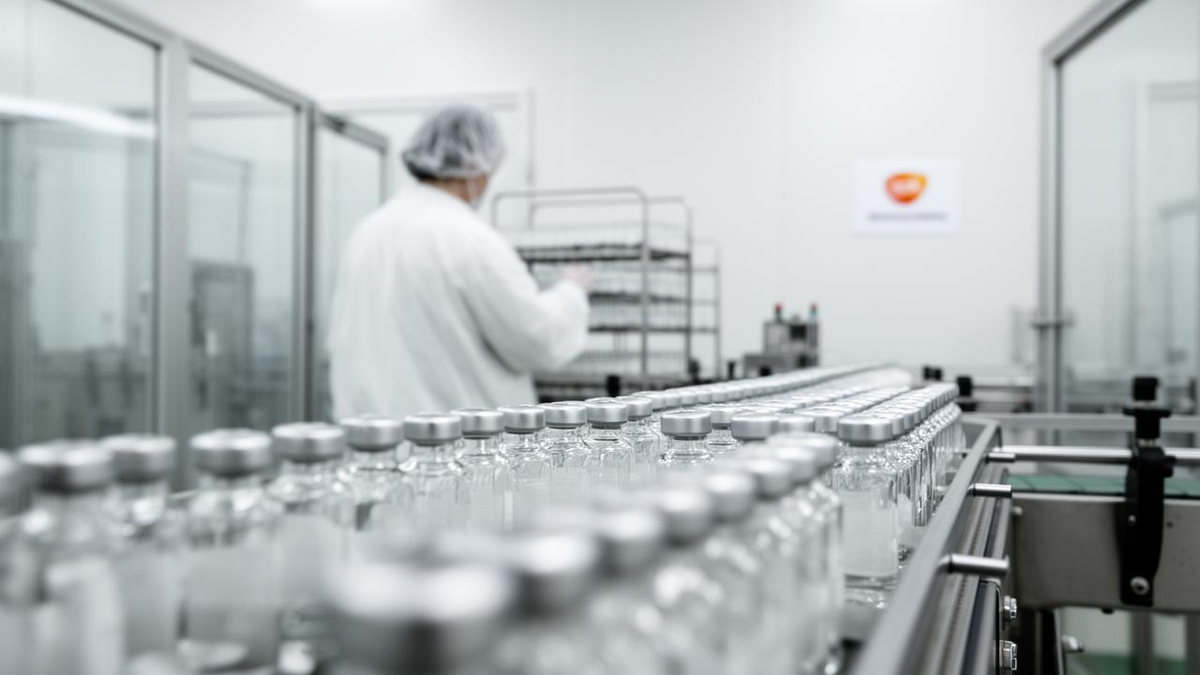
GSK Plc (NYSE: GSK) shares fell about 4% in London on Wednesday, at one point dropping 7.3%, after investors looked past a third-quarter sales and profit beat and focused instead on soft vaccine sales and lingering questions about the company’s late-stage drug pipeline. The decline put the stock on course for its steepest one-day drop since April and largely erased the gains logged since CEO Luke Miels took the top job in January.
The quarter itself was solid on the headline numbers. Adjusted earnings came in at 54.6 pence per share, or $1.47, against a consensus of 50.4 pence, while turnover rose 4% to £8.89 billion (about $11.8 billion), ahead of the £8.84 billion analysts had modeled. Specialty medicines revenue climbed 15% on a reported basis, with HIV sales up 9% to £2.12 billion, or 10% at constant currency.
Vaccines were the weak spot. Segment sales fell 4% to £2.583 billion, dragged down by Shingrix, Arexvy and flu products. Shingrix revenue slipped 6% to £780 million on lower international sales, mainly in China. Arexvy fell 22% to £195 million as demand softened and the company adjusted U.S. returns provisions. Influenza vaccines dropped 18% to £177 million amid competitive pressure in the U.S. and delayed deliveries. Meningitis vaccines were a bright spot, rising 11% to £599 million for their best quarter ever on the back of the Penmenvy launch and Bexsero stockpile building.
General Medicines held roughly flat at £2.43 billion, as growth in Trelegy was offset by declines elsewhere in the respiratory portfolio.
SegmentQ3 RevenueChangeSpecialty medicines£3.87 billion+14% (reported)HIV£2.12 billion+9%Vaccines£2.583 billion-4%Shingrix£780 million-6%Arexvy£195 million-22%Meningitis£599 million+11%Influenza£177 million-18%General Medicines£2.43 billionbroadly flat
Note: Segment figures are as reported by GSK for the three months ended Sept. 30; specialty medicines growth reflects the reported rate cited by the company.
On the call, CFO Julie Brown said the quarter absorbed a £300 million (about $399 million) charge tied to the Accelerate Growth restructuring program. With the effort to simplify operations and shift spending toward research now well advanced, she said the company is moving faster than planned and expects charges of up to £1 billion (about $1.3 billion) in 2026.
Miels framed the overhaul as a way to free up cash for development. “Finally, on simplification, we made progress on the Accelerate Growth program, helping to reallocate resources to invest in R&D and accelerate our late-stage development pipeline,” he said, adding that the changes should align the cost base with the evolving portfolio. He told journalists the company was “playing a very long-term game” and needed to keep “putting one foot in front of the other and quietly getting on with it.”
Guidance was left intact. GSK still expects 2026 sales growth of 3% to 5% and core operating profit and core EPS growth of 7% to 9%, with turnover landing in the upper half of the sales range and earnings per share in the lower half. Specialty medicines are forecast to grow at a low double-digit rate, vaccines to be broadly stable or up low single digits, and General Medicines to decline by a low- to mid-single-digit percentage.
The sticking point for shareholders is what comes next. GSK is working to reduce its dependence on dolutegravir, the HIV blockbuster facing patent expiries between 2028 and 2030, and is developing longer-acting alternatives such as Apretude. It plans to start 22 late-stage studies by the end of 2026, 18 of which are already running, and has said R&D spending will grow faster than sales. Newly launched asthma drug Exdensur missed expectations in the quarter.
Market forecasts for 2031 revenue sit at £36.64 billion (about $48.7 billion), well short of GSK’s own target of more than £40 billion (about $53.2 billion).
“Cost management progress will be received well in general, (but) it suggests the outperformance is almost entirely driven by cost timings rather than underlying business momentum,” said Verso Investment Management analyst James Eugene. “Pipeline credibility is more of a medium-term concern.”
The restructuring has already produced visible cuts. GSK announced plans this month to eliminate 1,217 jobs in Belgium, though it said the impact in the UK would be limited. The company has not disclosed many details of the program, though Miels described it as slightly ahead of plan.
For investors, the read-through extends beyond one quarter. GSK is spending heavily on research while its top-selling HIV franchise heads toward patent cliffs, and the market is effectively asking whether the pipeline can replace that revenue before it erodes. A beat built partly on cost timing does little to answer that question, which helps explain why the stock gave back so much ground even as the numbers cleared expectations.