
Earlier this week, Eli Lilly and Company’s LLY oncology and business development chief, Jake Van Naarden, told Bloomberg that oncology is likely to be the company’s next major growth opportunity following the success of its obesity franchise. Calling oncology “probably the next leg of the stool,” Van Naarden explained that Lilly’s obesity business provides the financial flexibility to invest in future growth.
Lilly has eight new oncology medicines or major new indications in or approaching late-stage development that could reach the market over the next five years, with half developed internally and the remainder obtained through external deals. Three programs could generate late-stage results in 2027, making the next year an important period for assessing this opportunity. These include data from late-stage studies on breast cancer drug Inluriyo, lung cancer candidate olomorasib and investigational antibody-drug conjugate or ADC, sofetabart mipitecan.
Van Naarden’s comments underscore oncology’s potential to become another major growth driver for Lilly alongside its successful GLP-1 franchise.
Lilly’s Existing Oncology Portfolio Provides a Strong Base
Lilly already has an established oncology business, led by breast cancer drug Verzenio, which generated sales of $4.29 billion in the first nine months of 2026, up 4% year over year. Blood cancer treatment Jaypirca contributed $585 million, up 63%, while newer breast cancer medicine Inluriyo recorded $183 million in sales. Other marketed cancer drugs include Retevmo, Cyramza and Erbitux. Together, Lilly’s oncology portfolio generated $7.44 billion during the period.
Beyond its marketed drugs, Lilly is advancing a broad cancer pipeline that could strengthen oncology’s contribution to long-term growth.
Lilly’s Oncology Pipeline Offers Further Growth Potential
Lilly is developing imlunestrant, already marketed as Inluriyo for certain advanced breast cancers, for use in earlier disease. The phase III EMBER-4 study is evaluating the drug in high-risk early breast cancer, potentially expanding its eligible patient population.
Other key late-stage candidates include olomorasib, an oral KRAS G12C inhibitor being developed for KRAS G12C-mutated non-small cell lung cancer; tersolisib, a mutant-selective PI3Kα inhibitor being evaluated with endocrine therapy and a CDK4/6 inhibitor as first-line treatment for PIK3CA-mutated, HR-positive, HER2-negative advanced breast cancer; and sofetabart mipitecan, a folate receptor alpha-targeting ADC being studied in platinum-sensitive ovarian cancer.
Conclusion
Taken together, Lilly’s established cancer portfolio and advancing pipeline provide a credible foundation for oncology to become a significant growth contributor. The anticipated 2027 readouts will help determine how quickly that ambition can translate into additional approvals and sales, while longer-term success will depend on clinical differentiation and commercial execution.
Competition in the Oncology Space
Key drugmakers in the oncology space are PfizerPFE, J&J JNJ, AstraZenecaAZN, Merck, Novartis and Bristol-Myers.
Oncology sales comprise around 27% of Pfizer’s total revenues. Its oncology revenues grew 6% in the first nine months of 2026, driven by drugs like Lorbrena, the Braftovi-Mektovi combination and Padcev.
For J&J, oncology remains a key growth driver, contributing approximately 30% of total revenues and 45% of Innovative Medicine sales. In the first nine months of 2026, oncology sales surged 16.8% on an operational basis to around $22 billion, driven by sustained momentum for Darzalex, the growing adoption of Carvykti and Tecvayli, and strong uptake of Rybrevant/Lazcluze and Erleada. However, declining sales of Imbruvica partially offset the growth.
Oncology is AstraZeneca’s biggest segment. The segment contributes roughly 46% of total product sales. AstraZeneca’s oncology sales were $21.9 billion in the first nine months of 2026, up 16% at CER. The strong oncology performance was driven by robust demand for drugs like Tagrisso, Lynparza, Imfinzi, Calquence and Enhertu (in partnership with Daiichi Sankyo).
Merck’s key oncology medicines are PD-L1 inhibitor Keytruda and PARP inhibitor Lynparza, which it markets in partnership with AstraZeneca. Oncology generates more than 60% of Merck’s pharmaceutical revenues, with its blockbuster cancer therapy, Keytruda, including Keytruda Qlex, contributing roughly 55% of pharmaceutical sales. Combined Keytruda and Keytruda Qlex generated sales of $23.6 billion in the first nine months of 2026, rising 1% year over year.
LLY’s Stock Price, Valuation and Estimates
Lilly’s stock has risen 29.5% so far this year compared with the industry’s increase of 24.1% over the same timeframe.
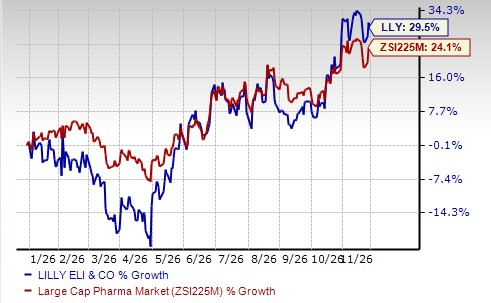 Image Source: Zacks Investment Research
From a valuation standpoint, Lilly’s stock is expensive. Going by the price/earnings ratio, the company’s shares currently trade at 28.14 forward earnings, higher than 19.34 for the industry. However, the stock is trading below its 5-year mean of 34.57.
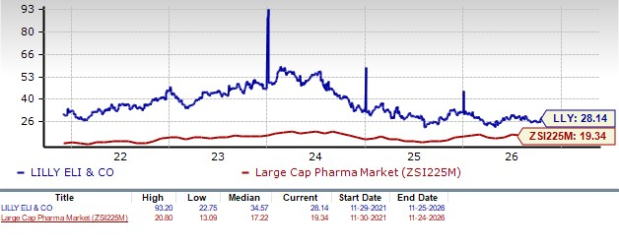 Image Source: Zacks Investment Research
The Zacks Consensus Estimate for 2026 has risen from $33.56 to $35.39 per share over the past 30 days, while that for 2027 has risen from $47.19 to $51.33 per share over the same timeframe.
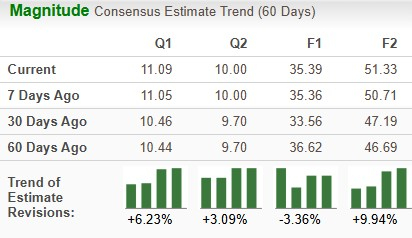 Image Source: Zacks Investment Research
Lilly has a Zacks Rank #3 (Hold). You can see the complete list of today’s Zacks #1 Rank (Strong Buy) stocks here.
Beyond Nvidia: AI’s Second Wave Is Here
The AI revolution has already minted millionaires. But the stocks everyone knows about aren’t likely to keep delivering the biggest profits. AI’s second wave is moving from infrastructure to implementation and these companies are at the forefront of this transition, positioned to become what Amazon and Google were to the internet era.
This article originally published on Zacks Investment Research (zacks.com).