
Saturday saw me marching through a chilly central London, one of the half million who converged on Westminster for the Together Alliance march against the far right.
It remained good-natured throughout, despite the lengthy wait to get moving.

 KentOnline columnist Melissa Todd
Can you imagine trying to shift half a million people anywhere? We stood two hours through all four seasons and yelled every anti-racist slogan we knew.
Unemployment and inflation, are they caused by immigration? Bull****, come off it! The enemy is profit
I remembered that one from my uni days, and yelled myself deaf.
People shared sandwiches, gave out water and indulged in some good-natured, terribly British grumbling about the length of the wait.
Nonetheless, we did as we were told. Of course we did. This is what community looks like!
 Placards at the Together Alliance march against the far right in London. Picture: Melissa Todd
We set off at last, our slow bimble teeming with warmth, humour and bonhomie, and nairy a sniff of rage.
I was told several times that my hat looked “divine”, which, for the record, it did.
This was not a gathering spoiling for a fight. It was keen to present a version of Britain that’s plural, tolerant and pleasant.
A country of which we can all be proud. And it managed it just by existing.
I passed the time by snapping a creative mix of placards.
 Placards at the Together Alliance march against the far right in London. Picture: Melissa Todd
Plenty of anti-Farage slogans, anti-fascist riffs, funny rather than spiteful; the familiar refrains about fighting ignorance rather than immigrants.
Jackboots then, now suits and ties, we recognise the same old lies: our grandparents fought against these guys.
These sat alongside a more eclectic mix: appeals for trans girls to be readmitted to the Girl Guides, calls to reopen a local lido, the evergreen “eat the rich”, and a smattering of “stop the war” banners whose specifics were left usefully vague.
If you wanted a single, unifying message, you had to squint.
It was less a tightly focused political intervention and more a living collage, with drummers, dancers and that earnest, chaotic energy that characterises grassroots organising at its most sincere.
 Placards at the Together Alliance march against the far right in London. Picture: Melissa Todd
One group marched under the banner “Bassists Against Racists”: top marks for specificity.
It brought together trade unionists, seasoned activists, first-time marchers, and local groups like Faversham Against Racism, who’d laid on coaches for the day.
Some came with clear ideological commitments; others seemed motivated by a general sense that things weren’t quite as they could be, and perhaps we should unite and mention it publicly, politely, preferably to a banging tune.
Music was everywhere. We danced to ABBA and Tainted Love; elsewhere there was folk, a spot of Morris dancing, a gentle tongue-in-cheek rebuttal to the notion that “British culture” is under threat.
Here it was, bells and all, thoroughly unbothered.
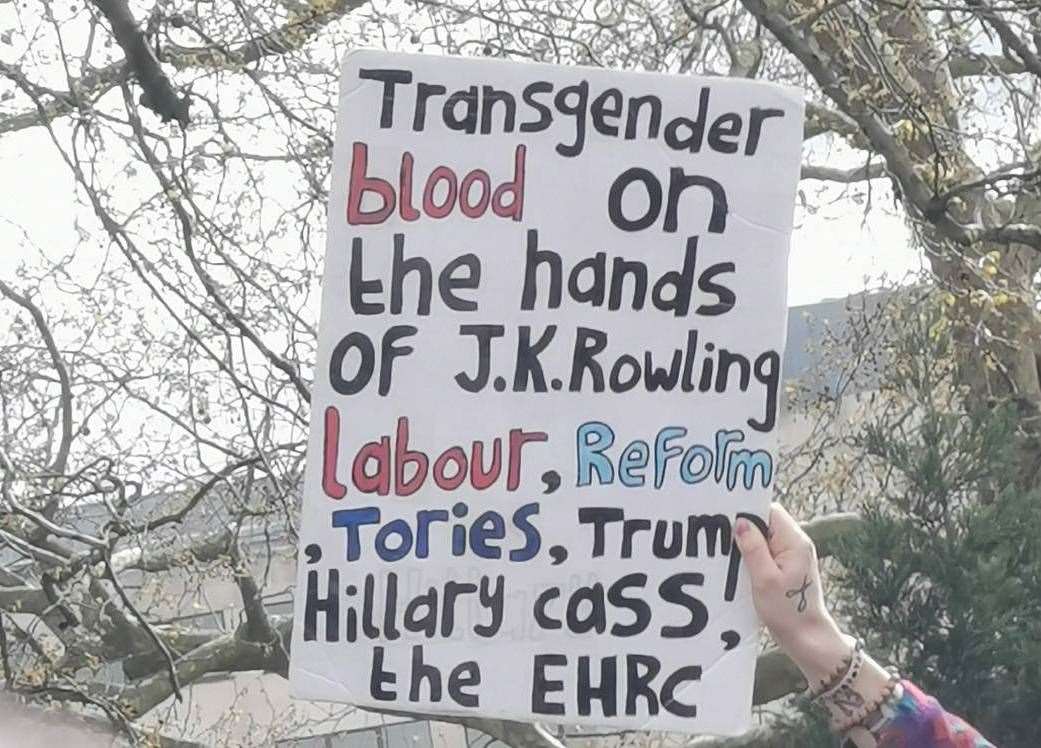 Placards at the Together Alliance march against the far right in London. Picture: Melissa Todd
Last year’s large far-right mobilisation in London appeared rather more uniform in composition and considerably more aggressive in tone.
This weekend’s crowd was more female, more varied in age, and less obviously drawn from a single demographic mould.
One hesitates to generalise, but then, the far right make it so easy.
Makes writing about this stuff tricky, though. While the march was explicitly political – a response to the rise of far-right sentiment, an attempt to demonstrate such views don’t command majority support, a march against hate, a march for hope – it didn’t feel confrontational.
It was less about drawing hard lines than about sketching an inclusive picture.
 Placards at the Together Alliance march against the far right in London. Picture: Melissa Todd
The underlying message was clear enough: this is what Britain looks like too. But it was delivered with a lightness of touch that resists easy caricature.
This may also explain the curious afterlife such events tend to have online.
Coverage of the march has already attracted the usual flood of comments, the arguments familiar, almost ritualistic: Nigel Farage will save the country; no he won’t; yes he will; no, you’re a sheep, and so it goes, until everyone’s wound up to apoplexy.
It’s so much easier to type “this country is broken” than stand in the cold and try, however imperfectly, to fix it.
My pals in the US are busy protesting too, but there demonstrations often frame themselves in opposition to the system itself, invoking the language of “no kings”, drawing on a long tradition of suspicion towards centralised power.
 The Together Alliance march against the far right in London. Picture: Melissa Todd
In Britain the system is largely taken as given.
The argument is not about whether it should exist, but who it should serve, who gets to feel at home within it.
This weekend’s march fits squarely into that latter category.
Whether that message cuts through is another question.
Optimism doesn’t usually travel as far as outrage.
 Placards at the Together Alliance march against the far right in London. Picture: Melissa Todd
It’s easier to rally against something than make a compelling case for a gentler, more inclusive alternative.
And yet, for a few hours at least, central London offered a glimpse of what that alternative might look like: imperfect, charming, unfocused, undeniably human.
But not always the easiest beast to turn into a headline.