Global infrastructure consulting firm Aecom has formed a consortium with two nuclear fusion developers to pursue what is being described as the first private‑sector‑led fusion power plant project in the UK.
Aecom, Tokamak Energy and Type One Energy announced the creation of the UK Infinity Fusion Consortium, saying the new group intends to develop a commercially credible fusion project built from existing enabling technologies and capable of attracting private capital.
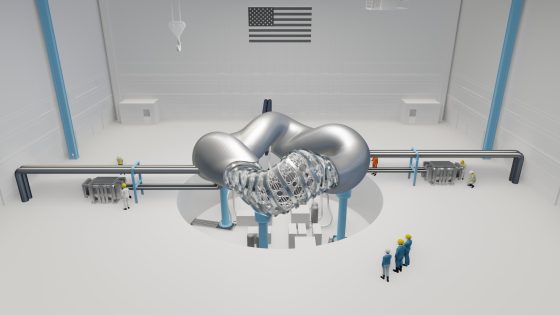
The consortium will aim to combine Type One Energy’s Infinity Two stellarator (rendered image above) design, a 400MWe concept, with Tokamak Energy’s high‑temperature superconducting (HTS) magnet technology and Aecom’s engineering and project delivery capabilities.
The recent partnership announcement discussed the “first‑of‑a‑kind” Infinity Two project planned by Type One Energy and the Tennessee Valley Authority (TVA) in the US, which is targeted for commercial operation in 2034, as laying the groundwork for what could be built in the UK.
Designs for Infinity Two have proposed a deuterium-tritium fueled, “burning plasma stellarator”, with 800MW of fusion power, with the capability of delivering 350MW of electricity to the grid.
The consortium’s emphasis on using HTS magnets and a stellarator design sets it apart from other UK efforts focused on spherical tokamaks, including the UK Government’s plan to build the Spherical Tokamak for Energy Production (Step) in West Burton, Nottinghamshire.
Stellarators avoid some operational issues of tokamaks by design, but are complex to engineer.
Tokamak Energy and Type One Energy have both been active in developing novel approaches to the magnetic confinement challenge that exists for stellarators.
Regardless, UK Infinity Fusion Consortium said the project will draw on wider participation from the UK fusion supply chain, including construction, finance and offtake partners.
The companies said lessons from the US project and support from US government fusion programmes will also provide a technical and programme foundation for a UK deployment.
The consortium framed the programme as complementary to the UK Atomic Energy Authority’s (UKAEA’s) Step programme and its recently published UK Fusion Strategy, which aims to move from scientific demonstration to commercial deployment.
All three partners are members of the Sustainable Markets Initiative (SMI), a CEO‑led network launched by King Charles.
Type One Energy chief executive Chris Mowry said: “Fusion needs to be delivered, not just developed. This consortium brings together the core industrial capabilities in the UK and US required to deploy real-world fusion power plant projects that are commercially viable.
“By aligning fusion technology, advanced manufacturing, and power plant engineering, we are closing the gap between today’s energy innovation and tomorrow’s energy infrastructure. Our initiative is fully aligned with UK and US ambitions to be leaders in commercial fusion deployment.”
Tokamak Energy chief executive officer Warrick Matthews said: “This consortium puts Tokamak Energy’s transformative magnet technology and manufacturing expertise in the centre of another world-class fusion programme.
“Together, we can accelerate towards commercialising a new form of limitless, clean energy and, in combination with our role as Step magnet systems partner, strengthen the UK supply chain’s leadership in global fusion.”
Aecom chairman and chief executive officer Troy Rudd said: “Fusion represents one of the most important long-term energy solutions, offering a clean, safe and reliable source of power for future generations.
“Delivering on fusion’s potential requires disciplined engineering, well-established infrastructure delivery models and collaboration across the entire energy ecosystem.
“Through this Consortium, Aecom is bringing its global experience in complex energy infrastructure to help lay the groundwork for commercial fusion projects that can scale with confidence, supporting the UK’s energy system while strengthening its industrial and infrastructure base.”
UK minister for science, innovation, research and nuclear Patrick Vallance said: “This government is backing fusion with over £2.5bn and recently announced a deal with the United States, which includes closer working on fusion research and development, taking us closer to a future powered by limitless clean energy.
“Our long-term vision and investment in the sector is now helping turn that ambition into reality.”
UK minister for investment Jason Stockwood said: “The UK is a world leader in renewables, and this consortium will play a key role in new fusion projects, creating exciting opportunities for people in local communities.
“We’re serious about the benefits of clean energy technologies, which is why our modern Industrial Strategy is attracting investment into the sector to boost economic growth as the UK powers towards net zero.”
SMI CEO Jennifer Jordan-Saifi said: “Type One Energy, Tokamak Energy and Aecom have come together as members of the SMI, demonstrating the SMI’s Terra Carta and Astra Carta mandates in action — business and finance working together to turn breakthrough innovation into measurable progress in building a more sustainable future.”
Like what you’ve read? To receive New Civil Engineer’s daily and weekly newsletters click here.