

The Met Police is launching an unprecedented operation this weekend to stop violence and hate speech erupting in London at two marches on FA Cup Final day.
For the first time live facial recognition and new powers to crack down on hate speech will be used in a public order operation.

Protesters clash with police officers in Trafalgar Square during the Unite the Kingdom march last September
Getty
Police chiefs are concerned that football hooligans may head to London, on FA Cup Final day, to join the Unite the Kingdom march which is expected to be led by Tommy Robinson, whose real name is Stephen Yaxley-Lennon.
In total around 4,000 officers, including 660 from outside London, will be deployed on the capital’s streets to prevent violence, antisemitism, anti-Muslim and other hate speech.
Here’s everything we know about the two rallies.
People taking part in the Unite the Kingdom protest must remain in Kingsway until the rally begins.
Anyone participating in the Unite the Kingdom march must not deviate from the designated route, shown on the map below and imposed under the Public Order Act 1986, which is Kingsway, Aldwych, Strand, Trafalgar Square, Whitehall, Parliament Square.
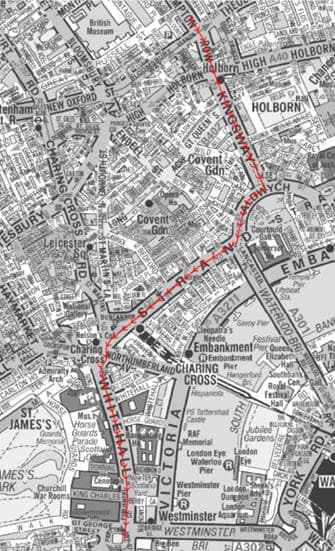
The route of the Unite the Kingdom march
Met Police
Any speeches or music performed/played as part of the Unite the Kingdom post-march assembly must end by 5.30pm.
The Unite the Kingdom assembly must finish by 6pm.
Organisers and speakers at the Unite the Kingdom assembly must ensure all content displayed and broadcast (including speeches, pre-recorded videos and imagery) does not include content likely to stir up racial or religious hatred.
Nakba 78/United Against Tommy Robinson and the Far Right protest
People taking part in the Nakba 78/United Against Tommy Robinson and the Far Right protest must remain in Exhibition Road until the march begins.
Anyone participating in the Nakba 78/United Against Tommy Robinson and the Far Right march must not deviate from the route shown on the map below which is Exhibition Road, Cromwell Gardens, Brompton Road, Knightsbridge, Piccadilly, Pall Mall.

The designated route for the Nakba Day march
Met Police
Any speeches or music performed/played as part of the ‘Nakba 78/United Against Tommy Robinson and the Far Right’ post-march assembly must finish by 5pm.
The ‘Nakba 78/United Against Tommy Robinson and the Far Right’ assembly must end by 5.30pm.
Organisers and speakers at the ‘Nakba 78/United Against Tommy Robinson and the Far Right’ post-march assembly must ensure all content displayed and broadcast (including speeches, pre-recorded videos and imagery) does not include content likely to stir up racial or religious hatred.
How many people are expected?
Around 50,000 people are expected by the Met to join the Unite the Kingdom protest, and some 30,000 the march to mark Nakba Day.
What is the Met police’s approach?
Given the scale of the challenge to keep law and order with two marches on FA Cup Final day, the Met Police’s plan involves “the most assertive possible use of powers including strict conditions”.

Officers from the Met Police Mounted Branch look toward protesters gathered in Trafalgar Square during the “Unite The Kingdom” rally last September
Getty
What police resources is Scotland Yard deploying?
Specialist armed police units will be on standby and police helicopters and drones will watch the marches from the skies.
Mounted police, dog teams, traffic units, large numbers of police with riot equipment, and detectives will be among the 4,000 officers on the streets.
Football hooligans warning
Deputy Assistant Commissioner James Harman said: “We need to be mindful this Saturday of the history of football hooligan groups supporting causes fronted by Stephen Yaxley-Lennon.”
Speakers who engage in antisemitic, anti-Muslim or other hate speech will face arrest, and organisers of the protests may also be prosecuted under powers being used by the Met for the first time.
People who use chants such as “Death to the IDF” or “Globalise the Intifada” will face arrest, as will individuals who commit anti-Muslim hatred.
Live facial recognition will be used for the first time as part of a public order operation but not on the march routes.
Instead, it will be used at a location in the borough of Camden where suspected offenders, on a “watch list”, may gather ahead of the United the Kingdom march.