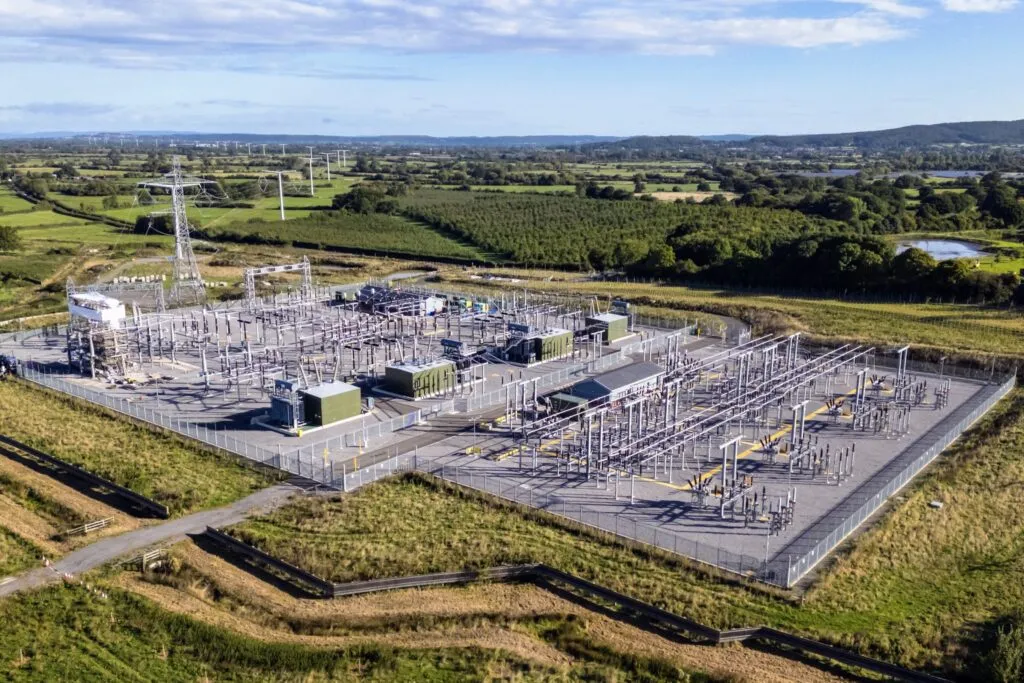
National Grid has launched a new framework for £8bn worth of substation projects across England and Wales, with contractors expected to take on a greater role in early-stage design and site works including ground engineering.
The Electricity Transmission Partnership (ETP) will see National Grid work with regional and national partners to deliver around 130 substation projects during the next regulatory period to 2031.
The framework gives the partners regional exclusivity on substation work, with performance and capacity commitments determining future awards. In a recent release, the energy company said the approach is intended to strengthen the supply chain, encourage long-term investment and support local skills.
The model is also designed to involve contractors earlier and to a greater extent than under previous arrangements, with responsibilities starting as early as the front-end engineering design stage and initial site activities, which will cover geotechnical work.
“This means we can better assess how projects will be built from the start, helping to create a fairer balance of risk for all parties involved, which in turn improves planning and decision-making,” a National Grid spokesperson told GE.
“Our ETP partners retain responsibility for delivery of the activities mentioned, engaging and building capability with the supply chain across their regional or national portfolios.”
Regional partners will have first refusal on substation work in their designated areas, while two national partners will support work outside regional portfolios.
The appointed regional partners are Balfour Beatty in the North East, Morgan Sindall Infrastructure in the North West, Murphy in the South West (region one) and London & South East, M Group Energy in the South West (region two), and the Omexom and Taylor Woodrow joint venture in the Central West.
Linxon and Burns & McDonnell have been named as national partners.
Work worth an initial £1.3bn has already been allocated under the framework, which forms part of National Grid’s wider £35bn RIIO-T3 investment programme for the transmission network.
RIIO (Revenues = Incentives + Innovation + Outputs) is Ofgem’s price control framework, with the next one, RIIO-T3, running between 1 April 2026 and 31 March 2031.
National Grid said the new ETP model could in future extend beyond substations to other transmission infrastructure.
National Grid Electricity Transmission president Alice Delahunty commented: “By adopting a regional, long-term approach, we’re giving our supply chain the certainty to invest in people, skills and innovation. It’s a key step in turning our RIIO-T3 investment ambitions into action and building a resilient grid to support Britain’s clean energy future.”
The ETP sits alongside National Grid’s Great Grid Partnership and its High Voltage Direct Current (HVDC) supply chain framework, both aimed at increasing capacity and resilience.
In May 2024, the company appointed seven companies to the Great Grid Partnership under its Great Grid Upgrade programme. An Aecom-Arup joint venture and WSP joined the partnership as design and consenting service partners, while Laing O’Rourke, Morgan Sindall Infrastructure, Morrison Energy Services, Murphy and Omexom/Taylor Woodrow joined as construction partners.
Today (21 August), National Grid also announced the award of its HVDC civil works supply chain framework. Six suppliers – Balfour Beatty, Bam Nuttall, Galliford Try, Laing O’Rourke, Skanska and Taylor Woodrow – were awarded lot 1 of the HVDC converter civil works framework, valued at approximately £9.07bn, while three – Balfour Beatty, Murphy and Volker Fitzpatrick – secured lot 2 for onshore cable civil works, worth an estimated £3.7bn.