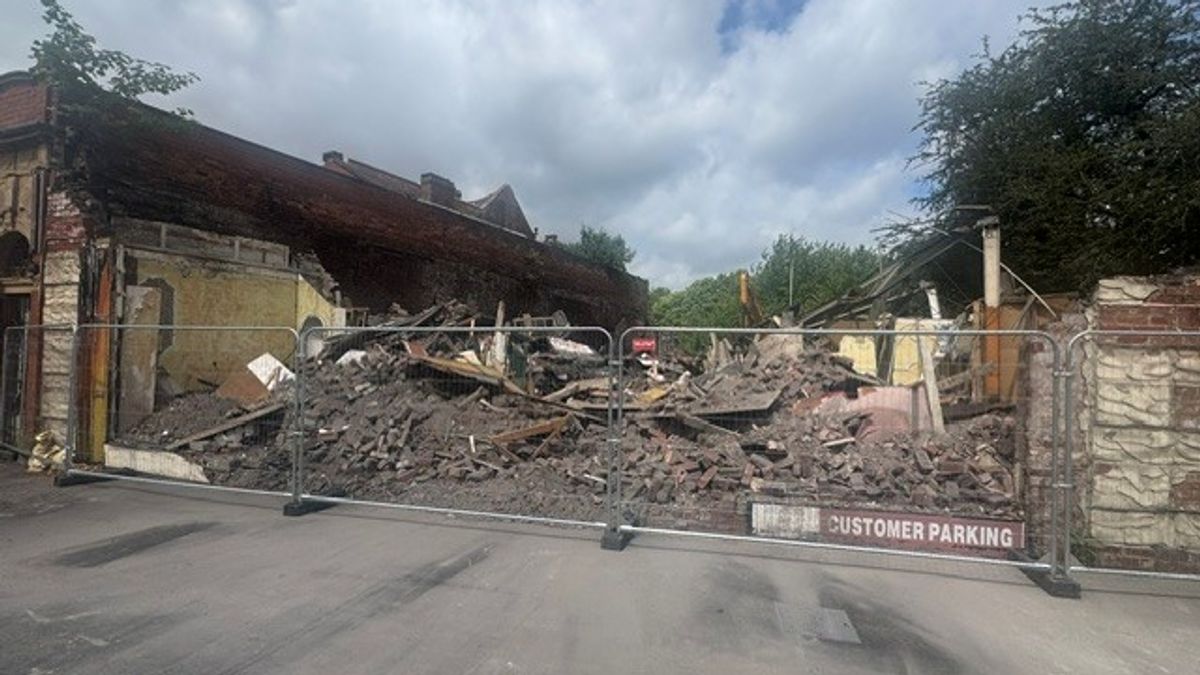
It has now been flattened
The building has now been flattened(Image: Trafford Council (X))
The building which one housed one of Greater Manchester’s most quirky shops has now been demolished after it collapsed.
Emergency services rushed to the former Tommy’s House of Fires on Talbot Road in Stretford yesterday (Thursday) after the building began crumbling.
The roof could be seen warping with bricks giving way underneath. Rubble quickly piled up on the ground around it in what was dubbed by devastated locals a ‘Mancunian tragedy.’
A cordon was put in place as structural experts were drafted in.
Click here to get the biggest stories straight to your inbox in our Daily Newsletter
And it has now been fully demolished, Trafford Council confirmed this evening (Friday). The local authority posted on X saying: “Following the building collapse on Talbot Road yesterday, our contractors have worked hard to clear the road and pavement and demolish the structure.
“Talbot Road has now reopened to traffic and the site has been secured.”

It has been reduced to a pile of rubble(Image: Trafford Council (X))
The post was accompanied by pictures of the building having been completely raised to the ground.
The House of Fires was known across the city-region for its bonkers advertising and wild designs and posters, including mock-up’s of Tommy as Yul Brynner from The King And I alongside the caption ‘Yul save plenty’, all to promote the fireplace showroom.
For more than three decades it was run by Tommy Dolan, whose face was hung above the door.

The collapsing building pictured on Thursday(Image: Manchester Evening News)
Tommy, who sadly died aged 72 in 2023, had a career just as colourful as the signs above his iconic showroom before ever venturing into the world of fireplaces. While working as a chef, he cooked for music legend David Bowie, and went on a three-day bender with The Prodigy’s Keith Flint.
In the years before Tommy’s death, the once eye-catching showroom fell into a state of disrepair. It’s colourful exterior began to fade, with brickwork becoming exposed. It was also daubed in graffiti. Despite planning permissions in years past, it was never repurposed or given a new shot in life and instead became another one of Manchester’s many empty curiosities.