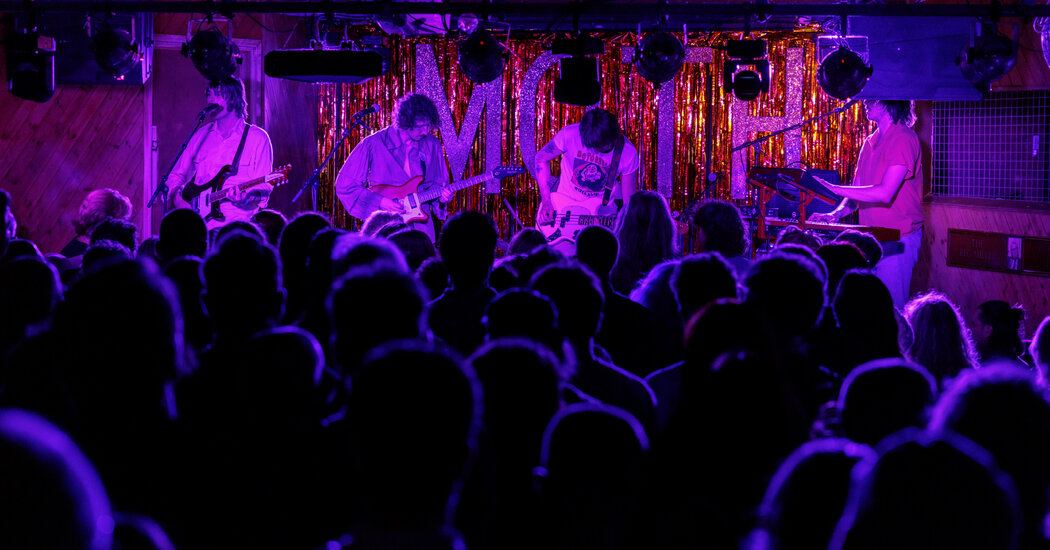
At a February gig in East London called “Save the Moth Club,” hordes of people jammed inside the venue to see a show by the Chicago band Whitney.
“It was just suitably rowdy,” said Julien Ehrlich, the drummer, who said that Moth Club was one of the band’s favorite stops in London: “It certainly felt like the energy was 1000 percent.”
The event was intended to raise awareness about what the club — which hosts gigs for up-and-coming bands, and sometimes bigger acts like Wet Leg (and once even Lady Gaga) — has described as an existential threat: a pair of building proposals for apartments next door.
Among other things, it would mean that people would be living right up against the nightclub’s noisy smoking area, said Keith Miller, the head of events at Moth Club. He said that would be a potential disaster for a music venue with a late-night license: “We will unfortunately be creating noise seven days a week.”
Miller said it was a common tale for a club to “regenerate the area, and then people end up killing it” once they flood in to live there.
That tension is explored on the other side of town at the Victoria and Albert Museum, in an exhibition that examines some of those fallen sites and the forces that did them in. The show, “Lost Music Venues,” which runs through October 2027, looks back at 50 clubs that shuttered across Britain between the mid-1980s and 2010s, some of which had helped launch bands like Oasis and Daft Punk.
Harriet Reed, the exhibition’s curator, said that it was a chance to “celebrate the creative contribution” of music venues but also “to explore the issues that they face as a sector, particularly the last 15 years or so.”
The Victoria and Albert Museum collected memorabilia from the public for the show, acquiring objects like an old device from the Haçienda nightclub in Manchester that measured noise levels. Other submissions included a trove of items from Mark Webber of Pulp from the band’s early touring days.
Reed said that the reasons that venues close were “almost cyclical,” with issues coming up again and again, like new housing developments that drive up rent and then lead to a burst of noise complaints from new residents. “The politicians may change, the audiences may change, the way music is played might change — but you see the same difficulties,” she said.
The Museums Special Section
Changing social habits and the rising cost of living also mean that people go out less and, crucially, buy less alcohol when they do. This all comes as the industry is still recovering from the toll of pandemic-era shutdowns. And although venues in other cities around the world have faced similar struggles, nightlife in Britain seems to have been hit particularly hard.
“There isn’t a single one of these buildings that wouldn’t be making more money if it was a pizza restaurant,” said Mark Davyd, the founder of the Music Venue Trust, a nonprofit that supports independent music clubs, known as grass-roots venues, that typically host lesser-known acts.
“If you were simply in the business of making as much money as you possibly could, then tickets would just go up exponentially,” he added — but that’s at odds with “the kind of work that these venues do.”
Davyd said that more than 50 percent of those smaller venues in Britain didn’t make a profit last year. According to research from his organization, an average of one venue closed every two weeks in 2024. The pace slowed last year, he said, but the situation for clubs is “inherently fragile.”
Moth Club launched an aggressive campaign for support, and its Change.org petition acquired 35,000 signatures, including from well-known musicians like Lewis Capaldi and Tame Impala. Tens of thousands of people wrote to local officials in support of the venue.
Whitney’s guitarist, Max Kakacek, said the decision to perform at the “Save the Moth Club” event didn’t take “a long conversation” — “it was just: of course.”
The public pressure seems to have paid off, at least for now. In March, the local council rejected one of the neighboring building applications, though the developers are appealing, and the second is still under consideration. But Miller, the club’s events head, said he was “far more optimistic” than a few months ago.
Other venues haven’t been so lucky. Last September, Corsica Studios, a beloved club in the Elephant and Castle district of London, announced that it wold be shutting down after 24 years. The raucous venue, where acts from Bicep to Björk had played sets, cited a tidal wave of redevelopment that had transformed the neighborhood. “It’s no secret that operating a late-night venue such as ours has become increasingly difficult,” the club said in a statement announcing the closing.
Corsica Studios emphasized that it had not been squeezed out by developers or officials, and said it might reopen in some form in the future. But for now, its closure in March has left a void in London’s club scene.
Jay Donaldson, an English D.J. who performs as Palms Trax, played at Corsica Studios in January for a closing event. He said he had attended gigs there before becoming a D.J., and later found it to be a valuable “testing ground” for his music. “There’s always an ebb and flow in nightlife” he said, but “it’s impossible to see what kind of small venue would be able to rise from the ashes and fight off all of the existential threats that the city poses to it.”
London’s mayor convened a nightlife task force last year to assess those headwinds. The city is trying to act on some of its recommendations, said Justine Simons, a deputy mayor for culture and the creative industries, though she said its powers were limited. The efforts include a bid to allow the mayor to grant late-night licenses — which are now given by local boroughs according to their own complex rules — as well as a push to create a higher bar for noise complaints.
The British government is also pushing a ticket levy, intended to funnel money from big stadium shows to more intimate spaces. Yet for the moment, it is voluntary and has had a lower-than-expected uptake by larger venues.
Changes might not come soon enough for Rafael Pesce, the founder of Spiritual Bar, a small folk and blues club in the Camden district of North London. Pesce said he had been inundated with noise complaints from a local resident for about two years. He said he had added a second door, bought equipment to measure sound levels and stopped booking very loud bands — but the complaints have continued.
“If it keeps going like that, I think I’m going to go bust,” Pesce said, adding: “If one person can destroy a 15-year-old business, there’s something wrong with the system.”
Lost Music Venues
Through Oct. 30, 2027, at the Victoria and Albert Museum in London; vam.ac.uk.