(Bloomberg) — A move by the National Pension Service to temporarily suspend portfolio rebalancing has fueled volatility in South Korea’s stock market and added pressure on the won, according to Barclays Plc.
Most Read from Bloomberg
“While the rebalancing waiver contributed to superior returns for the NPS and Kospi, we believe the key tradeoff was really the increased volatility,” Bum Ki Son, an economist at Barclays, wrote in a note. “Pensions are typically considered a stabilizer in the financial market. However, we believe the NPS tweak of its operations became an amplifier instead.”
The NPS, Korea’s biggest pension fund and also the largest holder of stocks, in January temporarily waived rules requiring it to realign its portfolio when asset allocations drifted beyond preset limits. Continued adjustments amid heightened market volatility — especially when domestic equities exceed their target range — could have an outsized impact on local stock and foreign-exchange markets, the NPS’ management committee warned at that time.
While optimism over artificial intelligence and the ensuing demand for memory chips have spurred unprecedented gains in Korea’s stock market, a build-up of margin debt and developments in the Iran war have triggered bouts of intense volatility. Investors paid the highest-ever premiums to hedge against market swings after the benchmark Kospi soared 24% in January, a record monthly advance that was eclipsed by a 31% rally in April.
As the Kospi extended its 2026 rally as the world’s hottest benchmark, the NPS last month sharply ramped up its allocation target for local stocks while cutting back its target for foreign equities. The pension fund posted a return of 21.7% on domestic equities during the first quarter, official data show, and oversaw 1,526.1 trillion won ($1 trillion) in total assets as of March 31.
“We ran a counterfactual analysis on ‘what if’ the NPS had continued normal rebalancing and estimate that the return would have been smaller at 11.1% by the end of May,” Son wrote.
Despite superior returns, the portfolio’s volatility was much higher without the rebalancing, he noted, adding that the waiver also increased the Kospi market volatility “as the NPS did not sell during the overheating nor buy during the dips in March or even in June month-to-date.”
Story Continues
“The fund’s management committee’s previous decision was made with the objective of enhancing the profitability and stability of the fund, taking into account efforts to strengthen the fundamentals of Korea’s capital markets, including the amendments to the Commercial Act,” the health and welfare ministry, which oversees the NPS, said in response to Bloomberg’s questions on the observations made by Barclays.
“The Barclays’ report relies to a significant extent on assumptions that are excessive, as well as on analyses of causal relationships that have not been sufficiently verified,” it added.
While the Kospi has fallen this month, it is still up about 93% so far this year, and concerns have been rising about the sharp swings in the market. A gauge of volatility for the Kospi 200 hit a record earlier this week as South Korean stocks lurched from one extreme corner to another.
Son also wrote that while the NPS pointed to FX market pressure as one of the reasons when it waived rebalancing, the decision instead turned out to place “significant pressure” on the FX market.
“We believe the NPS’ rebalancing waiver arguably transferred its rebalancing needs to foreign investors, which translated into outsized USD demand driven by equity outflows from the Korean FX market,” Son wrote.
Global funds have sold a net $78.7 billion from the local stock market this year. Analysts have attributed the bulk of these outflows to forced selling after sharp gains in market leaders like Samsung Electronics Co. and SK Hynix Inc. pushed holdings above mandated portfolio limits.
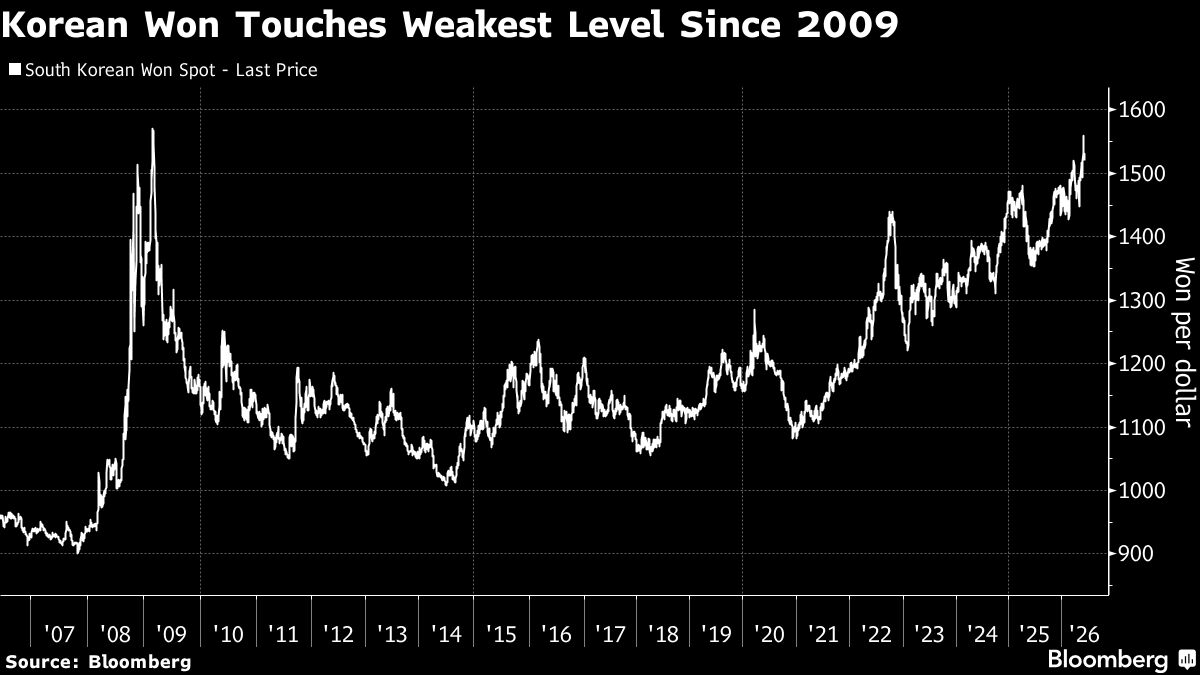
The South Korean won fell to the lowest since 2009 earlier this month even as the government pledged to curb excessive volatility, underscoring the pressure some Asian currencies have faced on account of the Iran war and the energy shock unleashed by it. Authorities this week announced plans to crack down on speculative currency trading, helping spur a strong rebound in the currency.
“With rebalancing set to be reinstated from July, we believe how closely the NPS will stick to its rules-based rebalancing will be an important factor for the KRW,” Son wrote. “The NPS already hinted that rebalancing will be softer as it has trimmed daily rebalancing limit. This could keep volatility in the domestic equity market and pressure on the KRW elevated.”
Most Read from Bloomberg Businessweek
©2026 Bloomberg L.P.