Reopening on 28 November, in time for the museum’s 50th anniversary, the date marks a milestone in the decade-long project to transform Smithfield’s General Market. A further expansion of the museum into the neighbouring Poultry Market is scheduled for completion in 2028.
The museum is currently being constructed to the designs of a 2016 competition-winning architects team comprising Stanton Williams, Asif Khan and conservation architect Julian Harrap.
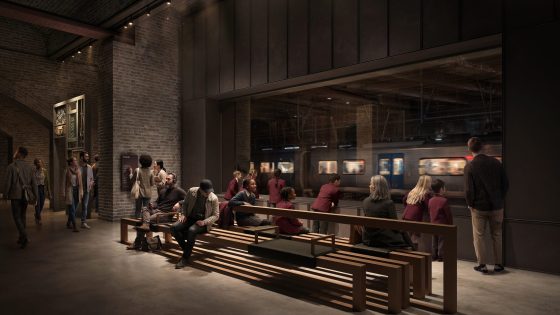
The latest visualisations now show how the new galleries will look, including the ‘train window’ in the General Market, where visitors can see tube trains go past, images of the Our Time and Past Time galleries and an impression of a night-time event.
There are also pictures of ongoing construction as work continues to restore the historic market, which opened in 1883 and remained in operation until the late 1990s.
Three main gallery spaces have been designed around the theme of Past, Present and Future. Visitors will enter through Real Time, an exhibition on Heritage Fund Street showcasing data that captures ‘London in the moment’.
From there, Our Time in the former market’s Linbury Hall acts as a central hub for events and houses 13 large installations involving ‘eclectic objects from London in living memory’. Below ground in the subterranean galleries, Past Time offers an overview of the city’s history through chronologically ordered displays.
In addition to the permanent galleries, the London Museum will host a ‘day to night programme of events’, shaped by rotating guest curators. The first, London Tastes, will be co-curated by Ruby Tandoh and Jonathan Nunn and is sponsored by Sainsbury’s.
London Museum director Sharon Ament said: ‘This has been a long undertaking – not without its challenges but mostly filled with immense joy and hyper-creativity – and now we are counting down the days to welcome our first visitors.
‘At the beginning we asked ourselves how to be the best museum for London. The answer is to be London itself, in all its grit and glitter.’
The design team has ambitions for the new museum to be net-zero carbon. As well as planning ‘state-of-the-art technologies’ to minimise operational carbon, it has taken a retrofit-first approach, preserving 70 per cent of the original building fabric and retaining as much of Horace Jones’s original designs as possible.
Measures to improve sustainability include toilets flushed by rainwater, the use of geothermal energy and an eco-concrete mix in construction.
In a statement, Mayor of London Sadiq Khan said: ‘The opening of the new London Museum will be a hugely significant moment both for London and internationally. Backed by one of the largest-ever cultural investments in our capital, London Museum will attract millions of visitors and Londoners and reinforce our status as the culture capital of the world.
‘London Museum celebrates the past, creates opportunities in the present and will inspire future generations as we continue to build a better London for everyone.’
For now, the museum’s 7 million artefacts – including 20,000 pieces of human skeletal remains – are mostly in storage. Some half a million items will be decanted from the galleries and storage of their Barbican home, designed by Powell & Moya.

General Market Dome Oculus, 2023 © Museum of London
Source: London Museum