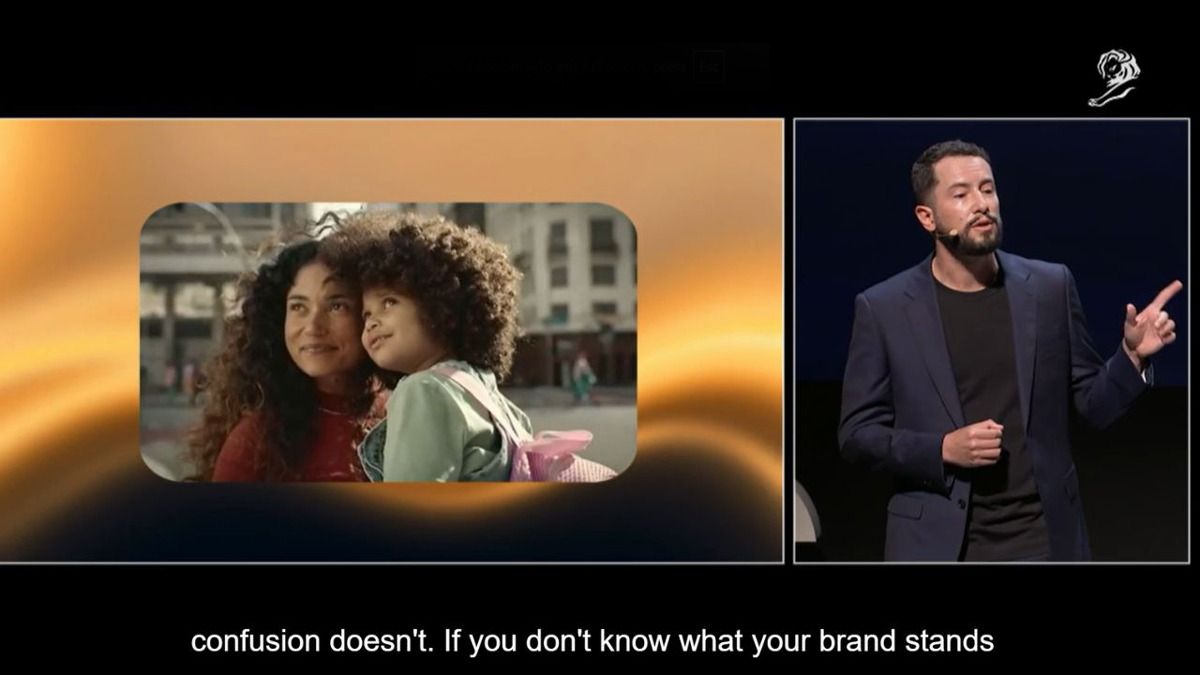
New Delhi: At Cannes Lions, Unilever’s Leandro Barreto argued that the future of brand building lies not in what brands say, but in what people choose to pass on.
There was a time when brand building was largely about crafting a message and broadcasting it to as many people as possible. In today’s fragmented media landscape, however, attention is no longer guaranteed, and neither is influence.
That was the central theme of a session titled ‘Who Carries the Fire?’ at Cannes Lions, where Leandro Barreto, Chief Marketing Officer of Unilever’s Beauty & Wellbeing business, challenged some of marketing’s most deeply held assumptions.
His argument was straightforward but uncomfortable: brands are no longer built by the messages they create, but by the stories that people choose to carry forward.
“Meaning still moves through what people choose to pass on,” he said.
The session explored a growing tension facing marketers. While technology has made content creation faster, cheaper and more abundant than ever, it has not necessarily made it more meaningful.
“We have tools to create more stories than ever. Infinite content, endless creation, instant distribution,” Barreto noted. “And somewhere along the way, value has been replaced by volume.”
The problem with more
For years, digital marketing has been driven by scale. More content, more posts, more impressions and more optimisation. Yet Barreto argued that the industry has become obsessed with output rather than impact.
“As an industry, we’ve confused motion with meaning,” he said. “We’ve become incredibly efficient in creating things that people ignore.”
The real challenge, he suggested, is not distribution but memorability. Most marketing never travels beyond the media spend supporting it.
“The real test of a brand is if people keep telling your stories when you’re not in the room anymore. Most brands fail that test. Most of what we create will never travel. Not because the media is not working, but because it was not meaningful enough to be shared.”
That shift in thinking has led Unilever to rethink how some of its brands operate. “At Unilever, we have decided to stop asking what our brands want to say and start asking what others want to say about our brands.”
From brand authorship to participation
The conversation inevitably touched on creators and influencer marketing, particularly given Unilever’s increasing emphasis on social-first strategies.
But Barreto pushed back against the idea that the company’s approach is simply about shifting budgets from traditional media to influencers. “This debate missed the point entirely,” he said. “It’s not about channels, it never was.”
Instead, he framed the rise of creators as part of a much older human behaviour: people trusting recommendations and stories from their communities.
“People listen to the recommendations of their communities, they trust what other people are doing, they always have. Long before platforms, before influencers, before algorithms, gathered around the fire.”
Barreto further highlighted that it’s not about going social first but about going reality first. His criticism extended to how brands often approach creator partnerships.
“We treat creators like a channel. We reduce them to distribution, to media inventory. They are not.”
Rather than viewing creators as paid amplifiers, Barreto described them as people who determine whether a brand remains culturally relevant after the campaign ends.
“They don’t carry things because you pay them. They carry them because it means something to them. Because they care. Because their community cares.”
When consumers create the meaning
One of the session’s strongest examples came from South Africa, where Vaseline has become intertwined with a long-standing family ritual. For generations, parents have applied Vaseline to their children’s faces before school.
What endured, Barreto argued, was not the product itself but the emotional meaning attached to it.
“When they grow up, what they remember is not the Vaseline, it’s the hands,” he said. “A mother, a father, a grandparent, early in the morning, go shine. That’s not a skincare ritual. That’s love.”
The significance of the story was that it did not originate from a campaign. “That meaning was carried for a hundred years in South Africa. And it was carried without a brief, without a campaign, without us.”
The role of the brand, he suggested, was not to invent meaning but to recognise it.
“Our job was to be humble enough to listen and brave enough to follow.” The difference between renting attention and earning it
Another recurring theme was the distinction between buying visibility and earning genuine cultural participation.
Using examples from Hellmann’s collaborations with creators and communities, Barreto argued that the strongest brand associations often emerge when consumers begin reshaping a brand themselves.
“The moment people stop reshaping your brand is the moment it stops mattering,” he said.
“When someone really cares enough about your brand to make it part of their identity, you don’t control that. You earn it.”
That distinction between renting a voice and earning one may become increasingly important as generative AI floods platforms with content. If content becomes easier to create, the value of genuine human endorsement may become even more significant.
Poetry and plumbing
While much of the session focused on emotion, community and cultural relevance, Barreto stressed that creativity alone is not enough.
He described successful brand building as a combination of what he called “poetry and plumbing”.
“Poetry is consumer intimacy, cultural relevance, and creative courage. Plumbing is the system, the tools, the technology that makes a story travel.”
“Without poetry, nothing matters. Without plumbing, nothing spreads.”
The idea reflects a broader challenge facing marketers today that balances timeless principles of storytelling with increasingly sophisticated systems of distribution.
Beyond campaigns
Perhaps the most striking aspect of the session was its rejection of the campaign-centric mindset that has long dominated marketing. “When I think about the brands we are building, I don’t think about campaigns anymore,” Barreto said. “I think about what survives.”
The implication was that brands should be judged less by the content they publish and more by the stories people continue telling after the brand has stopped speaking.
As platforms become more crowded and AI-generated content becomes ubiquitous, the question facing marketers may become simpler and harder.
“If this is true of your brand, you do not have a media problem. You do not have a creator problem,” Barreto concluded. “You probably have not built something worth sharing.”
The challenge, then, is not creating more content. It is creating meaning strong enough that someone else wants to carry it forward.