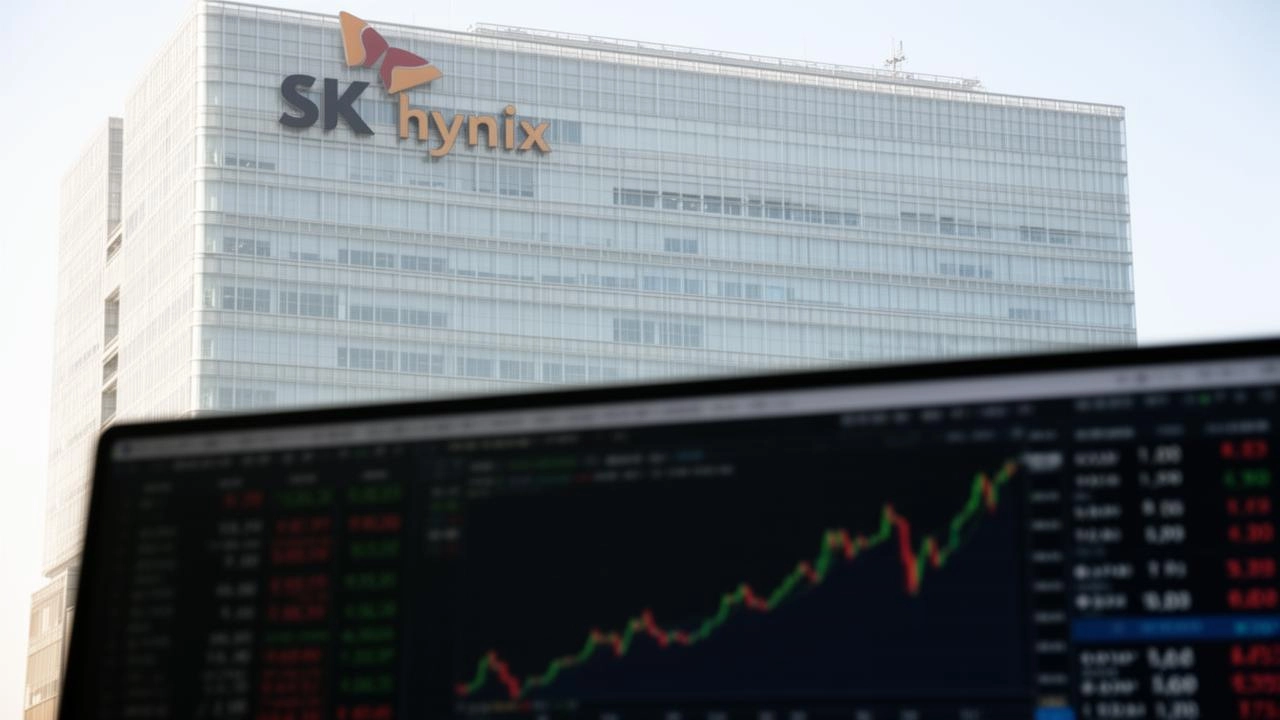
SK Hynix’s American Depositary Receipt (ADR) is drawing fervent interest from global investors, trading at a premium of up to 50% over its Seoul-listed common stock since its Nasdaq debut. With Nvidia CEO Jensen Huang hailing the listing as “incredibly successful,” Wall Street is piling on with bullish calls, including a $330 price target (approximately ₩490,000) that implies significant further upside.
According to the Korea Exchange and the financial investment industry on the 17th, SK Hynix ADRs have maintained a substantial premium over the underlying shares since their Nasdaq listing on the 10th (local time). After closing at $168.49 on the first day of trading—up roughly 13.1% from the $149 IPO price—the ADRs surged to $176.46 on the 15th, representing an approximately 25% premium over the Seoul-listed shares (₩2,082,000). Based on the closing price on the 16th (₩1,842,000), the premium had widened to 42%. At one point during intraday trading, the ADR hit $177, pushing the premium close to 50%.
The phenomenon of ADRs trading at a premium to the underlying shares is largely attributed to the practical difficulties of arbitrage. To profit from the price gap by converting between ADRs and common shares, existing holders must first convert their ADRs into the underlying stock within the issuance limit. However, with a premium already in place, there is virtually no incentive to convert ADRs into common shares. For this reason, some experts suggest the ADR premium could weigh on the price of the Seoul-listed shares for some time. Swiss investment bank UBS had anticipated such a premium even before the listing and had recommended a strategy of buying the ADR instead of the KOSPI-listed shares.
Over the longer term, however, the prevailing view is that a price discovery mechanism between the two markets will take hold. Kim Jae-seung, an analyst at Hyundai Motor Securities, noted, “In the case of TSMC, foreign buying expanded in an environment where the ADR commanded a 25-30% premium over the underlying shares.” He added, “For global investors with access to both markets, there could be a shift toward buying the cheaper common stock rather than the pricier ADR.” Kim further commented, “It is more reasonable to view SK Hynix’s ADR listing not as a structural factor driving foreign outflows from the domestic common stock, but as an opportunity for a new price discovery pathway to emerge between the U.S. and South Korean equity markets via the ADR premium.”
Wall Street’s expectations are even more heated. Simon Coles, an analyst at global investment bank Barclays, initiated coverage on SK Hynix ADRs with an Overweight rating and a $330 price target, implying roughly 87% upside from current levels. He noted that even after applying a target valuation of 8 times price-to-earnings ratio (PER), the stock “remains undervalued compared to global peer Micron.” His rationale rests on the persistence of the memory semiconductor supercycle and SK Hynix’s continued dominance in the High Bandwidth Memory (HBM) market.
SK Hynix’s ADR listing also marks a historic milestone in terms of scale. The company raised a total of $26.5 billion (approximately ₩39.4 trillion) by issuing 177.9 million shares at an IPO price of $149, surpassing the $25 billion (approximately ₩37.2 trillion) raised by China’s Alibaba Group in 2014 to become the largest ADR listing by a foreign company on a U.S. exchange. Including U.S. companies, it ranks as the second-largest listing ever, behind only the recent SpaceX offering ($75 billion).
The ADR listing is expected to significantly broaden SK Hynix’s investor base. Previously, buying South Korean stocks directly required navigating complex procedures, but the ADR format improves accessibility and boosts liquidity. In particular, the listing opens the door for global institutional investors who were previously unable to hold SK Hynix shares or faced portfolio weighting restrictions, raising expectations for an expanded supply-demand base and a lower cost of capital. On the first day of trading alone, more than 84,000 domestic South Korean investors purchased SK Hynix ADRs through nine major local securities firms, with net buying totaling ₩338.9 billion (approximately $227.8 million).
Kim Min-gyu, an analyst at KB Securities, said, “An environment is being created in which the valuation gap between SK Hynix and domestic semiconductor stocks can narrow.” He added, “Considering the market dominance and profitability edge of South Korean semiconductor companies, we expect them to move beyond resolving the multiple discount and enter a multiple premium phase going forward.”
Another focal point for the market is whether SK Hynix ADRs will be included in major U.S. indices. Industry watchers view inclusion in the Philadelphia Semiconductor Index as highly likely given the total offering size. For the Nasdaq 100, analysts suggest inclusion is possible if the semiconductor sector’s strength persists and is supported by further ADR issuance or sustained share price outperformance relative to the broader market.
Meanwhile, the debate over the semiconductor cycle is intensifying. Disappointing earnings from U.S. chip designer Broadcom sparked peak-cycle concerns, while Meta’s announcement of a cloud business selling idle computing resources from its own data centers fueled AI overheating fears that bled into semiconductor peak-cycle narratives. However, positive catalysts such as Micron’s blowout earnings and ASML’s upward revision of its annual revenue outlook appear to be restoring momentum to the sustained-cycle thesis. Barclays forecasts that supply shortages in the memory semiconductor industry will intensify next year and that improvement will remain limited even into 2028.
Optimism also persists among South Korean brokerages. Kim Dong-won, head of research at KB Securities, maintained a Buy rating and a ₩600,000 (approximately $403) target price on Samsung Electronics, citing a high likelihood that memory semiconductor supply shortages will extend through 2028. He particularly forecast that next year could mark the tightest supply conditions in the history of the memory semiconductor industry.
Samsung Electronics, for its part, saw speculation emerge that it might consider a U.S. listing in the wake of SK Hynix’s ADR debut, but the company immediately issued an official denial, stating it is “not reviewing” such a move. Samsung Electronics reported better-than-expected second-quarter results, with consolidated revenue of ₩171 trillion (approximately $115.0 billion) and operating profit of ₩89.4 trillion (approximately $60.1 billion). This operating profit figure handily surpasses the $53.5 billion (approximately ₩79.6 trillion) posted by Nvidia in the first quarter of its fiscal 2027, marking the largest quarterly operating profit ever recorded by a private-sector company globally. However, shares of both Samsung Electronics and SK Hynix have experienced heightened volatility on the domestic South Korean market, falling 20-30% from their peaks. Experts point to the recently launched single-stock leveraged ETFs as a primary factor amplifying stock market volatility.