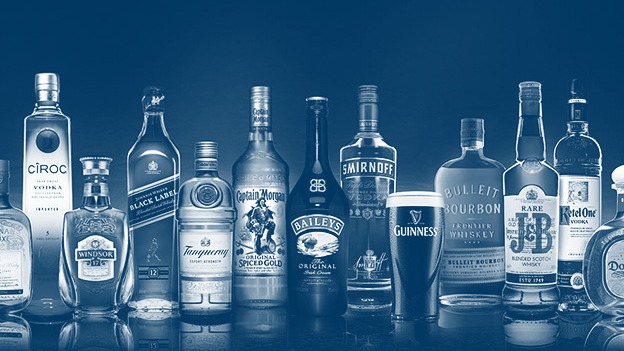
Drinks giant Diageo (DGE) is at the outset of a big shake-up led by new chief executive “Drastic” Dave Lewis. Already, that has entailed cutting its dividend, a cardinal sin for many income investors. For the current year ending June 2026, dividends per share are now expected to come in at 59₵ (44p), that’s a yield of three per cent.
When we launched the Alpha income portfolio in October 2025, forecasts implied Diageo’s annualised dividend yield would be more like 4.3 per cent. At the time we acknowledged the risk in backing the early iteration of the company’s turnaround strategy, but it’s fair to say I made a wrong call and should have waited for clarity on the clear risk there would be a dividend cut.
The eventual cull is one of several factors to have knocked the share price over the last six months. Ongoing weak performance in the Chinese white spirit market (affected by a government crackdown on drunkenness) and disappointing holiday season sales in North America also contributed to a loss of 22 per cent on our Diageo holding.
Would it be best to call time on the position, or are we at the bottom of the glass and due a refill? Whenever you’re in the situation of deciding whether to sell a poorly performing investment there are some psychological traits to beware.
Loss aversion is chief among them – this is the tendency of investors to hate crystallising losses. Investors sit on paper mark-to-market losses in the hope they’ll bounce back, rather than making the harder decision to take some tough medicine and then put the diminished pot to use in other investments with better chance of growing back the capital.
This cognitive dissonance is a risk as I decide what to do about Diageo, or in other words, we’ll need a better reason to keep it than salvaging my pride.
Decisions to sell shares should be made on the basis of a) whether the original investment thesis stacks up, b) if objectives remain the same and c) availability of better alternatives. Attacking these points in reverse order, there were superior income stocks available when we chose the portfolio, but we opted for Diageo to give us greater sector diversification.
On the matter of my investment thesis, the logic was that an income portfolio should be a blend of companies. Some can be in cyclically high-yield sectors (such as mining or energy), some can be in mature cash cows (tobacco stocks) and then you want companies set up to grow their pay-out over time.
Diageo was included because I believed it is a company with quality characteristics and the potential to grow again as its new strategy takes shape. Foolishly I jumped the gun when a difficult decision to rebase the dividend was clearly in the offing.
Looking forward from the current vantage point, I must ask whether the company has hit a floor and if it is more likely to bounce back than sink further. Having crossed the Rubicon of making a dividend cut, a yield of three per cent isn’t a bad place to start if the company can grow from here.
Estimates of 4.2 per cent dividend growth to FY 2027, and from then at an annualised 3.5 per cent to 2030, are reassuring. Furthermore, with expectations having taken a beating in recent years, uncertainty could break to the upside.
Of course, we should never just assume a recovery – there are structural and operational challenges to be met. Diageo’s top line has been squeezed by the American tequila boom running out of steam and Gen-Z’s apparent disdain for alcohol is well (perhaps over-) documented.
Trade and distribution impacts of the Trump tariff wars are driving costs for all import and export industries. On top of this, the Iran war means both higher transportation costs and a risk of energy-induced inflation squeezing discretionary spending. There could even be recession or very low growth creating a stagflation environment in several major markets. All in all, it’s recipe for a tough operating environment.
New chief executive Lewis’ rationale for scaling back dividends is strengthening the balance sheet to go for growth in the longer term. Net debt was almost $22bn in the full year to June 2025, with forecasts it will come in a lower at $20.6bn this year. Looking further out is tough but the aggregate of estimates in the FactSet data terminal suggest the level could halve by 2030.
Lewis’ immediate targets for generating free cash flow with which to pay down debt are ambitious: although FCF fell to $1.5bn at the half-year stage the company is still guiding for $3bn for the year to June, which would be a year-on-year rise. It is anticipated the improvement will be driven partly by progress on costs efficiencies.
Capital expenditure was guided to be lower to the tune of a couple of hundred million dollars, and the company signalled it expected to make 50 per cent YoY cost savings. It must be cautioned, however, that upbeat estimates on supply chain efficiencies and working capital trends for the rest of the year were made prior to the Iran war.
Separate from the FCF guidance, is the $2.3bn disposal of East African Breweries, which will also help pay down debt.
Overall, the company is very much in consolidation mode, so any one-off bonuses aren’t certain to end up being paid as dividends. There might be greater hope regarding positive surprises to organic eps growth. Overall, guidance is for a 30-50 per cent payout ratio of earnings, with a floor of 50 cents per share annually.
Getting out now does feel like selling out at a bottom, especially if there are catalysts for better trading ahead – such as the 2026 FIFA World Cup in North America. On the flipside, optimism must be tempered by the still very bad situation in the Middle East.
Importantly for our income portfolio, the foundation for growing distributions remains and we now have the intriguing situation of what historically was one of the FTSE 100’s genuine quality stocks now being a value play – it trades on a 12-mth forward price-to-earnings (PE) ratio of 12 times, far below a pandemic peak of around 28 times. What’s more, the relative value has gone from being more than twice that of the FTSE All Share, to being 0.94 times – those who give any credence whatsoever to mean reversion have reason to give that some thought.
Given our utility from holding the stock will derive from how much free cash flow flows to equity (FCFE) it makes sense to use forecasts of this number to arrive at a fair value. With the focus so firmly on debt reduction the FCFE, which is the cash left over for shareholders after commitments to creditors are honoured, is likely to be negligible this year. The likely step-up next year still wouldn’t justify the current share price, which implies analysts are confident of improvements further out.
Picking an income portfolio isn’t only about the best payers today, you also want companies that are likely to grow the dividend over time. From the present-day price lows and with a commitment to build on the re-based dividend, Diageo looks a good fit for that role. I made a school-boy error picking it early but there is still an investment case that works with my portfolio strategy.
The mean analyst price target for the stock in FactSet’s data terminal is 1,940p which is 30 per cent higher than the price at the time of writing. The risk is that disappointment on costs or revenue would de-rail any recovery narrative, but there appears to be far more of a margin of safety baked into the valuation these days: the company is rated on a price to estimated 2026 book value of 3-and-a-half times. The same stat for June 2021 would include look-ahead bias, but can be estimated at 12 times, which still illustrates our point on the historic cheapness of Diageo.
At this price and with dividend growth on offer from a lower level, it still works as a diversifier in our energy and finance heavy portfolio. Therefore, we hold Diageo.