Andy Burnham will enter office as Britain’s new prime minister on Monday preaching a message of “unity and stability”, just hours after removal vans depart Downing Street with the belongings of Keir Starmer, the outgoing premier whom he ousted.
Key reads
Sarah Burns – 19 minutes ago
Andy Burnham woke up this morning in Admiralty House, a UK government building in Whitehall that contains a number of ministerial flats, writes London correspondent Mark Paul.
Tonight, he will go to sleep a few hundred yards away in Downing Street as the UK’s new prime minister.
He is expected to formally assume office at around noon, and will give his inaugural address outside the black door of Number 10 shortly before 1pm.
In a break with Downing Street tradition, it is rumoured he will not stand behind a lectern.
In the hour or so preceding Burnham’s formal appointment by the British King Charles, the outgoing PM, Keir Starmer, will head to Buckingham Palace to tender his resignation and request that Burnham be allowed to replace him.
Starmer will also give his final address on Downing Street a few minutes before he heads to the palace. That is expected to happen shortly before 11am.
This morning, security at the gates of Downing Street, one of the one of the most famous streets in global politics, is far tighter than usual.
It is believed that protestors will be kept back from the gates and amplifiers will be banned, which means anti Brexit campaigner Steve Bray, whose loud musical interludes have provided the backdrop to many big UK political moments, may be stymied.
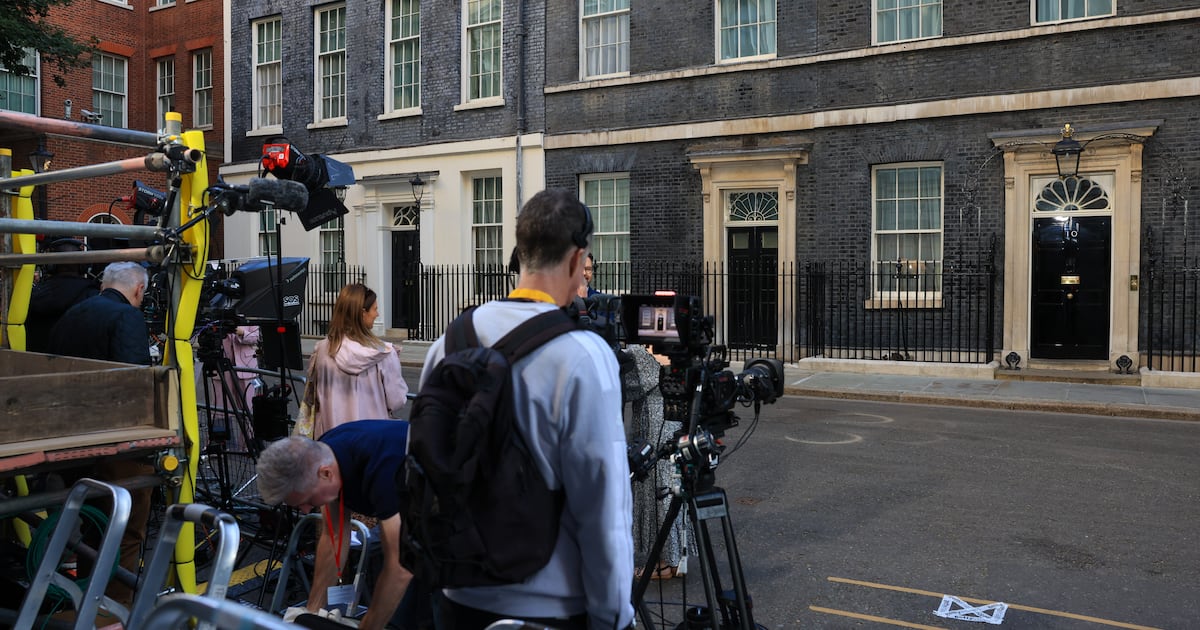
Broadcasters from Britain and across the world have been marking out their positions on the street all weekend, following a ballot. Platforms have been erected for broadcasters to occupy and a forest of step ladders are propped up against the walls to give photographers the best angles to capture the transition.
The Irish Times has elbowed its way in to occupy a position opposite Number 11 Downing Street, the base of the chancellor of the exchequer. Who will occupy that role under Burnham is the biggest decision he will make today and, perhaps, ever.
Shabana Mahmood, the home secretary under Starmer, is favourite to take over as Burnham’s chancellor. That may disappoint the restive left wing of the Labour Party but Burnham will never again be as powerful as he is today, and for now, at least, what he says goes for the UK’s current party of government.
As well as appointing his cabinet, Burnham is also expected to announce the abolition of the UK’s digital ID scheme.
 Members of the media gather at Downing Street in London. Photograph: Neil Hall/EPA
  Remote cameras are placed at Downing Street, as members of the media gather in London. Photograph: Neil Hall/EPA
  Remote cameras are placed at Downing Street, as members of the media gather in London. Photograph: Neil Hall/EPA
Sarah Burns – 26 minutes ago
It’s the biggest job in British politics, and Andy Burnham has had relatively little time to prepare. Once installed in Downing Street as prime minister on Monday, Burnham will need to make dozens of decisions each day, resolve disputes among ministers and act as the political figurehead of the government.
He faces a long and daunting list of issues, some of which you can read more about here.
Make-up of new cabinet expected to be revealed soon after inauguration speech
Soon after his speech, Andy Burnham is expected to reveal the make-up of his new cabinet, the formation of which has been veiled in secrecy since his ascension to the top job became inevitable a couple of weeks ago.
There has been acute speculation over who might be chancellor of the exchequer, a role coveted by left-leaning former Labour leader Ed Miliband.
His allies fear, however, that he is danger of losing out on that role to the current home secretary, Shabana Mahmood. Pat McFadden is seen as a contender for Northern Ireland secretary.
 Former UK Labour leader Ed Milliband. Photograph: Andrew Winning/Reuters Burnham’s inaugural speech due to focus on need for ‘honesty and reflection’
In his first speech as prime minister, Burnham will promise to strive to ensure his country is once again recognised internationally for effective government, after a decade-long carousel of psychodrama.
It is expected that Burnham will seek to focus in his speech not on triumphalism, after his allies in Westminster effectively sacked Starmer two years after winning an election landslide. Instead, he will talk of the need for “honesty and reflection”.
He will also argue that it is time to give Britons “more breathing space” with a focus on policies that improve their everyday lives.
Burnham’s inaugural speech as UK prime minister comes three days after his first address as Labour leader on Friday, when he was officially confirmed in that role. On Friday, he focused on calling for an end to division and “factionalism” in his party. Monday’s Downing Street speech, however, will focus more on the British nation.
 Andy Burnham gives a speech on Gravesend Town Pier, as he makes his first official visit as Labour leader last week. Photograph: Dan Kitwood/Getty Images
Andy Burnham will enter office as Britain’s new prime minister on Monday morning preaching a message of “unity and stability”, just hours after removal vans depart Downing Street with the belongings of Keir Starmer, the outgoing premier whom he ousted.
Sixteen years after first seeking the Labour party leadership, Burnham now becomes leader of his country, which is still bruised by a decade of rows over Brexit and roiled by political and economic pressures that have, at times, threatened to cleave it apart.
Burnham, who until last month was the mayor of Greater Manchester, will give his first speech outside the famous black door of Number 10 soon after Starmer departs, and Britain’s King Charles gives him permission to form a UK government.
He will acknowledge that he is “acutely conscious” of being the sixth new prime minister to walk up Downing Street since the Brexit vote of 2016. Burnham is expected to argue that this “unprecedented turnover” in national leadership underlines the need for more “stable and responsible politics” in Britain.
Follow irishtimes.com for updates throughout the day.
 The entrance to 10 Downing Street in London. Photograph: Neil Hall/EPA