
The British Jewish Campaign Against Antisemitism organization urged the country’s new prime minister, Andy Burnham, to make combating antisemitism a central priority of his government, warning that the UK’s Jewish community was facing an unprecedented security crisis.
In an open letter published as Burnham took office on Monday, CAA Chief Executive Gideon Falter wrote that British Jews live under constant threat, citing years of attacks on synagogues, Jewish schools, community institutions, and individuals, which have escalated significantly in the past year.
“The crisis has gone on so long now … that it has become the new normal,” Falter warned, noting Jews have been targeted disproportionately by hate crimes after successive governments failed to confront the problem. He cited arson on targets such as synagogues and a Jewish volunteer ambulance service.
“Synagogues and Jewish schools require a quarter of a billion pounds of police protection. Jewish volunteer ambulances are firebombed and charitable institutions are targeted by arsonists,” wrote Falter.
“Jews have been murdered at synagogue, stabbed in their neighborhoods, and attacked when they dare venture farther afield,” he added, referring to the deadly 2025 Yom Kippur terror attack at Heaton Park Synagogue in Manchester, and the stabbing of two Jewish men in a London neighborhood in May.
Get The Times of Israel’s Daily Edition
by email and never miss our top stories
By signing up, you agree to the terms
He noted that Burnham, as the then-mayor of Greater Manchester, “saw the effect firsthand” at Heaton Park Synagogue, and said, “Now, as prime minister, you have an opportunity to do what your predecessors did not: You can do something about it.”
Burnham attended a vigil in the aftermath of the Heaton Park terror attack, where he told the city’s Jewish community that Manchester’s leadership “have your back,” and that it would “always be that way.”
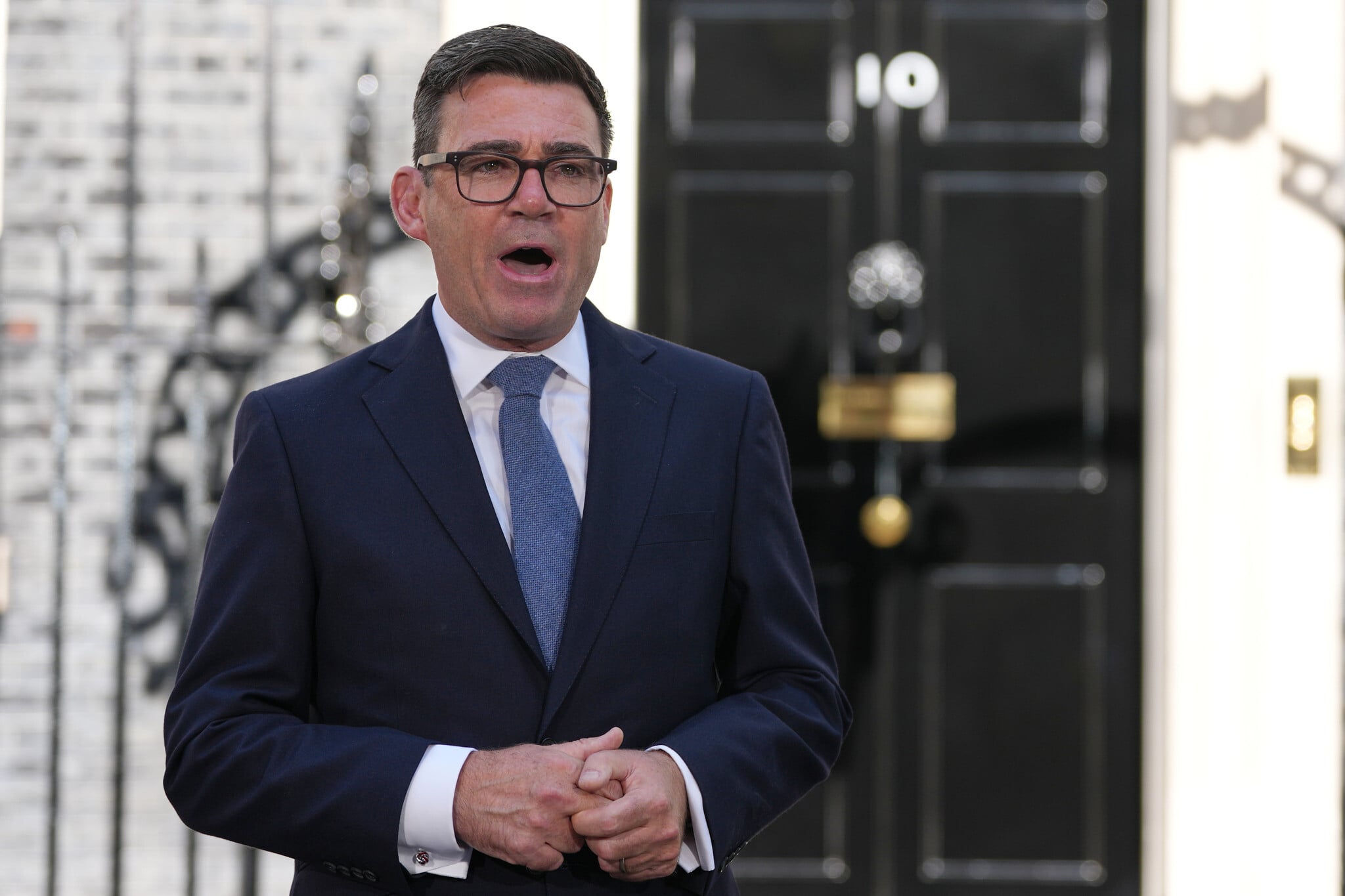
Britain’s new Prime Minister Andy Burnham speaks to staff and media at 10 Downing Street in London, July 20, 2026. (AP Photo/Kirsty Wigglesworth)
Last week, Burnham also backed a £250 million funding boost to protect Jewish communities, saying he has “seen first hand the anxiety in our Jewish communities and the very real threat they face.”
“Their safety will be a priority for me — we must do more to stamp out the scourge of antisemitism and protect Jewish communities across the country,” he added.
Letter urges solutions, doesn’t include concrete proposals
Falter, in his letter, urged the new prime minister to do more than just fund protective measures, saying, “The Jewish future in Britain — if there is to be one — cannot be lived behind ever higher walls.”
“Protection and anonymity are precautions; they are not a solution,” he said.
Instead, he added, the correct approach would be to “stop appeasing the extremists,” whom he identified as those associated with “Islamism” and the far-left. He urged police and the courts to crack down on those movements.
“No concession will ever be sufficient to those whose values are antithetical to ours, who want to see our liberal society overturned and who are prepared to ostracize, discriminate, abuse, and even murder to achieve their goals,” he added.
The letter did not include concrete policy recommendations. But Falter said that the CAA has already formulated a plan for combating hostile elements, and would be happy to meet with Burnham and his team to discuss it.
‘Disheartening’ focus on Israel-Gaza policy
The CAA chief also criticized Burnham for a recent interview in which he discussed the United Kingdom’s stance on Israel and the Gaza war, and in which the new premier said his predecessor Keir Starmer had not taken the correct approach.
“It was disheartening to British Jewry,” wrote Falter, “that you recently found time to announce specific policy measures relating to a foreign policy matter over which Britain has very little influence, but managed only a passing reference to antisemitism without mentioning a single policy.”
In an interview with the Guardian earlier this month, Burnham said Westminster needed to put more pressure on Jerusalem over its actions in Gaza.
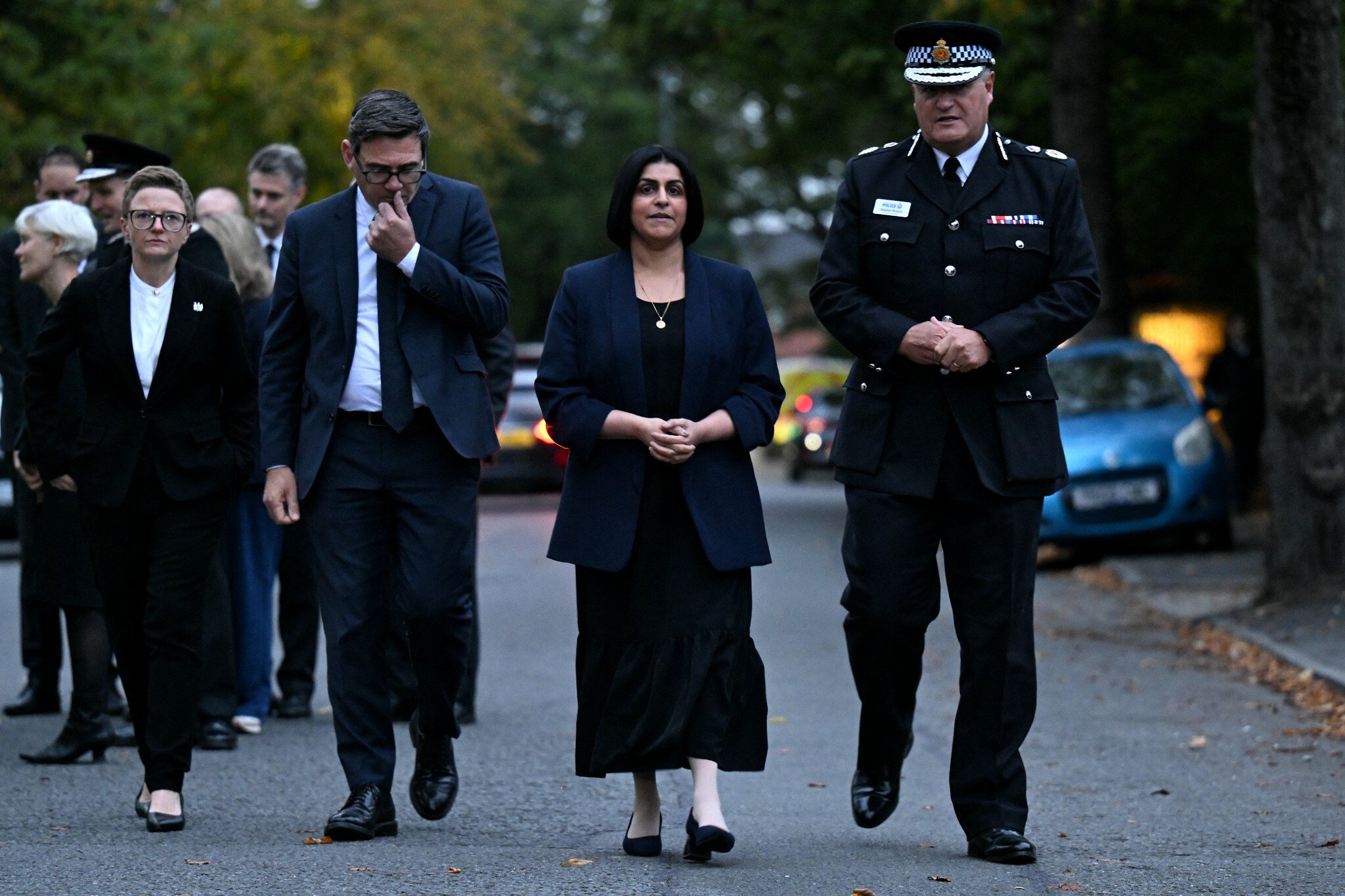
Then-Britain’s home secretary Shabana Mahmood (C) and then-mayor of Greater Manchester, Andy Burnham (2L) arrive to address members of the media, near to Heaton Park Hebrew Congregation synagogue in Crumpsall, north Manchester, on October 2, 2025, following an attack at the synagogue. (Oli SCARFF / AFP)
He told the newspaper that many people thought Starmer’s government “didn’t get it right,” when it came to responding to Israel’s war on Hamas in Gaza, following the group’s October 7, 2023, invasion and massacre in southern Israel.
“I am sorry about that. The response has too often not been good enough. We need to do better,” he told the newspaper.
While he stopped short of declaring the war a genocide, a charge that Israel vehemently denies, Burnham said there was “increasing evidence that war crimes appear to have been committed.”
He added, however, that, ultimately, “it must be for the international courts to determine, rather than politicians.”
Burnham also said he believed “further sanctions” on Israel should be considered, and that measures should be examined “to ban trade in goods with illegal settlements.”
The new Labour leader also insisted that there was “no contradiction between a zero-tolerance approach to antisemitism and holding the Netanyahu government to account,” and vowed to always “take a fair and balanced approach and stand up for what is right.”
Falter noted in his letter, however, that although “British foreign policy in the Middle East may exercise some politically significant communities over here,” the government’s approach to antisemitism “is literally a matter of life and death for the Jewish minority in this country.”
“Your legacy will not be remembered solely in terms of tax rates and hospital waiting times,” Falter told Burnham, the seventh British prime minister in less than a decade. “It will be whether Jews were murdered or thrived in Andy Burnham’s Britain.”
We can’t do this work alone.

The war with Iran has been draining for all of us in Israel. But when I heard about a high casualty incident – ballistic missile impacts in Arad and Dimona that left nearly 200 people wounded – I drank a cup of coffee, packed a bag, and headed south.
There, I spoke with Shilgit, the head of an after-school program for underprivileged youth. Standing outside her destroyed center, Shilgit said it was a miracle that no children were hurt and spoke about the community coming together in the hours since.
As a Times of Israel reporter, I’m committed to telling stories of resilience like Shilgit’s. But my colleagues and I can’t do this alone. If you value work like this, please consider joining our reader support group, The Times of Israel Community. Your financial support is essential to keep real human reporting like this going.
— Stav Levaton, military reporter
Already a member? Sign in to stop seeing this
You’re a dedicated reader

That’s why we started the Times of Israel – to provide discerning readers like you with must-read coverage of Israel and the Jewish world.
So now we have a request. Unlike other news outlets, we haven’t put up a paywall. But as the journalism we do is costly, we invite readers for whom The Times of Israel has become important to help support our work by joining The Times of Israel Community.
For as little as $6 a month you can help support our quality journalism while enjoying The Times of Israel AD-FREE, as well as accessing exclusive content available only to Times of Israel Community members.
Thank you,
David Horovitz, Founding Editor of The Times of Israel