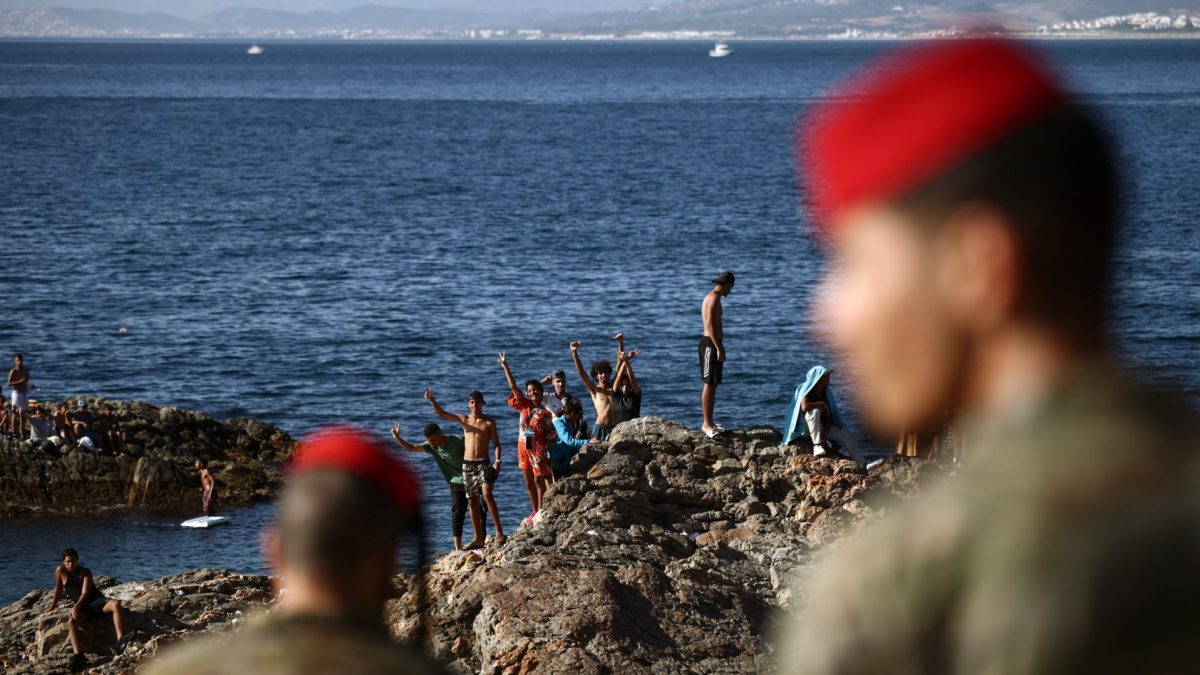
After tens of thousands of people started flooding into the Spanish enclave of Ceuta from neighbouring Morocco on Thursday, viral images from the collapsing border were characterised as an “invasion” by populist politicians across Europe.
Members of Reform UK party began advancing the claim that significant numbers of those arriving in the North African territory would soon journey onwards towards Britain.
Nigel Farage posted on X: “Before long many will be crossing the English Channel to enter Britain illegally.”
In a separate video, Farage made the unevidenced assertion that a lot of the men arriving in Ceuta were “dangerous” and called the issue “a battle for the future of our civilisation”.
Suella Braverman and Robert Jenrick also claimed the men were on their way to the UK and on Saturday, Reform home affairs spokesman Zia Yusuf visited Ceuta and wrote on X that he had spoken to “a number” of people “who made it quite clear they intend to make it to Britain”.
A video he posted showed an interview with one man, who when asked where he would like to go, replied: “Europe [inaudible] I have go to England, anything, not Morocco.”
Later, Yusuf posted another video where he claimed the militarisation of the border had stopped the flows of migrants and sent the majority back, despite previously claiming many were on the way to the UK.
 Migrants try to cross from Morocco into the Spanish enclave of Ceuta on Thursday (Photo: Antonio Sempere/AP)
The migrants who arrived in Ceuta found the reception centres where applications must be made in order to travel to mainland Spain overwhelmed, with thousands of people sleeping on the streets with no shelter, food or water.
More than 80 people have died during the crisis, either by drowning while trying to swim to Ceuta from the Moroccan town of Fnideq, or being crushed while trying to cross a border fence.
Ceuta’s local government said that around 60,000 people had entered the territory on Thursday and Friday. The Spanish interior ministry said by Friday evening 48,300 people had returned to Morocco.
As well as deploying the military, an inflatable barrier has been installed to prevent further sea crossings.
 Members of the Royal Moroccan Navy patrolling the floating barrier with Ceuta on Sunday (Photo: Violeta Santos Moura/Reuters)
UK ‘not the desired destination’
Home Office figures show that between 2021 and 2025 an average of 61 Moroccans a year reached the UK on all irregular routes. From 2021 to March this year, 128 Moroccans arrived on small boats, making up 0.07 per cent of the 186,466 people intercepted in the English Channel during the period.
Myriam Cherti, a senior researcher at the University of Oxford’s Global Exchange on Migration, said the number of people who remained in Ceuta seeking to travel onwards to mainland Europe was unknown.
Cherti, who is based in the Moroccan capital of Rabat, said that Spain – where Moroccans are the largest immigrant population – was a common target, partly because of cultural and family ties.
“I don’t think that the UK is the desired destination for many people arriving in Ceuta,” she told The i Paper. “The majority are Moroccan.”
Cherti said her research had found that Moroccans moving onwards from Spain were likely to choose countries in mainland Europe, such as the Netherlands, but could ultimately be sent back to Spain as the country of their initial arrival under an EU scheme.
 Moroccan security forces monitoring crowds near the border with Ceuta on Friday (Photo: Hicham Rachidi/Anadolu via Getty Images)
Numerous social media posts by people arriving in Ceuta over recent days, seen by The i Paper, carried emojis of Spanish flags and the caption “Spain is open” in Arabic.
Countless videos, of unknown origin, have been shared by people who made the journey on TikTok, Instagram and other platforms, in viral trends that Spanish authorities have blamed for inciting the mass crossing.
The videos, sharp influx of migrants and swift return of many, indicates this is not a constant nor regular route to reach the UK and beyond.
Origin of social media trend unclear
Earlier in July, some of the accounts now posting “success stories” from people reaching Ceuta shared news that the Spain’s Supreme Court ruled that migrants intercepted at sea while trying to reach Ceuta or the Spanish enclave of Melilla could not be immediately turned back.
The case followed a new policy allowing undocumented migrants and asylum seekers to regularise their status in Spain, and the days leading up to the Ceuta crisis saw claims the border crossing was open flood Moroccan social media, Cherti said.
“I think it’s a combination of factors that led to this misinformation that the borders were open, and that this was the opportunity and the moment to act quickly,” she added. “The authorities were overwhelmed and it got completely out of control.”
 An Instagram account dedicated to migration to Ceuta with 15,500 followers posted news of the Spanish Supreme Court ruling before sharing numerous ‘success stories’ of people swimming to the territory
Morocco, which does not recognise Spanish sovereignty over Ceuta, was accused of relaxing border controls in 2021 as revenge for Spain hosting an independence leader from the Moroccan colony of Western Sahara.
Last month, Spanish prime minister Pedro Sanchez visited Algeria, with which Morocco has strained relations following a succession of diplomatic disputes.
What the UK could learn
The local context has been absent from heated discourse among European Union leaders, with Italian prime minister Georgia Meloni temporarily suspending free movement with Spain in a move she said was “adopted to safeguard national security and prevent possible repercussions”.
EU leaders will hold emergency talks on the crisis on Tuesday. In a letter to European Commission Ursula von der Leyen, Sanchez hit back by saying that Ceuta was not in the Schengen area and that some European governments were attacking Spain “driven by prejudice, fake news, ignorance, or political interest”.
The deepening row will be a warning for Britain, which has for years been managing periodic disputes with France over allegations that efforts to prevent small boat crossings are inadequate.
Prime minister Andy Burnham said on Saturday that he had been in touch with Sanchez and was “providing what help we can”.
Speaking on a visit to Dover, Burnham indicated there is a “broader issue with the Schengen” and how the UK interacts with it.
On the specific question on small boat crossings, Burnham said the government was “changing the whole approach” to tackling it and would be “relentless” in doing so.
Home Secretary, Shabana Mahmood, said the small boats crisis was “different and trickier in many ways” to what was seen in Ceuta, and rejected the Spanish technique of pushing thousands back over the border.