Paint is better than it used to be.
I was recently charged with painting an accent wall—the first time I had painted a nonwhite interior wall in more than a decade. The color was to be red, and I approached the job with some trepidation. Red typically covers poorly. I was in for two coats, perhaps even a third.
I purchased a single quart (0.95 L) can, manufactured by Benjamin Moore, and worried whether that would be sufficient, despite assurances from the proprietor of the local hardware store.
The result was spectacular. The coating went up very evenly. The coverage was great, even over a spot I had repaired with spackle. There were no heavy brush lines, even though I was using a cheap brush with stiff bristles. There were no drips. The painters’ tape left a sharp line. I hardly needed a second coat, but the can had enough paint left so I applied one. The wall looked terrific, professionally done.
When we think about new technology, we often think of things like artificial intelligence, new drugs, or the latest app, often ignoring the technological evolution in products like paint. My good result was really the work of dozens of chemists fine-tuning the resins, pigments, and surfactants in the formulation. Great work, chemists!
Questions? Comments? Tips? Send them to me, senior correspondent Alex Tullo, at a_tullo@acs.org.

A worker wearing a helmet, gloves, a mask, and a lab coat handles trays of vials with red caps.
At Cuba’s National Center for Biopreparations, vials of a vaccine for meningococcal disease are prepared for packaging on July 15, 2022.
Credit:
Credit: AP Photo/Ramon Espinosa
Top stories from C&EN
Editorial: Gene therapies don’t lend themselves to typical drug trials and need special consideration.A US oil blockade has hobbled the once-teeming Cuban biopharma industry.Editorial: Preventing US pharma firms from working with Chinese companies would set the US industry back.
Business in brief
Sabic and Borouge post strong results despite Iran war

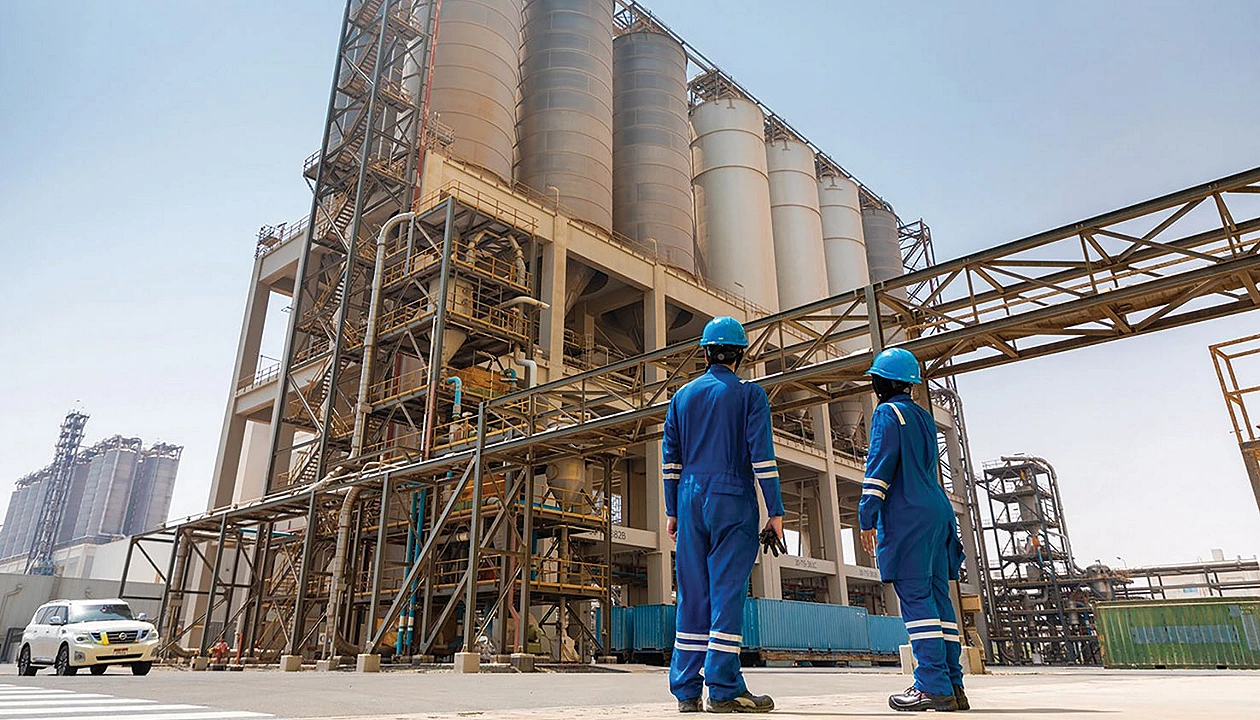
Two chemical workers in blue jumpsuits observe a petrochemical plant on a sunny day.
Borouge says production from its plant in the United Arab Emirates has circumvented the closure of the Strait of Hormuz.
Credit:
Borouge International
Two of the largest petrochemical makers in the Middle East—Sabic and Borouge—say they have been able to largely circumvent the closure of the Strait of Hormuz and have reported strong second-quarter earnings despite the war in their region. Sabic says it had success with shipping out of Saudi Arabia’s west coast to avoid the strait. In polymers, such shipments increased by about 150% from the prior quarter. New routes increased logistics costs by about 40%, the company said in a conference call with analysts. Sabic’s sales volumes declined by 33%, but a 41% increase in average sales prices meant its revenues fell by only 5%. Meanwhile, Borouge says it was able to make repairs to its Ruwais, United Arab Emirates, facility and start it back up in June after it was hit by debris from a drone interception in April. The company says that thanks to alternative routes, it has been able to ship all the polymers it produced during the second quarter. Borouge’s sales rose 17% during the quarter because of a 53% increase in selling prices.
—Alex Tullo
Yara, Air Products finalize green ammonia agreement

An aerial view of a massive industrial complex on Saudi Arabia’s coast at dawn.
Air Products and Chemicals’ green hydrogen joint venture in Neom, Saudi Arabia. Yara has agreed to distribute some of the ammonia produced at the facility.
Credit:
Air Products and Chemicals
Air Products and Chemicals has completed a previously announced agreement whereby Yara will distribute some of the ammonia produced at a soon-to-be-completed Air Products joint venture in Saudi Arabia. The Neom Green Hydrogen Project will use wind and solar power to run water electrolysis units to make hydrogen, which will be used in ammonia production. Air Products says Yara will be compensated on a commission basis in the arrangement. The companies have been deepening their relationship. Air Products will supply hydrogen to an ammonia plant Yara is buying in Texas; Yara was considering buying the ammonia assets that were part of a green ammonia project Air Products ultimately decided to cancel in June.
—Alex Tullo
Dutch court rejects Shell claim for ethylene damages
The Amsterdam District Court has dismissed a Shell Chemicals Europe claim for approximately $1 billion in damages from Celanese, Clariant, Orbia, and Westlake Chemical. Shell alleged that the four ethylene purchasers had colluded to artificially depress ethylene prices in Europe between 2011 and 2017. Shell, a major ethylene producer, brought the case in October 2023 to recover “substantial damages” from the alleged price manipulation. But the court ruled July 29 that Shell suffered no harm attributable to the four companies’ conduct. On the contrary, an increase in steam cracker margins indicates that ethylene supplier profits “rose significantly” during the years at issue, according to the judgment. The ruling is the first in a series of suits, most recently from Dow, brought against the alleged ethylene buyers’ cartel; proceedings in German and other Dutch courts are ongoing. In a statement Sheldon Hirt, Orbia’s general counsel, says that future proceedings “will need to look deeply into . . . how this market operates, and why the profit margins of the ethylene suppliers were rising during a period in which they claim to have been harmed.”
—Vanessa Zainzinger
Lenzing to shutter flagship lyocell plants
Lenzing, a producer of wood-based cellulosic textile fibers, has announced the closure of its Austrian and UK plants after a yearslong downturn. Fiber production in Heiligenkreuz, Austria, is scheduled to cease by year-end, while production in Grimsby, England, will shut down by the end of 2027. The moves will lead to the loss of 2,000 jobs. The Austrian maker of Tencel fiber is also seeking to sell its Indonesian viscose site, PT South Pacific Viscose. The cuts form part of Lenzing’s new strategy to significantly expand its nonwoven fibers business by 2030 and focus on materials used in hygiene products, filters, and technical applications. In textiles, it plans to concentrate on higher-value specialty and premium fibers while reducing its exposure to standard viscose products. Lenzing has had several difficult years. In 2025, it posted a net loss of $156 million. Management hopes the restructuring will increase pretax earnings by about $173 million.
—Vanessa Zainzinger
State-owned Indian gas company to ramp up fertilizer production
GAIL (Gas Authority of India Ltd.), a state-owned natural gas company, is partnering with Rashtriya Chemicals and Fertilizers (RCF) to build a natural gas–based fertilizer manufacturing facility in the western region of Maharashtra. The planned unit is expected to produce 1.27 million metric tons per year of urea-based fertilizer. The site will be located along GAIL’s natural gas pipeline. The move comes after India, one of the world’s largest agricultural economies, was heavily impacted by supply chain disruptions in recent years affecting the raw materials needed to manufacture fertilizers. The partnership between GAIL and RCF aligns with the Indian government’s recently approved policies to boost domestic urea production and reduce the country’s dependence on other nations, GAIL says in a press release.
—Aayushi Pratap
Quote of the week
“I really don’t think that there should be Richard Pazdurs and Janet Woodcocks. I think it’s good that new people come into the agency.”
Richard Pazdur, former director, US Food and Drug Administration’s Center for Drug Evaluation and Research, at the American Association for Cancer Research’s Drug Discovery and Development meeting
Linde to invest $1 billion in semiconductor gases
The industrial gas firm Linde will spend $1 billion to build a pair of air separation units in Phoenix to supply new semiconductor manufacturing lines in the area with oxygen, nitrogen, and argon. In a press release, Linde says the investment is connected to a long-term supply agreement it has signed with an unnamed semiconductor maker. The release says Linde is also building an $800 million air separation unit in Taiwan to serve the same customer’s new capacity there. Taiwan Semiconductor Manufacturing Company (TSMC) and Intel both have major chip fabrication plants near Phoenix that include capacity that is new or under construction, but Intel relies on other industrial gas firms for its manufacturing in Taiwan. Linde competitor Air Liquide recently announced a high-purity gas expansion for semiconductor industry customers in Arizona.
—Craig Bettenhausen
Claros raises cash for PFAS destruction
Claros Technologies has raised $45 million to fund the commercialization of its per- and polyfluoroalkyl substances (PFAS) destruction technology. To break down PFAS, Claros shines ultraviolet light on inorganic photocatalysts that split the carbon-fluorine bond. Regulators in Europe, the US, and other parts of the world are pushing companies to reduce PFAS pollution, which is spurring demand for technologies to remove the chemicals. Claros plans to use the funding to scale up its manufacturing. In April, the firm reported that it had destroyed nearly all PFAS in groundwater samples from the Minnesota Pollution Control Agency. In July 2025, Claros announced successful destruction of PFAS in industrial wastewater at Daikin America’s fluorochemical plant in Alabama.
—Matt Blois
AstraZeneca, BMS reportedly in talks to merge
Pharmaceutical industry heavyweights AstraZeneca and Bristol Myers Squibb (BMS) have had multiple discussions about merging into one $400 billion corporation, the Financial Times reported over the weekend. The combination would be among the largest pharmaceutical mergers in history. The FT reports that talks could still fall apart. In any case, such a merger would be subject to intense regulatory scrutiny. Both drugmakers have large cancer therapy portfolios. AstraZeneca’s share price was down slightly during the trading day Monday, while BMS’s was flat.
—Rowan Walrath
Johnson & Johnson could acquire Sail with new agreement
Johnson & Johnson has signed a collaboration agreement that will enable it to acquire Flagship Pioneering–backed Sail Biomedicines for $2.85 billion. Sail is a start-up developing in vivo chimeric antigen receptor T cells (CAR-Ts) for immunological diseases. It was born from a 2023 merger of two other Flagship-founded firms: Laronde, a once-buzzy circular RNA start-up, and Senda Biosciences, which was researching intersystems biology. Johnson & Johnson is paying Sail $785 million up front to develop CAR-Ts alongside the option to acquire Sail down the line. The companies have not disclosed specific disease areas. Sail’s current lead drug candidate targets CD4+ and CD8+ T cells.
—Rowan Walrath
What we’re reading