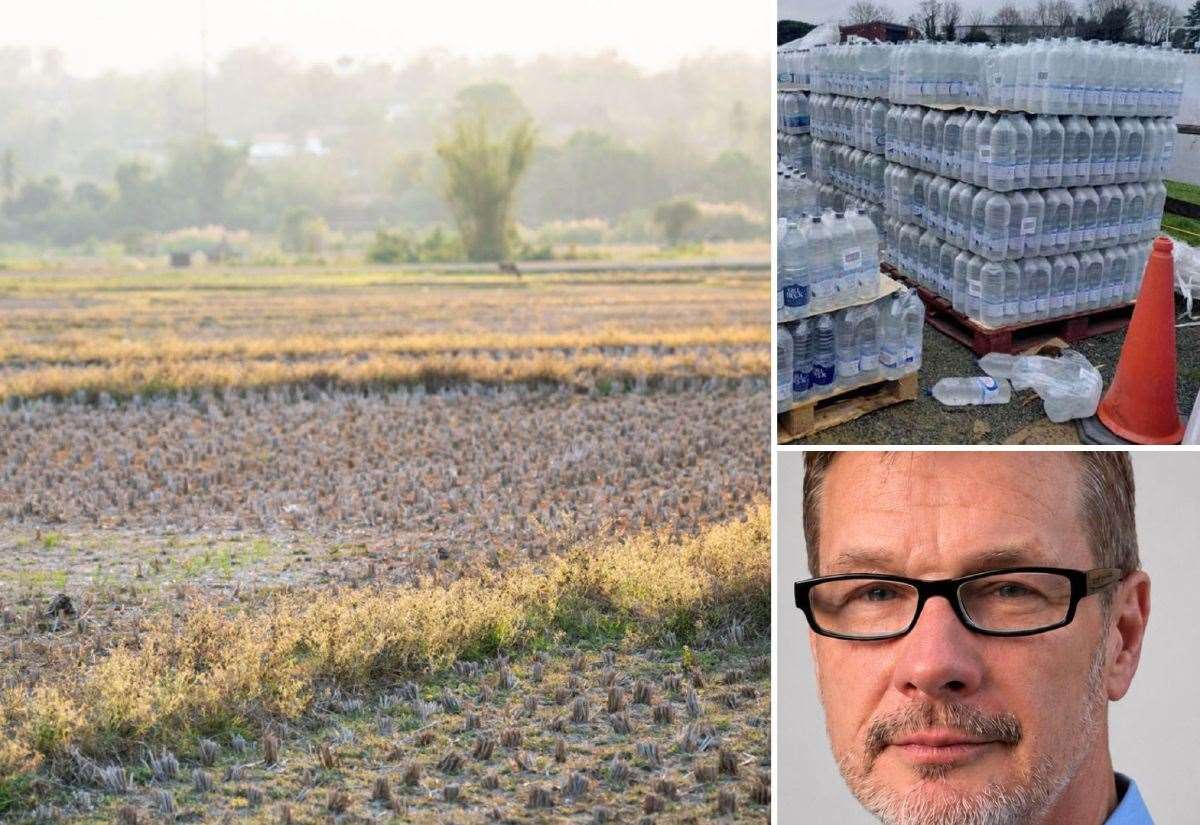
Residents across parts of Kent are on the verge of losing water supplies as the country’s ongoing drought continues to disrupt homes.
South East Water (SEW) bosses have confirmed outages remain across parts of Canterbury, Herne Bay and Whitstable.

 Water deliveries have been carried out in Charing, near Ashford, as a precaution this morning
The Environment Agency (EA) has placed Kent and South London into drought status after prolonged hot, dry weather and record-low rainfall.
Currently, a burst water main is leading to low pressure in the Island Road, Hersden area, while neighbours in Bredlands Lane, Westbere are also facing the same problem.
The operator has also apologised to customers in Whitstable who continue to have supply issues.
Chiefs say they are “tankering water into the area and injecting directly into the network that feeds the impacted properties” this afternoon – something which may lead to people facing “short periods of low water pressure or intermittent supplies”.
Meanwhile, “precautionary bottled water deliveries” to properties in Charing, near Ashford, have also been carried out this morning.
 Residents across Whitstable are among those facing water supply issues today. Picture: South East Water
SEW’s Matthew Dean has urged people to use water for drinking, cooking, and hygiene amid its ongoing hosepipe ban, now in place for all 2.4 million customers.
The company’s incident manager said: “Due to the prolonged period of hot and dry weather, water levels in our local drinking water storage tank in the Whitstable and Herne Bay areas continue to be extremely low.
“This may soon impact our ability to pump fresh drinking water to our customers.
“All customers are currently in supply. However, if demand for water continues to remain high, there is a risk of supply interruptions.
“We’re continuing to ask customers to use water for essential purposes only: drinking, cooking and hygiene. This is in line with our temporary usage ban that is now in place for all of our 2.4 million customers across our supply area.
 Recent drone photo showing parched land in Wouldham village. Picture: Barry Goodwin
“To safeguard our shared resource and help prevent any homes from facing a sudden loss of water, we are incredibly grateful to everyone helping us protect water supplies in Kent.”
SEW chiefs have acknowledged they have work to do to build long-term resilience in the area.
They added: “While those building plans take time, these small actions over the coming days will allow our storage tanks to steadily refill rather than continue to drain down.
“We are monitoring the situation continuously and will update you again tomorrow (Thursday) with news on this developing situation or earlier if the situation escalates.
“Thank you for your help, patience, and support. Please share this information within your communities.”
“We are monitoring the situation continuously…”
Today’s issues comes just five days after crews raced to fix a burst water pipe in Herne Bay.
It also follows a recent heatwave in May, which left more than 15,000 homes across Whitstable and Herne Bay without running water.
Businesses were also forced to close over the Bank Holiday Weekend, when many expected a bumper week of trade.
The crisis was said to have been triggered by soaring demand amid high temperatures, sparking fresh questions over the water company’s ability to cope with periods of extreme weather and growing pressure on the network.
The EA declared half of England in drought last week, following record-low rainfall and extremely high temperatures.
 South East Water’s John Halsall took over as chief executive in July. Picture: South East Water
Last month, new SEW boss, John Halsall, promised a £1.9 billion infrastructure boost to “really focus” on fixing leaks and other problems.
He replaced the under-fire David Hinton following months of pressure from MPs and residents after thousands of homes and businesses were left without supplies.
Mr Halsall has announced SEW will be ploughing resources into long-term “sustainable improvements” and taking “small actions” to improve the service during the next nine months.
The huge cash injection will go towards more storage tanks and reservoirs as well as improving water treatment works.
It would also be spent on changing the way water is moved around pipes in the south east.