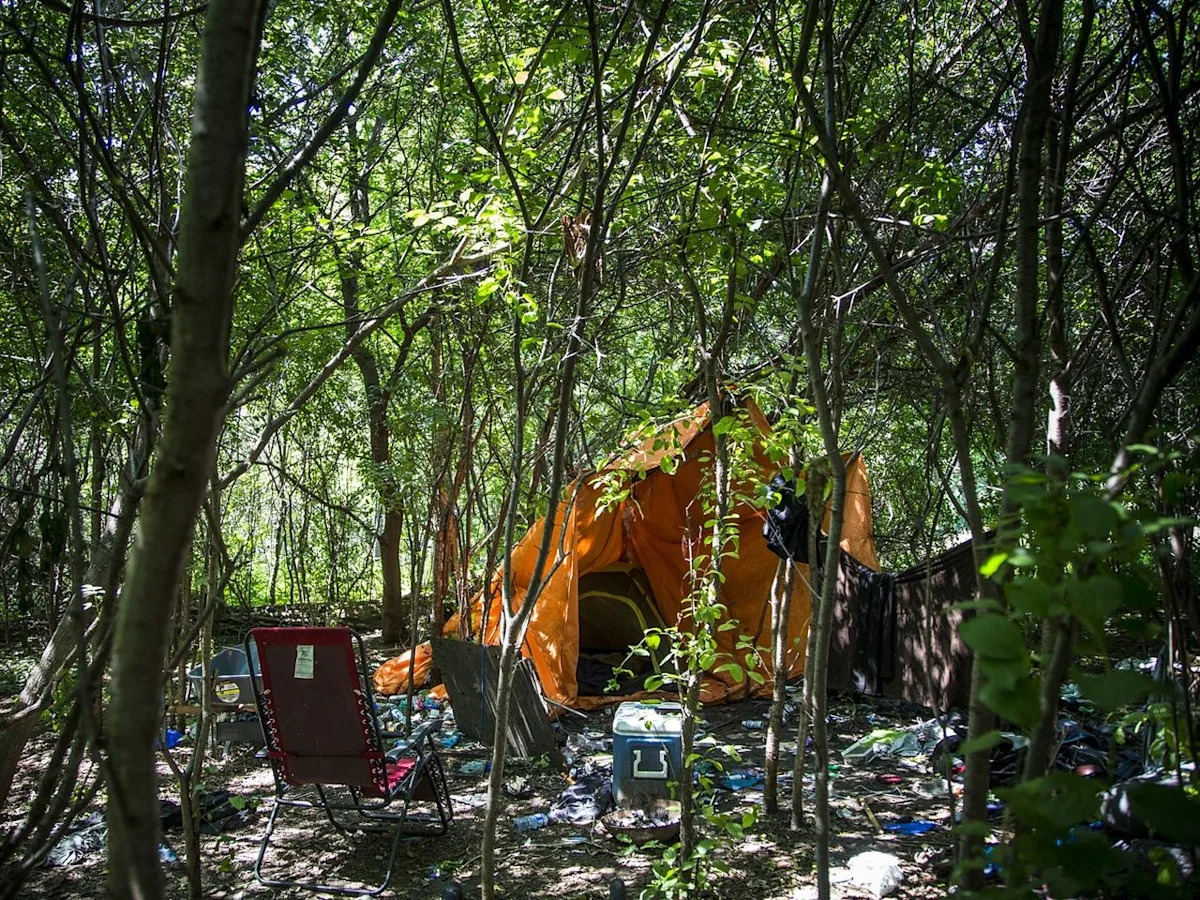
The City of Ottawa‘s homelessness outreach program will include a standardized reporting system for encampments designed to improve supports and to collect data while maintaining the privacy of the city’s unsheltered homeless population.
A motion from Rideau-Rockcliffe Coun. Rawlson King received unanimous support from fellow councillors and calls on city staff to implement a standardized reporting framework for encampments as part of its unsheltered homelessness outreach model, which is to roll out in the fall.
Councillors will receive updates from staff on the status of service requests for encampments, including what response actions are taken, “in a manner that maintains the privacy of residents experiencing unsheltered homelessness,” according to King’s motion.
“Behind every data point and every reporting channel we’ll discuss today are people — unsheltered residents living in encampments across the city, often in unsafe and precarious conditions,” King told fellow members of the community services committee. “They face real risks to their health and safety … The human cost of encampments is significant, and it’s the human reality that makes timely, accurate, and accessible information so (important.)”
Residents of surrounding communities are also questioning their local councillors “to understand what’s happening and what needs to be done,” King said.
“Encampments are among the most complex challenges facing municipalities across Ontario and across the country today. They involve multiple city departments, community partners, outreach teams … Information exists across several systems and is not always easily accessible in a consolidated format. At the same time, councillors and the community are regularly seeking answers about encampments, service requests, response actions and available supports.”

Rideau-Rockcliffe Coun. Rawlson King introduced the motion that received unanimous support from fellow councillors. It calls on city staff to implement a standardized reporting framework for encampments as part of its unsheltered homelessness outreach model, which is to roll out in the fall.
Municipalities are also treading in uncertain legal waters with encampments following court decisions in the Waterloo region that upheld unsheltered residents’ rights to maintain a long-standing encampment in downtown Kitchener.
The May 21 decision from Justice Michael R. Gibson quashed a proposed “site-specific” bylaw to clear the encampment on the grounds that it violated Charter rights. The Ontario government and the municipality of Waterloo are appealing that decision.
Gibson’s decision reaffirmed earlier court rulings that stated eviction from the encampment would place residents at greater risk of harm and suggested establishing an alternative lawful encampment site, pointing to other Ontario cities like London and Thunder Bay that had created lawful designated encampment zones.
“No one should romanticize or be starry-eyed about the encampment,” the judge wrote in his decision. “It is a miserable and desperate place. But it represents the only remaining safety valve for the region’s homeless as a refuge of last resort.”
In Ottawa, the city’s unsheltered task force and its community partners will not carry out any enforcement “until all other supportive solutions have been exhausted,” according to Clara Freire, general manager of community and social services.
The city has been receiving legal guidance since the first court rulings out of Kitchener-Waterloo in 2023, Freire said.
“Since the first court ruling coming out of Waterloo, we have been applying more of a human rights approach, ensuring that there’s adequate shelter space because that was part of the initial ruling … not being able to take away someone’s right to housing if there was no other option for them,” Freire said.
“We now have enough shelter space for anyone who wants to come in, and our unsheltered task force takes a human rights approach, with 84 per cent of encampments resolved with that approach before a enforced dismantle is required.”
Bay Coun. Theresa Kavanagh said collecting data on encampments was an important first step.
“To just sweep it under the carpet is just not possible and we have to truly understand what’s going on and what we can do about it,” she said. “One of the biggest problems is that we do not have supportive housing that would be the ideal situation for many of these residents.”
As of March 1, 2026, there were 664 families (2,212 people) being served through the city’s family transitional housing system. That represented a 76 per cent increase since January 2023, when 377 families were being served, according to the community services department.
Somerset Coun. Ariel Troster said the dismantling of a large encampment near the Bayview O-Train station in May pointed to deepening signs of crisis.
Cleanup crews discovered about 2,000 discarded needles and other drug paraphernalia along with dozens of propane tanks amid piles of garbage.
“The profile of people who tend to choose an encampment over shelter, we know what that looks like. It’s typically people who have significant trauma, who have experienced trauma in the shelter system. It’s often couples, it’s often people with a pet,” Troster said.
“As we push people more and more to the margins, as things like supervised consumption sites are closed — and then people don’t want public drug use on the street near them — it’s a natural inclination that people are just going to move farther and farther away, deeper into wooded areas.”
Freire said staff were fully supportive of King’s motion.
“It does reflect work that we have committed to doing as part of our encampment strategy,” she said. “In the last couple of years, we’ve been incrementally improving the access to information on shelter statistics, and then last year introduced a dashboard for reporting encampments. So this is part of an evolution of work that we’re committed to.”
Related