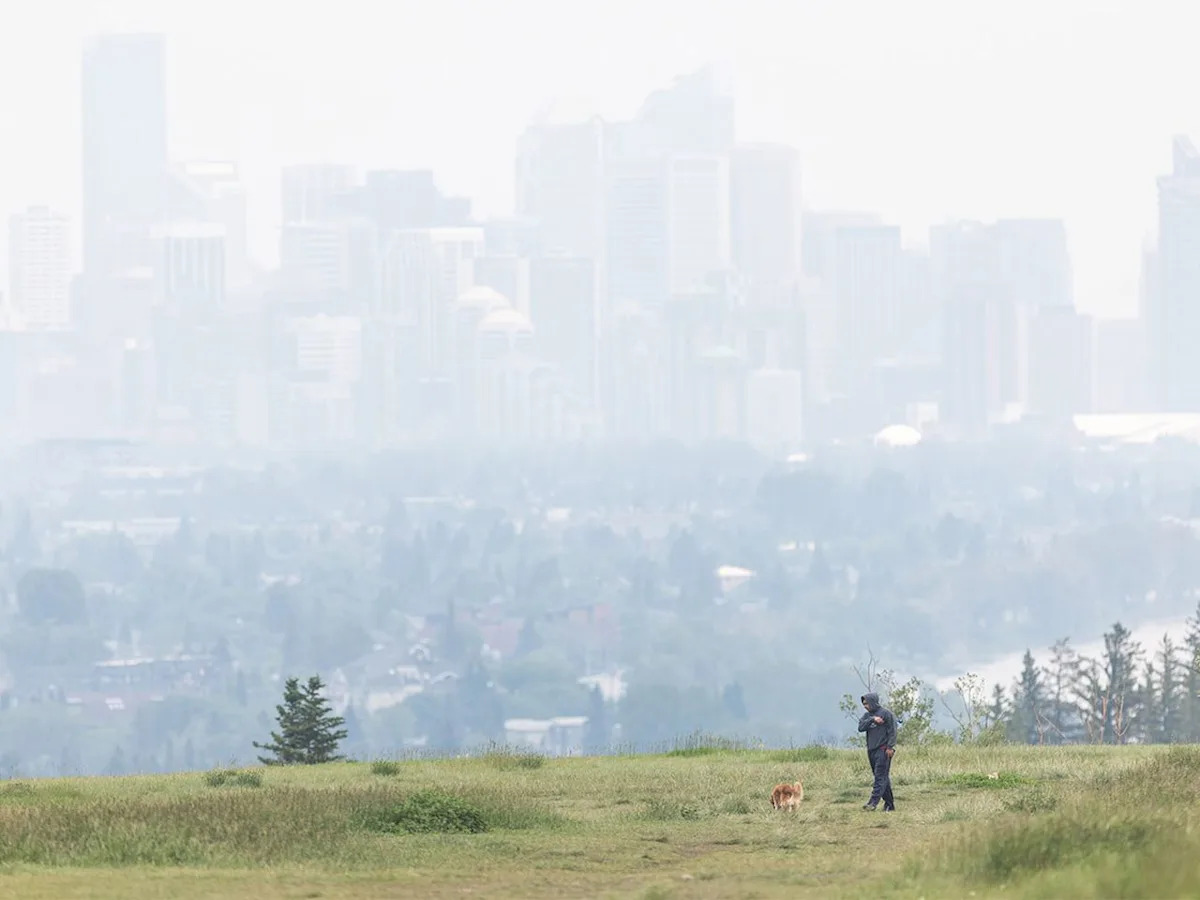
The Calgary area remains under an air quality warning after wildfire smoke rolled in Monday afternoon.
According to Environment Canada, smoke from wildfires in northern Saskatchewan has blown across parts of Alberta, causing poor air quality.
Though Tuesday’s risk levels were forecast at around an 8 — which falls within the high-risk range — actual levels were sitting at a 6, or moderate risk, on Tuesday afternoon, said Environment and Climate Change Canada meteorologist Brian Proctor.
“We’re a little bit better than what the forecast is suggesting, but we’re definitely seeing an increase in the amount of smoke out there, and it should be decreasing in its intensity through the evening tonight,” Proctor said.
Conditions are expected to improve throughout the day Wednesday.
How does weather affect wildfire smoke movement?
Where and how fast smoke travels has a lot to do with wind patterns and atmospheric stability, Proctor said.
In this case, he said, the low pressure system that was responsible for the weekend’s heavy rainfall is making its way slowly eastward, and the return flow has brought smoke from wildfires in northern Saskatchewan and Manitoba south and west into central Alberta and the foothills.
“We’re expecting gradual improvement as those low pressure areas drift ever so slowly eastwards,” Proctor said.
“We would have had smoke even earlier in the day (Monday), and even on Sunday, but we were raining so hard on Sunday it was washing all that smoke out, so that’s why it almost looked like someone threw a light switch, and the smoke came in.”
Though there are smaller fires scattered throughout Alberta, the most active areas are currently in northern Manitoba and Saskatchewan, as well as the southern portion of the Northwest Territories.
Those areas have been “exceptionally dry,” Proctor said, while the southern parts of Manitoba and Saskatchewan have seen similar precipitation levels to central and southern Alberta.
“It’s really the smoke that’s from the fires east of us that’s affecting us now,” he said. “Longer term, I think we’ve got more concerns with what may develop over in British Columbia coming into southern portions of Alberta as we move into July.”
July is typically one of southern Alberta’s rainiest months, and is predicted to see normal precipitation levels, but higher-than-average temperatures.
“Given the amount of moisture that we’ve got out there, and warmer-than-normal conditions, it’s implying that we should be prepared for a fairly significant severe weather outlook period as we move into the summer,” Proctor said.
Who’s most at risk?
Those most likely to be impacted by poor air quality — including seniors, infants and young children, pregnant people, those with an existing illness or chronic health condition, and anyone working outdoors — are encouraged to avoid strenuous activities outdoors where possible, and seek medical attention if experiencing symptoms.
Mild symptoms include eye, nose and throat irritation, headaches or a mild cough. More severe but less common symptoms include wheezing, chest pains or severe cough.
Environment Canada recommends protecting indoor air quality by keeping windows closed and using a high-quality air filter.
If spending time outdoors is necessary, a respirator mask can help to reduce exposure and associated health risks.
Catch up with the day’s headlines, curated by our editors and delivered to your email inbox at lunchtime on every business day. Sign up now for the Calgary Herald Noon News Roundup.