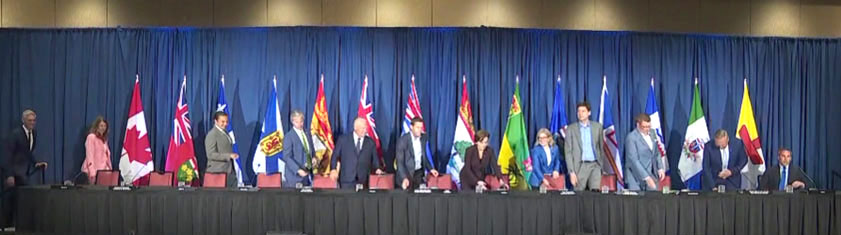
 Canada’s Premiers at their 2026 summer meeting closing press conference, July 22, 2026 in Charlottetown, PEI. [screenshot]

Wednesday July 22, 2026 | CHARLOTTETOWN, PEI [Posted at 3:41 pm PT]
Political news analysis by Mary P Brooke | Island Social Trends
Canada’s Premiers addressed media today at the conclusion of their summer meeting at the Council of the Federation (COF).
This comes still as they intend to meet as First Ministers tomorrow, with Prime Minister Mark Carney.
 Premiers of Canada’s provinces and territories, July 2026. [Council of the Federation]
So only the most basic of positions were sporadically commented on by the premiers until they hear more from the prime minister tomorrow about a national economic strategy or at least the approach to dealing with the current 30-day period of the latest Trump tariff threat).
The topics covered in a media conference with so many leaders at the table depends in large part on the type of questions that the media chooses to ask. Media was asked to adhere to a one-question protocol (so there could be more questions).
The premiers did highlight things like health care that is under-funded, economic drivers that are under threat or need boosting, and regional disparities especially for the north and smaller provinces.

Chair’s remarks:
Over two days the premiers had “a number of productive discussions on a number of issues that matter most to Canadians,” said COF Chair Rob Lantz (premier of PEI). He said that Canadians are looking to their governments for leadership in a time of uncertainty that is ‘the new norm’.
Workers, businesses and families are impacted by decisions made beyond Canadian borders, said Lantz. “The cost of living is rising in every Canadian home. Businesses are looking for certainty. Communities want to know that governments can work together, strengthen our economy, improve health care and build a secure future,” said Lantz.
“One message remained clear — Premiers support a strong and united Canada,” said Lantz.
 Council of the Federation Chair Rob Lantz and press conference Co-Chair Christine Frechette, at COF closing press conference in Charlottetown, PEI on July 22, 2026. [livestream]
Delivering the introductory closing remarks in French, Quebec Premier Christine Fréchette said that collaboration was evident even as each province and territory has their respective interests. “We have been able to demonstrate that we can focus on what brings us together,” said Fréchette [translation].
“So we have had constructive discussions, namely as to how to reinforce economy, how to address internal trade, how we must invest in infrastructure, and also how we need to favour access to the different government services,” said Fréchette [translation].
She highlighted energy and energy security, and the reliability of Canadian electrical grids. Health and health-care were discussed as a priority: “This is one of the points we will highlight with our meeting with the prime minister,” said Fréchette. Health-care requires planning and investment, she added.
 In this municipal election year, get signed up for the Island Social Trends Premium ENews.
CUSMA negotiations:
“It’s in everyone’s best interest in North America for us to come to an agreement in a new and reviewed CUSMA,” said Saskatchewan Premier Scott Moe.
Moe said he’s optimistic of that outcome “but not entirely confident we’ll get there”, implying that he’s realistic about the magnitude of the challenge.
 Summer meeting of Canada’s Premiers on July 22, 2026, shown here (from left): Susan Holt (NB); David Eby (BC), Scott Moe (Sask), and Tony Wakeham (Nfld & Labrador). [livestream]
Ontario Premier Doug Ford commented on the upcoming meeting with Prime Minister Carney tomorrow.
 Ontario Premier Doug Ford at the Council of the Federation press conference on July 22, 2026 in Charlottetown, PEI. [livestream]
“He needs to lead the way and come up with a strong plan over the next 29 days. I’m interested in sitting down with him and hearing the plan. I’ll just speak for Ontario — everything’s on the table. We can’t keep rolling over for Donald Trump. That’s what I believe in. Standing up strong and negotiate through strength. You don’t negotiate through weakness, especially with President Trump,” said Ford.

It would be unlikely that Carney doesn’t realize about negotiating with strength and not backing down. So perhaps there is more to the negotiation scenario at this time than Carney or his negotiating team is revealing. Carney and his team often say they’re not going to negotiate in public.
“There is lots of opportunity for Canada when we work together,” said New Brunswick Premier Susan Holt. She noted that there is a Maritimes energy hub that is connected to Quebec, and to the USA through transmission lines. There is also room for supporting the US market with nuclear, said Holt as part of delivering “affordable, reliable secure energy”.

BC’s tough position:
“We can’t have a country on one hand attacking one group of families and workers while hoping to have access to the resources in Canada that the rest of the world wants,” said BC Premier David Eby. “The United States needs to make up its mind,” said Eby.
 BC Premier David Eby at the Council of the Federation summer meeting in Charlottetown, PEI on July 21, 2026. [livestream]
“I will say frankly, from British Columbia’s perspective, that we support the prime minister making that case at the table. If you want a strong partner, if you want the friendship that’s benefitted North Americans for generations, then let’s have that. And if you don’t want that, we need to be looking to the rest of the world,” said Eby during the July 22 press conference.
“If the prime minister calls British Columbia and says he needs support with some big sticks to have conversations at the table, then we’ll be there,” said Eby. “And I’m happy to stand with the prime minister in that kind of discussion,” said Eby, whose province has been pushing hard with a Look West economic strategy ever since Trump first announced tariffs.
“At the end of the day, the United States needs to decide what they want. Do they want a strong partner in Canada where we work together or are they keen to go it alone,” said Eby. “But there’s not this middle road where you attack British Columbians on one hand and the other hand you’re digging up our metals and minerals and bringing them south of the border,” said BC’s premier today.

Health and economy:
COF Chair Lantz said that the premiers had “a robust discussion about health care in this country and the need for the federal government to come to the table as a strong, stable reliable partner that’s able to fund universal health care, universal access to health care across this entire country”.
The premiers have strong expectations of “the role they expect the federal government to play” in supporting health care as a fundamental aspect of the Canadian way.
“It is fundamental to who we are as Canadians,” said Lantz, highlighting the shortage of access to primary care across the country.
The premiers heard a presentation this morning from the Canadian Federation of Nurses Union about the role of health care in the Canadian economy.
“Healthy people drive healthy economies,” said Nova Scotia Premier Tim Houston. “We can’t jeopardize the standard of care. We need a partner in the federal govt that realizes that,” said Houston.

Not specifically mentioned:
Not specifically mentioned or highlighted to the media by the premiers at this meeting were some hot topics of previous years such as housing, child care, artificial intelligence or Indigenous issues.
Clearly the premiers are aware of these issues, but they didn’t surface to the top of expressed concerns n either media questions or premiers’ answers, given that the latest US tariff threat looms so large.
 It’s a municipal election year in BC — get reliable informative news through professional journalism. Local, provincial and federal news and analysis posted daily at IslandSocialTrends.ca
===== RELATED: