While the GTA market continues to face significant headwinds, the foundations for Toronto’s next generation of communities are already taking shape. Across the region, investment is concentrating around higher-order transit, purpose-built rental housing, and mixed-use neighbourhoods planned with a long-term investment horizon.
In an earlier article, I discussed the rise of the portfolio model—where a growing number of developers have moved beyond considering geothermal one project at a time to incorporating it across their portfolios. While we continue to construct the geothermal infrastructure beneath each building, the technology is being considered more holistically as part of their broader development strategy.
Experience builds confidence. Learnings from successful projects are informing repeatable approaches. Developers are beginning to apply portfolio thinking to entire districts, particularly around higher-order transit where multiple phases, mixed uses and long investment horizons naturally reinforce one another. This evolution of community building anchors several major transit-oriented developments in the GTA supported by Diverso’s geoexchange infrastructure.
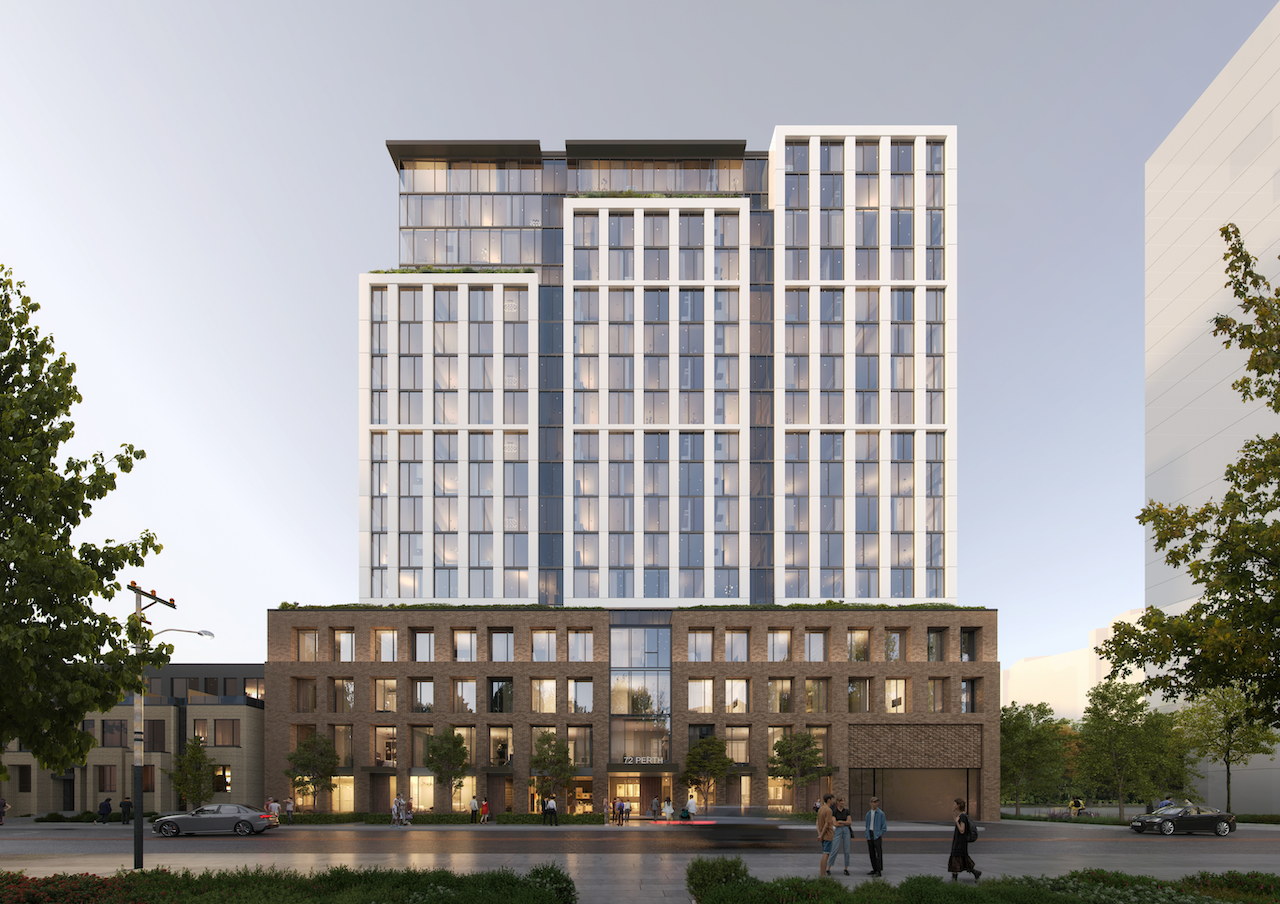
72 Perth Avenue by Castlepoint Numa and Hazelview Investments, a future 18-storey purpose-built rental community in Toronto’s Junction Triangle, image courtesy of Castlepoint Numa
Castlepoint Numa‘s redevelopment at 72 Perth Avenue, adjacent to the Bloor GO and UP Express stations, is transforming a former industrial district into a purpose-built rental community with an affordable housing component. Windmill Development‘s 2444 Eglinton East project across from Kennedy Station demonstrates how housing, transit and long-term community planning are increasingly being considered together. At 50 Wilson Heights, Greenwin, Kingsett Capital, and Tridel are partnering with the City of Toronto and CreateTO to deliver a large mixed-income community immediately adjacent to Wilson Station.
Although each project has its own objectives, they all reflect a broader shift toward planning communities with a longer investment horizon, where infrastructure decisions are evaluated not simply on initial construction costs but on how they contribute to neighbourhood performance over decades.
For institutional owners and purpose-built rental developers in particular, that longer-term perspective naturally extends beyond construction schedules and initial budgets to include the long-term performance of the assets they expect to own and operate for decades. Developers planning multiple buildings within the same neighbourhood naturally begin evaluating infrastructure at the community scale.
Realizing the benefits of community-level planning still requires developers to manage capital across projects that may be delivered over many years. That’s where Diverso’s single-building approach makes the most sense financially and practically. And our zero-cost utility model removes the biggest roadblock to adoption: upfront cost. By offering ownership of the geothermal infrastructure and delivering heating and cooling through a subscription-style utility service, we’ve removed one of the biggest barriers to adoption by eliminating the need for significant upfront capital investment.
A look inside the geothermal drilling operations at 72 Perth by Castlepoint Numa and Hazelview Investments
Geothermal on the ground floor of design and affordability
As Toronto continues to grow around higher-order transit, the conversation about city building is becoming more integrated. Housing, transportation, infrastructure and long-term affordability are no longer separate discussions—they increasingly influence one another. Communities that perform well over time will reflect decisions made early in the planning process, with infrastructure considered alongside architecture, mobility and public realm rather than after them.
Operating costs, maintenance requirements, energy price stability, and building durability all influence the cost of housing throughout its lifecycle. As governments increasingly tie financing and incentive programs to long-term building performance, infrastructure decisions are becoming investment imperatives as much as engineering choices.
This underlines one of the more significant shifts taking place—ownership models are beginning to influence design decisions much earlier in the development process. Developers planning to own and operate buildings for decades naturally evaluate infrastructure differently than those focused solely on project delivery. Energy systems have traditionally been evaluated one build at a time. Increasingly, they’re becoming part of earlier conversations about community planning, lifecycle value and long-term asset performance.
Benji Perry (left), a former oilfield driller now working in geothermal, and Jacob Arseneau (right), one of Diverso’s first hires from Fleming College’s Resources Drilling Technician program, collaborate on site in Toronto
Future-proofing buildings against changing energy markets, evolving regulations, and growing expectations around building performance is now simply part of responsible asset management. Long-term operating costs, maintenance requirements, system reliability, and the ability to adapt to changing building performance standards are built into the design brief from the outset.
This shift is creating new opportunities for infrastructure that delivers value over the life of a building. Geothermal is increasingly being considered through that lens because it supports stable operating costs, integrates well with long-term ownership strategies, and can be applied consistently across multiple developments. As developers gain experience, those lessons can be carried from one project to the next, improving planning and reducing complexity in future developments.
The portfolio model began as a way of thinking differently about geothermal. Today it also provides a framework for building stronger communities. As developers plan the next generation of transit-oriented neighbourhoods, long-term thinking will continue to shape not only individual projects, but the city itself.
By Tim Weber, Co-Founder, Partner, and CEO of Diverso Energy