In the world of feline fancy, few cats turn heads quite like the hairless Sphynx or the floppy-eared Scottish Fold. They are the “it” cats of social media, prized for their alien-like aesthetics and dog-like personalities. However, as of January 1, 2026, the Netherlands has officially called time-out on these “designer” traits, enacting a total ban on the breeding, sale, and even social media promotion of cats with harmful external characteristics.
The Dutch government argues these cats are “born to suffer.” But as a community of animal lovers here in Montreal, it begs the question: should Canada be next?
The reality behind the “fold” and the “fuzz”
The primary driver for the ban isn’t just aesthetics — it’s biology. According to Dr. Stephanie Surveyer of the Clinique Veterinaire Lac St Louis in Lachine, the very traits we find adorable are often synonymous with chronic health struggles.
“For Scottish Folds, husbandry can’t manage their chronic pain,” Dr. Surveyer explains. The genetic mutation that folds their ears is actually osteochondrodysplasia, a defect in cartilage that leads to severe arthritis and joint stiffness throughout the body.
Sphynx cats face different hurdles. Beyond being prone to Hypertrophic cardiomyopathy (HCM) — a genetic heart condition — they lack whiskers. “Whiskers are hugely important to a cat interpreting their environment,” says Dr. Surveyer. Without them, these cats lose a vital sensory world.

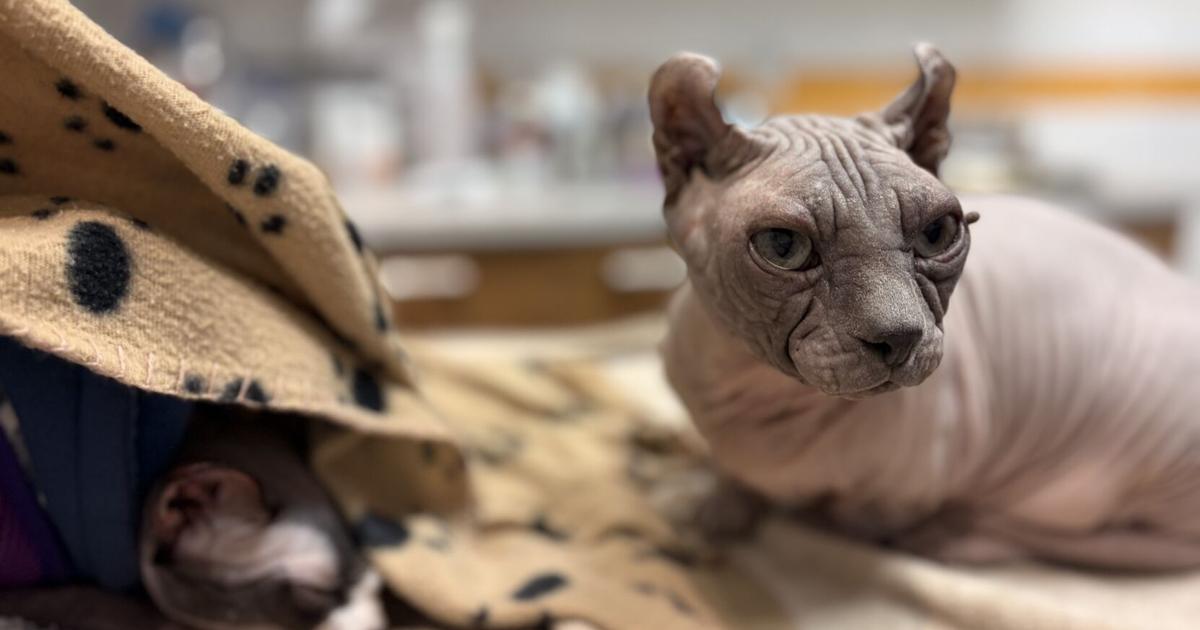
Nudelle (right) and Ray Charles (left) are both Sphynx cats that were abandoned by their owners and ended up in foster care with Pudding’s Palace Rescue. Ray Charles is blind, and Nudelle entered foster care extremely malnourished and sick.
Living with the breed
Local owners are understandably torn. Cara Trombetta, who lived with a Sphynx named Charlie, describes the breed as “intelligent, loyal, and full of life — like having a naked cat-dog in the house.” While she acknowledges the high maintenance — frequent bathing and ear cleaning — she believes the joy they bring outweighs the work. “I do not think these breeds should be banned. They are particular and out of the ordinary, but they are wonderful additions to a family.”
Carole Guindon, owner of Sphynx Rosie, offers a more cautious perspective. Rosie requires daily heart medication and costly specialist appointments. “I don’t think it’s right to breed knowing the health risks,” Carole says. “People should be made aware of the high risks and responsibilities. Too many times we hear of abandoned Sphynx for medical reasons.”
Rosie is a Sphynx cat owned by Vaudreuil resident, Carole Guindon who understands the special needs and health risks of owning the breed.
Photo: Carole Guindon
The rescue perspective
This trend of abandonment is something Anthea Diamandis, founder of Pudding’s Palace Rescue in Pointe-Claire, sees firsthand. She currently has four Sphynx in rescue—a rarity that is becoming more common.
One foster, Rawbert — a mix of Munchkin, Sphynx, and American Curl — recently required surgery for lumps linked to his genetic modifications. “They require a deep wallet when it comes to vet care,” Anthea warns. She suggests that those set on a specific breed look to specialized rescues like Chatopia or Pudding’s Palace rather than Facebook ads.
Sphynx cats, like Nudelle, cannot self-regulate their body temperature, so sweaters aren’t just a fashion accessory, they are a necessity in the colder months.
Is Canada ready?
While the Dutch ban is a landmark for animal welfare, Dr. Surveyer notes that Canada is still catching up on the basics. “Our biggest province still hasn’t banned declawing,” she points out. “I think it will be a ways to go before any official legislation like that comes here.”
Whether we move toward a full ban or stricter breeding regulations, the message from local experts and owners is clear: research is non-negotiable. If we prioritize “cute” over “quality of life,” the cats are the ones who pay the price.