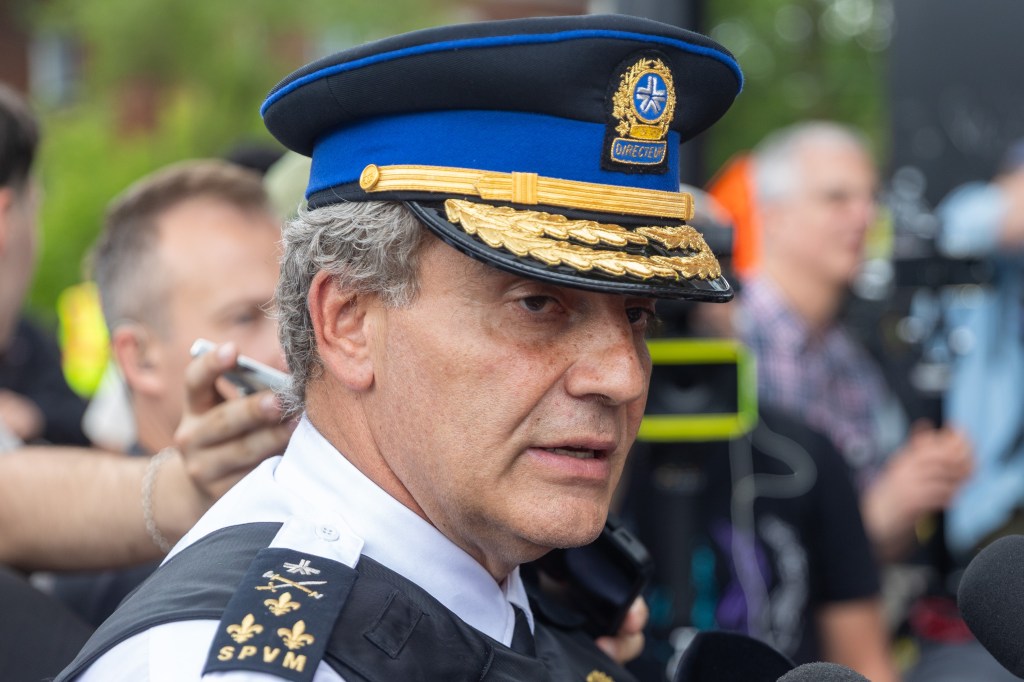
All eyes will be on Montreal Police Chief Fady Dagher on Tuesday evening when he offers a long-awaited update on the explosive allegations of racist abuse that rocked the force back in June.
Dagher and his team are scheduled to answer questions from citizens as well as members of the city’s public security commission at city hall for the first time since the bomb dropped that two officers had been suspended and 14 others reassigned from Station 39 in Montreal North amid reports of what Dagher called “unacceptable behaviour.”
The allegations that members of a patrol group of mainly young male officers were singling out Black and Arab men on their territory and may have taken locks of their hair as trophies sent shock waves through the city, sparked outrage among political leaders and the population alike, reignited concerns about discrimination by law enforcement, and dealt a blow to public trust in the Service de police de la Ville de Montréal.
It was a moment of crisis for a department that had been trying to undertake a culture change to address painful episodes in its past.
But only 10 days after the turmoil came to light, the SPVM was struck by tragedy.
A shootout in Côte-des-Neiges left a cop and a bystander dead. The department was plunged into mourning for Mohamed Lamine Benredouane, the first Montreal police officer killed in the line of duty in 24 years.
That very day, Dagher had been due to meet elected officials behind closed doors, but instead the chief had to deal with the fallout from the shooting.
A public question-and-answer session set for July 8 was understandably postponed to give the SPVM some breathing room after Benredouane’s public funeral a day earlier.
But it’s now time for that deferred reckoning to take place.
A month has elapsed since, allowing the dust to settle and flared tempers to ebb. If anything, the SPVM owes Montrealers even more transparency and openness given the public’s patience and forbearance while the department dealt with its grief.
Tuesday’s meeting will be a crucial test of what actions need to be taken next.
The SPVM must first and foremost provide a progress report on the status of the internal investigation that began in March and led to the removal of the 16 officers from active duty.
But concerns about discrimination by police go well beyond one group of officers in one neighbourhood.
Dagher set up a tip line when he first disclosed the racist misconduct alleged in Montreal North. The public deserves to know if any more allegations or incidents have been reported at Station 39 or any other detachment, and what is being done in response.
And the elephant in the room is whether the SPVM plans to continue its controversial practice of random street checks.
For years, the police force has been warned these interceptions give rise to racial profiling against Montrealers of diverse backgrounds.
It took a long time before the department even acknowledged the problem, let alone started to confront it.
Two studies in 2019 and 2023 confirmed earlier suspicions Montreal police disproportionately stop people who are Black, Arab, Latino and Indigenous.
Former chief Sylvain Caron tried to make the rank and file cognizant of these findings, develop more rigorous protocols and track interceptions.
Current chief Dagher was brought in to build bridges with minority communities in Montreal and apply his lauded approach to less confrontational policing from his time heading the Longueuil force. But he, too, has refused to outright bar random street stops.
Montreal also appealed a 2024 court ruling that found the city liable for the harm caused by this policing strategy, even while the previous administration expressed sympathy for people who had been targeted and promised compensation.
Editor’s Picks
But since the news broke about the racial abuse alleged in Montreal North, Mayor Soraya Martinez Ferrada has suggested it may be time for a moratorium on these random stops. She also revealed witnessing racial profiling up close when her husband, who is Black, was pulled over for a spot check while they were driving.
Abandoning this policy, or at least launching a pilot project to gauge how policing activities are affected without it, would be a good first step in efforts to re-establish trust in the wake of the Montreal North scandal.
Some community groups, citizens and lawyers have called for a public inquiry, saying it’s the only way to get to the bottom of the latest allegations of abuse as well as more widespread concerns about discrimination.
Quebec Premier Christine Fréchette has not closed the door.
The option should remain on the table until there is a full accounting of what transpired at Station 39, what consequences were meted out to those involved, and what measures the force is taking to ensure nothing like this happens again.
But Montrealers may not get answers to all of their pressing questions Tuesday.
Quebec Domestic Security Minister Ian Lafrenière appointed an outside independent observer to scrutinize the internal probe.
There are parallel investigations by Quebec’s police ethics commissioner, to see what if any disciplinary action may be justified, and the provincial prosecutor’s service, examining whether criminal charges are warranted in Montreal North.
It would be useful and reassuring to get a status report on these processes as soon as possible.
But after a delay of over a month, Tuesday will be a moment of truth for the SPVM — one way or the other.

I started at The Montreal Gazette in 2000 as an intern. Since then I have covered the National Assembly and courts, worked on the assignment desk and written editorials, before debuting as city columnist in 2017.
ahanes@postmedia.com