Get the best of Vancouver in your inbox, every Tuesday and Thursday. Sign up for our free newsletter.
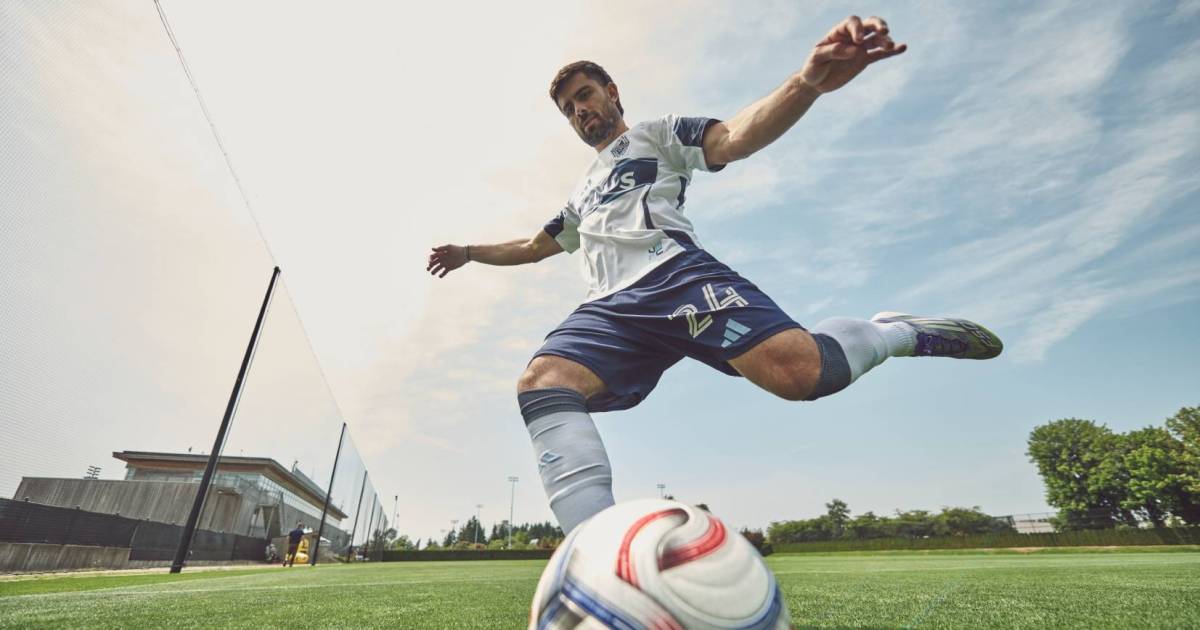
Brian White was living his dream.
The American forward was starring for Major League Soccer’s New York Red Bulls after having grown up in New Jersey. He navigated his way through the Red Bulls’ system and was drafted by the team in the first round of the 2018 MLS SuperDraft.
During the 2020 season, White scored a team-high six goals for the Red Bulls and was named the club’s offensive player of the year.
But after starting the 2021 season off with no goals in his first five games, White was traded to the Whitecaps for a $400,000 fee that included an extra $100,000 in performance bonuses.
He came to a Whitecaps side that was reeling. The club was 2-4-1 on the season when White came over and was actually located in Utah as a result of COVID-19 protocols.
“It was kind of a shock,” White tells the Straight at the team’s UBC practice field. “I was supposed to play the next day, and then my agent called me and told me I was getting traded. It was difficult because it was across the country and then in a new country [later on in the season when the team went back to Vancouver], and my then-girlfriend-now-fiancée was still in New Jersey.”
Other coveted things were also in the States.
“You don’t have pizza or bagels here,” he says with a matter-of-fact grin. “The pizza is okay. They try. It’s not the same, though.”
At the time, the Whitecaps already had a striker in White’s natural position in Lucas Cavallini. Following a slow start from White, the team’s sporting director Axel Schuster was doubted for making the move.
“After four or six weeks people said, ‘What have you done? This guy can’t play, another bad signing by the Whitecaps,’ ” Schuster recalls. “There were a lot of comments that were really negative. But we thought that there was more to him than what he had shown at that point in the MLS. We had a strong belief that he had certain qualities that are hard to teach and that there were a lot of other things that he needed to learn. But we believed that he was a hardworking guy who could learn and work on his game.”
In August of 2021, around the time that the team came back to BC Place, Cavallini went down with an injured knee. White took the opportunity and ran with it, scoring 12 goals in 27 games. The ’Caps emerged from the bottom of the standings to make the playoffs, with White scoring some key markers down the stretch.
There have been a number of changes since then, including two seemingly contradictory truths that soccer is exploding in Vancouver at the same time that the future of the Whitecaps is very up in the air.
THE TEAM AT the time, according to White, wasn’t the most “cohesive group”. It has evolved since then, as White and captain Ryan Gauld—who arrived shortly after him—and other additions by Schuster, including German star Thomas Müller, have created a different atmosphere around the club.
“We’ve had a group of a lot of the same guys for almost five years now,” White says. “So I think there’s a culture that we’ve put in place. I think everyone who comes in really enjoys being part of this locker room. People who’ve left have commented about how much they love this locker room.”
On the field, the team has had a well-documented run of success, spurred in large part by White, who has scored 56 goals over the last four seasons and has become the Whitecaps’ all-time leading MLS goal scorer. Last year, he became the first ’Cap to score a goal in the MLS All-Star Game.
It took about two years for New York Red Bulls fans to start regretting the move, with White popping up constantly on lists ranking the worst transactions in team history.
Even then, among the sporting stars in the city, White’s name has had nary a mention. The average Vancouverite could likely rattle off depth players on the Canucks before naming White, who only has two fewer MLS goals this season than global superstar Lionel Messi.
White was also a close call for the U.S. team at the World Cup, as he’d earned a spot in years past for different tournaments. Unfortunately, he just missed the cut. He watched as then-Whitecaps teammate Sebastian Berhalter played an important role for the team. Still, one wonders if an American team that lost 4-1 to Belgium in the Round of 16 could have used one of its top league’s most prolific goal scorers.
“In a sense, it was disappointing,” White says. “I always kind of knew I was on the outside looking in and that it was going to be really tough to push one of the [American team’s strikers] out. I think I did everything I could to try and make a name for myself and make the decision harder.”
Adam Blasberg
WHITE IS PERHAPS similar in some ways to his team—an exceptional performer that doesn’t always get recognition. Last year, after hiring Danish coach Jesper Sørensen, the Whitecaps racked up the honours. The team won a fourth consecutive Voyageurs Cup, which is given annually to the top Canadian club; faced off in the MLS Cup championship match against Messi and Inter Miami; and made the final of the CONCACAF Champions Cup. The latter two had never happened in club history. This year, the ’Caps are once again at the top of the Western Conference.
And yet, the Whitecaps are either second or third in terms of sporting fandoms in the city, depending on how the CFL’s BC Lions are performing. As far as summer tickets go, Vancouver Canadians games at Nat Bailey Stadium are more alluring for many than the ’Caps.
The Whitecaps’ base is passionate, though. The crowds have been mostly solid—the team is in the top 10 in MLS this year in terms of average attendance, with around 24,000 people typically passing through BC Place’s gates. That’s about a 2,000-person bump from last year, with some of that due to the growing #SavetheCaps movement as relocation rumours surround the franchise.
Time and again, Schuster has performed wonders in the transfer and acquisition market, bringing in players like White, Berhalter, midfielder Pedro Vite, and defender Tristan Blackmon.
But the reality of MLS is that, other than serving as a nice landing spot for select stars in their twilight years, it’s still mostly a feeder league for when other, high–profile teams get hungry.
Berhalter was recently sold to English club Middlesbrough F.C. for US $2 million a few years after Schuster picked him up for $50,000 from MLS side the Columbus Crew. Vite, who played for Colombia at the World Cup, left last year for the Mexican squad Pumas in a deal that was reported to net the ’Caps a fee in the neighbourhood of US $6 million. Ali Ahmed, who started for Canada at the World Cup, came up in the Whitecaps system before being transferred to Norwich City in the U.K. for what was reportedly over US $1 million.
Bobby Lenarduzzi knows it can be tough to watch players succeed here and leave. Especially those who are conditioned by watching the Big Four North American sports leagues of basketball, baseball, American football, and hockey.
“If you understand the background, you understand that most leagues in the world are developing leagues,” says Lenarduzzi, the Whitecaps’ club liaison, who has been in one role or another with the team and its predecessors since he joined as a player in 1974.
“There are only a handful of clubs in the world that are not developing clubs. You’re just not going to please everyone all the time. In the case of someone like Berhalter, yeah, fans might be upset. But they’d be upset if he moved at the end of the year when his contract runs out, so at least we got something for him. I understand it, and I’m sympathetic to it, but it’s the real world of football.”
AS MANY VANCOUVERITES will know, relocation rumours have swirled around the Whitecaps ever since its ownership group, led by Greg Kerfoot, put the team up for sale in December 2024 amidst reports that the team had been losing money consistently, due in part to its deal with BC Place.
A Las Vegas buyer submitted a bid to MLS to buy the Whitecaps and move the team to Sin City in April, according to The Athletic. Since then, government officials at all levels, MLS staff, and even FIFA brass have been working to find a solution.
“It’s been the heart and soul of this community for decades, and it’s really part of the fibre of the city,” CONCACAF president and FIFA Council Vice president Victor Montagliani, who was born and raised in Vancouver, told TSN in June.
A recent game against Los Angeles FC marked the return of the ’Caps to BC Place after the World Cup. It brought in a reported 40,086 fans. Is that the World Cup bump? Will we see a surge in a fanbase that was ignited by the world visiting?
“There’s not one game changer, but I think over the long term, the tournament will help,” Schuster says. “I think there were a lot of people who watched soccer or attended a soccer game in our city for the first time in their life—a lot of people who, for the first time, really felt the vibe of soccer. They were impressed by the crowds: the Colombians, Turks, Belgians, and Egyptians who came here. There is a lot of space to grow here in North America.”
Even if a major bump does happen, it will likely take both a deep-pocketed ownership group and shovels in the ground on a new stadium to keep the team here for the long haul.
“I feel like the same year that you host a World Cup and you’re being acknowledged as a great soccer city, the irony that the team could potentially be gone is like—it can’t be,” says Lenarduzzi, not hiding the desperation in his voice. “I’m keeping my fingers, toes, and everything else crossed to ensure that we can stay here for another 50-plus years.”
Is he optimistic, though?
“It’s been a long time since the club went up for sale,” he says, noting the reality that, in an ideal scenario, it would have been sold long ago to a local person or group. “But I think the best thing that happened ironically was the announcement that Vegas was ready to go. It brought the stakeholders together. Not just the city and the province, but the business community and Canada Soccer. Having the club here impacts a number of different aspects of our game and our city, including our development programs.”
The team will probably have to continue being successful to be an attractive purchase, even as players make an impact here and then leave. Schuster knows that he has his hands full with that obligation.
“I always tell people that everyone can make decisions in this organization, and if something goes wrong, I will take the responsibility for that,” Schuster says. “You have to go out and try something. If you think it’s the right thing, then you have to buy Brian White for $400,000 even though everyone criticizes you. And not everything will be right. But you will not go forward if you’re only playing it safe.”
Meanwhile, White is simply hoping to continue scoring goals in Vancouver. His fiancée moved here a couple of years ago, and the couple have put down roots.
“It’s a really cool city,” he says. “It has a big feel, but I wouldn’t call it a big city. It’s quiet—you can walk everywhere. It’s a fun place to live.”
He’s even starting to get recognized a bit.
“That’s a testament to how well the team’s doing and how much the city’s gotten behind us as a group, and it’s been really fun to interact with people on the street, see them take pictures, those kind of interactions help people feel more connected to the team, help them come out to more games,” he says.
“You see some of the same people around—I think it’s great to have that connection with the community.”
Maybe one of those fans can provide him with some pizza and bagels.