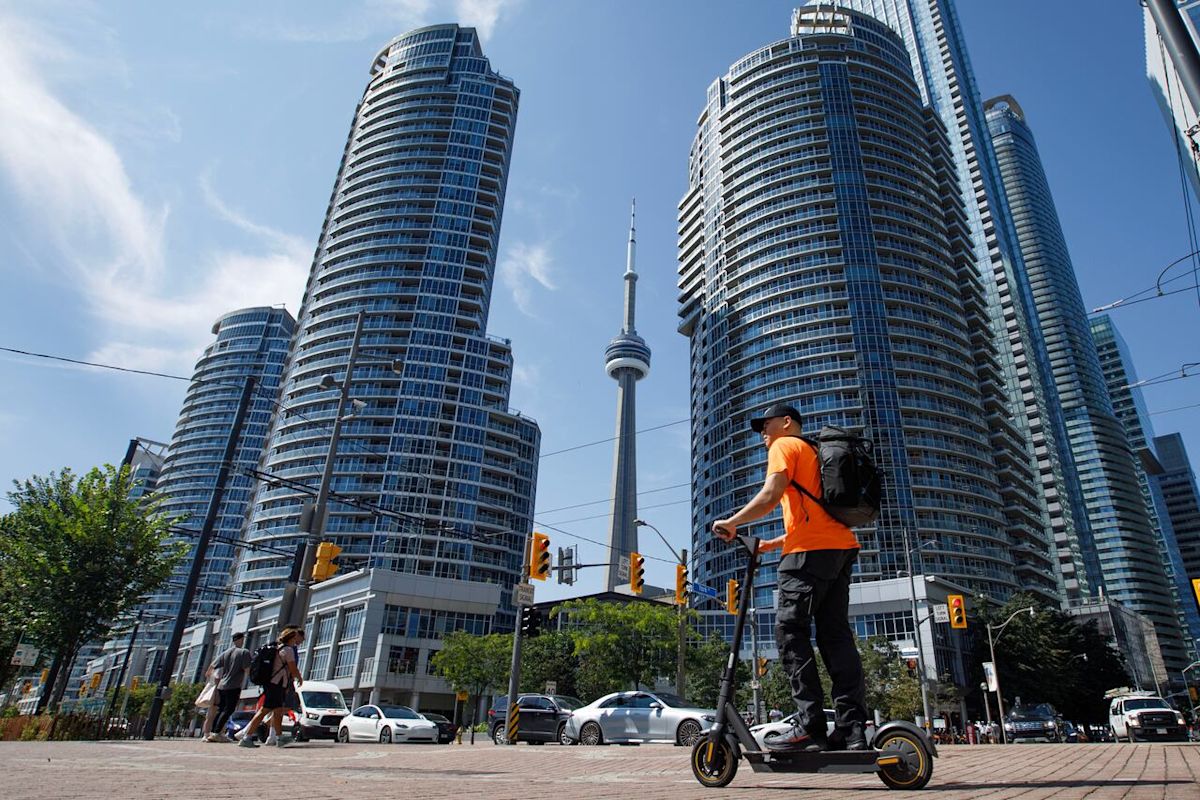
Toronto police launched a two-week micromobility traffic enforcement campaign Monday ahead of the back-to-school season, in the hope of increasing awareness of the regulation around e-bikes, e-scooters and other such vehicles.
In a news release Monday, the Toronto Police Service said more and more people are using micromobility devices, which include bicycles, e-bikes, cargo bikes, mopeds and e-scooters.
“Safety is a shared responsibility,” the police force said. “Whether driving, cycling, riding an e-bike, using another micromobility device, or walking, making safe and lawful choices helps protect everyone on Toronto’s roads.”
Officers will be providing information to road users on things like illegal sidewalk riding, wrong way riding in cycle tracks, illegal e-moped use in cycle tracks and illegal parking in bike lanes.
The campaign, which will run until Aug. 24, aims to encourage safe and lawful road use and to reduce the number of collisions involving “vulnerable road users,” police said.
There have been 514 collisions involving micromobility devices in Toronto so far this year, including two fatal crashes involving e-scooters, according to police.

Police will be enforcing the rules on roadways, bike lanes, cycle tracks, sidewalks and crosswalks. (Alex Lupul/CBC)
Sgt. Murray Campbell says illegal parking can increase the risk of collisions.
“When they’re parking in a manner that impedes the flow of bicycles, pedestrians and other cars, it causes people to change their behavior,” he said.
Police will be enforcing the rules on roadways, bike lanes, cycle tracks, sidewalks and crosswalks.
Police are reminding the public that while it’s not illegal to buy or own an e-scooter in the city, it is not permitted to ride them on public roads, sidewalks, bike lanes, cycle tracks or trails.
Campbell says the city’s website has a list of places where it is acceptable to use micromobility devices.
“Where you can ride these devices in the city of Toronto can be sometimes very confusing,” he told CBC Toronto Monday. “Those parameters were set to make it safe for everybody.”
Toronto police have previously introduced similar campaigns, including one last summer and an initiative in November 2024.
David Shellnutt, a personal injury lawyer and managing partner at The Biking Lawyer LLP, says ticketing isn’t going to solve the issue.
“Motorists, cyclists, e-scooter riders, pedestrians, we’re all trying to use the same finite space and get along without conflict. But that just sometimes is impossible,” he said. “That’s why we see year over year the same issues coming up.”
Shellnutt says education is the way to go, which is why he has already been running educational workshops for the e-bike food delivery riders, in partnership with Cycle Toronto.
“This is a hot issue,” he told CBC Toronto. “We’re trying to send the message that enforcement maybe works at an individual level, but to create this sort of societal long-term change, we need to focus hard on education.”