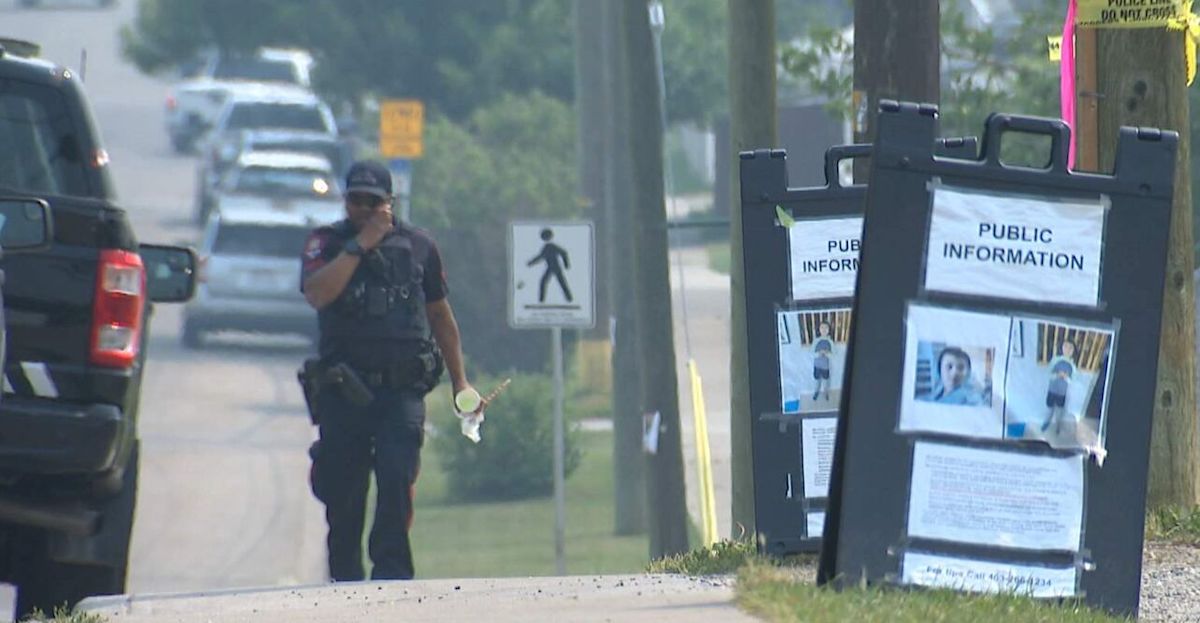
Beverly Fullerton closely followed the search for 11-year-old Parker, a boy with autism who left his specialized day facility in Calgary and disappeared last month.
Police and volunteers looked high and low for the boy, who was non-verbal, for nearly two weeks before he was confirmed dead.
“It really broke my heart,” Fullerton said.
Her eight-year-old son, Weston, is also autistic and non-verbal. He loves nature and exploring, and she doesn’t know if he would be able to ask for help if he wandered off and got lost.
As the Métis Nation–Saskatchewan’s minister of health, mental health and addiction, Fullerton is calling on the provincial government to create an Indigo Alert system. She’s one of several advocates who say a separate system would help protect vulnerable people who go missing but are not abducted.
“Walking away from a day home, walking away from a park … it could happen at any time, anywhere,” Fullerton said. “Having an added protection is what we’re advocating for.”
LISTEN | Amber versus Indigo Alerts:
What is an Indigo Alert?
In Saskatchewan, an Amber Alert can only be issued when a youth, child or person with a significant disability has been kidnapped.
Because foul play must be suspected, notices aren’t sent out when a vulnerable person, like a child with autism or a senior with dementia, just disappears, Fullerton said.
An Indigo Alert or an expansion of the province’s SaskAlert system would fill that gap by sending notifications to phones with the person’s description and last known location so searches can begin, she said.

(Submitted by Beverly Fullerton)
The MN–S sent a letter to the province last week asking to discuss the matter, and Fullerton said she’s joined Indigo Alert Canada to call for the change.
Why is it necessary?
As it stands, when a vulnerable person goes missing but isn’t kidnapped, loved ones and officials can only rely on social media and word of mouth to enlist help, according to Aly Rapinchuk, a Saskatchewan representative of the advocacy group Indigo Alert Canada.
An alert could help, said Rapinchuk, whose six-year-old daughter has autism and tends to run away.
“It’s still very heartbreaking, especially knowing that these tragedies can happen every day and sometimes these kids don’t get found in time,” she said.
LISTEN | When information spreads online:
Abby Firlotte, another Saskatchewan representative with the organization, said she believes Parker would still be alive in Calgary if an Indigo Alert system was in place — and that it could have helped with cases of other missing children in Saskatchewan and nationwide.
“Why are we not protecting the most vulnerable in our community?” she asked.
Canada-wide call
Since Parker’s death, Alberta has promised to review its emergency alert system. Federal Conservative Leader Pierre Poilievre has also called for nationwide reforms to emergency alerts, so they are issued for missing children even when there’s no evidence of foul play.
Saskatchewan Public Safety Agency spokesman Brody Ratcliffe said the province is open to the idea of a new alert.
“In previous years, Saskatchewan has joined with other provinces and territories in asking national governing bodies to explore options for alerting when a vulnerable person faces a significant risk but does not meet the criteria for an existing category,” Ratcliffe wrote in an email statement to CBC News.
Since the province operates within national alerting programs, any new system would have to be considered and coordinated alongside those bodies, he added.
Fullerton said she hopes the change is prioritized.
“Every human life matters,” she said. “To stall this any longer, we’re just putting more of our folks at risk.”