Vancouver Mayor Ken Sim’s push for plebiscite questions in the upcoming municipal election on public drug use and adding involuntary care beds has been condemned by opponents as an election ploy.
Sim said Thursday he wants voters to weigh in on strengthening the city’s laws on “open-air hard drug use,” and pushing the province for more involuntary care treatment at a soon-to-be-closed hospital site, through a plebiscite in the upcoming municipal election.
The mayor told a news conference — attended by councillors from his majority ABC Vancouver slate — that he will convene an emergency council meeting on Friday in order to add the questions to the ballot for Vancouver voters on Oct. 17.
He argued that asking voters to weigh in on the issues in an official capacity would give the next municipal government a stronger mandate to address drug use in the city.

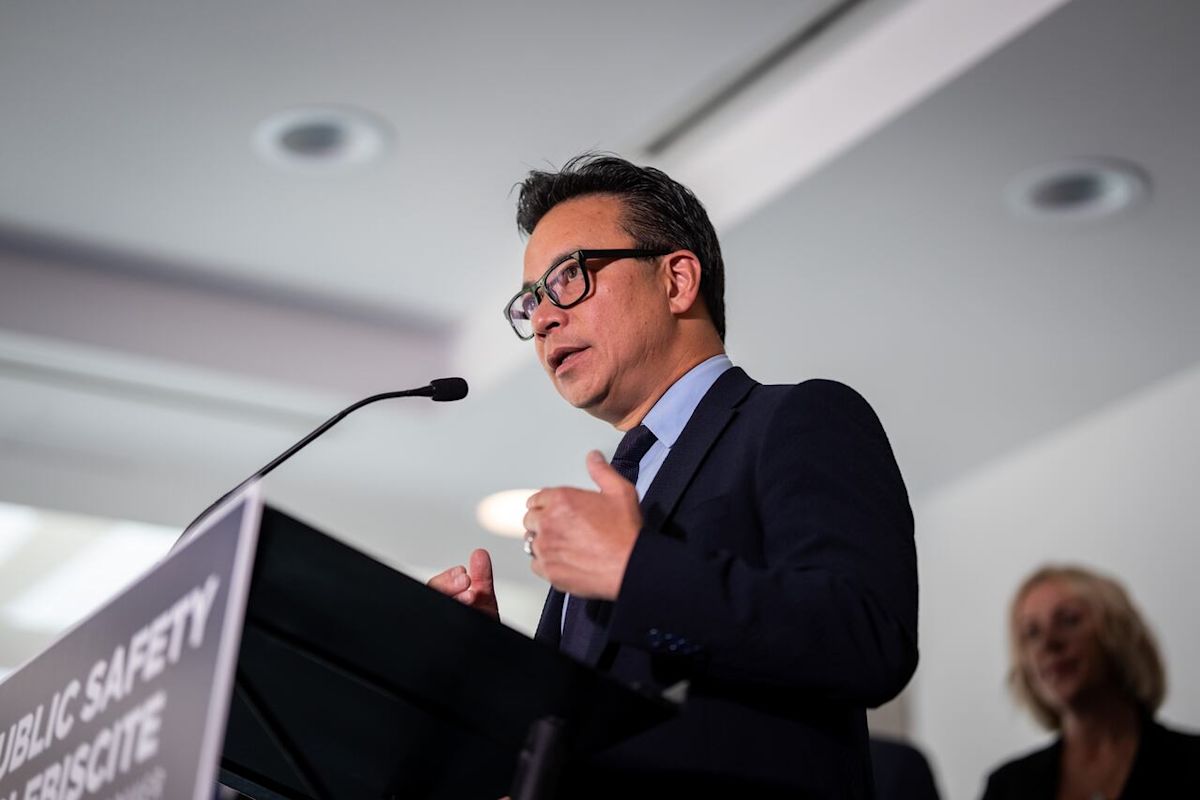
Ken Sim’s proposal — which will have to be passed by city council — would see two plebiscite questions added to the ballot on Oct. 17. (Gian-Paolo Mendoza/CBC)
However, in response to a question from CBC News, Sim did not specify which bylaws in particular would be strengthened if voters approve the proposed plebiscite question.
“The plebiscite is just another, you know, step in pivoting and making sure we’re … doing things that will actually make this place better,” he told reporters.
“When it comes to specific laws so, you know, we can take a look and make it a little clearer. And you know, we’ll get back to you on that one.”
Possession of small amounts of illicit drugs is already illegal in Canada, and Vancouver city bylaws prohibit smoking in public parks, beaches and a number of other areas.
Involuntary care at St. Paul’s
Sim and ABC were elected four years ago on a platform of increasing public safety in the city. The mayor has previously criticized the province for how it deals with social housing and overdose prevention services in the city.
During his tenure, Sim saw a motion passed that would freeze the construction of net-new supportive housing in the city, arguing that Vancouver is responsible for a disproportionate share of social housing units in the region.
In addition to the question on strengthening drug-use laws, Sim’s second proposed plebiscite question would be that the city push the province to convert portions of the St. Paul’s Hospital site in downtown Vancouver into a “secure medical facility that provides acute voluntary and 100-plus involuntary care beds.”
St. Paul’s Hospital is set to relocate from its current site on Burrard Street to a new site in the False Creek Flats next year.

The St. Paul’s Hospital site in downtown Vancouver, seen here in 2018, will be closed next year. (Tina Lovgreen/CBC)
In response to a question from CBC News on why it was so important to locate the involuntary care beds within the city — as opposed to within the wider region — Sim said that Vancouver had an acute need for involuntary treatment facilities.
“When you’re closer to your community, when you’re closer to loved ones, guess what? The chances of you having better or improved outcomes go up significantly,” he said.
Questions lack details, opponents argue
Vancouver Liberals mayoral candidate Kareem Allam — who was formerly Sim’s chief of staff — said the proposed second plebiscite question showed Sim has “flip-flopped” on the issue of whether social services should be located in Vancouver or not.
“Everything that Ken Sim has done on these issues has pulled Vancouver back and has not moved anything forward,” he said. “And I see this as nothing more than a cheap political distraction.”
City council, which was on summer break, will have to approve Sim’s proposed plebiscite questions at the Friday emergency meeting.
Coun. Pete Fry — who is also running for mayor with the Green Party of Vancouver — said the proposal to use the St. Paul’s Hospital site lacked details.
The site was bought by developer Concord Pacific for nearly $1 billion in 2020, and its future plans have not been fully revealed.
“The mechanics of this plebiscite are to create a wedge issue, are to drive voters to the polls. It’s a cynical election move,” Fry said.