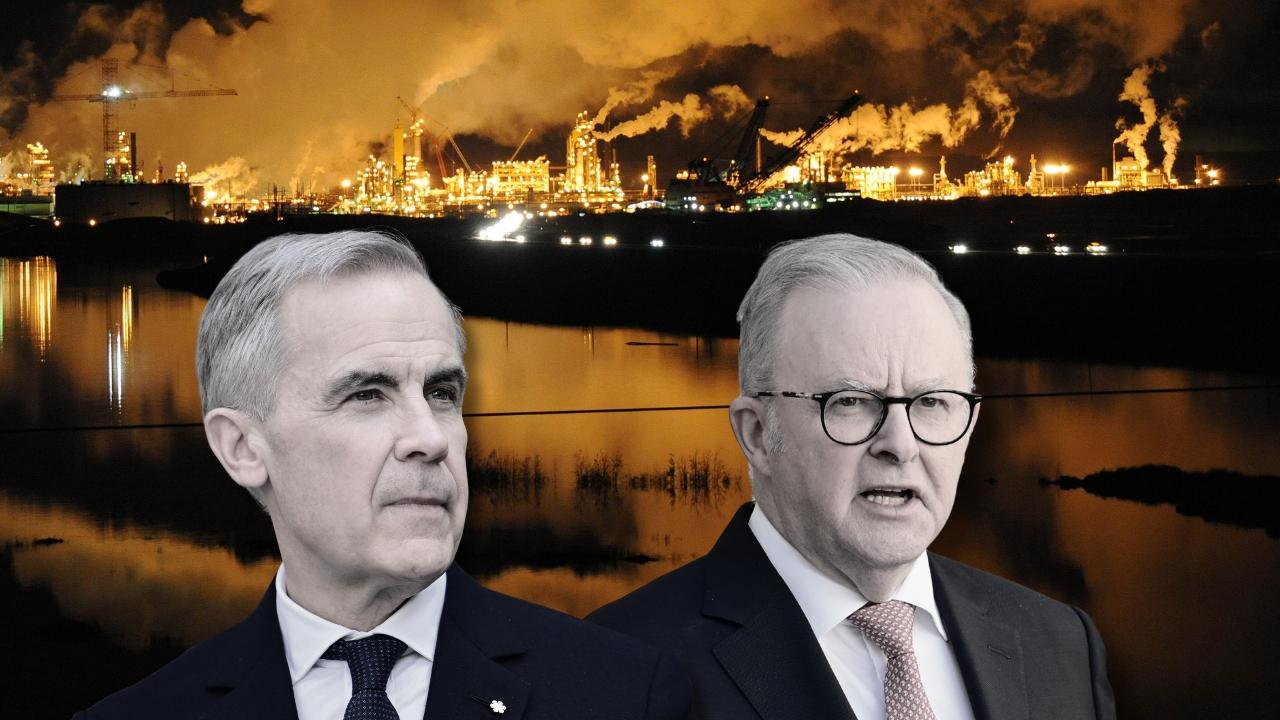
Unfortunately for both, the similarities don’t end there. Both have entered a period of largely self-inflicted, steady economic decline underpinned by mass immigration and a damaging obsession with phasing out cheap reliable power even as support for net zero fades globally.
For years Australia and Canada have vied for the most rapid population growth in the developed world, driven mostly by immigration from South and East Asia. For all the attention paid to the southern US border, US population growth hasn’t come anywhere near the 1.5 per cent growth a year Australians and Canadians have come to expect (and increasingly resent).
Australia and Canada both remain net-zero champions, legislating to at least halve greenhouse gas emissions on 2005 levels by 2035, whatever the cost.
Ottawa’s hiring spree has put even Canberra’s to shame, lifting the federal bureaucracy twice as fast or by about 950,000 between 2015 and 2024, according to Vancouver public policy think tank the Fraser Institute.
“The rest of the world should pay attention to Canada (because) it’s not failing spectacularly; it is failing gradually, systematically,” journalist Patrick Boyle noted in his On Finance podcast in April. “The same patterns are visible in countries across the developed world; Canada just got there first.”
Canada offers a preview of our own decline and a guide to how Australian governments are likely to respond. Its economic performance has battered social cohesion. Indeed, a judge in Alberta, the country’s richest and most conservative province, quashed a 300,000-signature petition to secede, reflecting growing animosity among Canada’s 10 provinces.
While Australia’s decline has been sudden – GDP per capita has contracted in 10 of the past 15 quarters – Canada’s slump has been chronic, deep and more embarrassing given the relative prosperity of its southern neighbour, the US.
In 2012 the median Canadian household income, buoyed by a global commodity boom, even may have exceeded that of the US but the decline since has been brutal. Canadian GDP per capita has slipped to about the level of Alabama, one of the poorest US states.
The gap between US and Canadian GDP per capita, a common shorthand for living standards, has never been greater. Canadians have been voting with their feet: net emigration exceeded 65,300 in the 12 months to June 2025, the highest level in 50 years according to data kept by Statistics Canada. The number of Canadians moving to the US, which has more than eight times the population, has long exceeded the reverse flow.
According to the International Monetary Fund’s 2025 World Economic Outlook, real GDP per capita growth in Canada across the decade to 2025 was barely positive at about 0.3 per cent, compared with roughly 18 per cent in the US and about 7 per cent in Australia. “We’re not keeping pace, and we should, there’s no excuse for it because we did up until about 10 years ago,” Canadian historian and former media baron Conrad Black said recently in an interview, noting that once much poorer nations such as Israel and South Korea had almost closed the gap with Canada entirely.
Between 2015 and 2024, more than $C1 trillion of investment exited Canada – the largest capital exodus in Canadian history. For every dollar of inward foreign direct investment, two dollars left, according to recent analysis by Royal Bank of Canada.
In 2024, Bank of Canada senior deputy governor Carolyn Rogers declared a “productivity emergency” following a roughly 26 per cent decline relative to that of the US since the 1990s.
Now, for every dollar of output produced by an American worker in an hour, a Canadian worker produces roughly 74c. Canada has fallen from sixth to 25th on the World Happiness Index, while Canadians under age 25 ranked 71st. Only Afghanistan, Lebanon and Malawi have experienced a steeper decline since 2011.
As in Australia, much of Canada’s economy is built around protected incumbents. Telecommunications, for instance, is dominated by three firms – Bell, Rogers and Telus – which combined have almost 90 per cent of the market, leaving Canadians paying among the highest mobile phone bills in the world, or about double the cost in Britain or France.
Canada’s predicament is all the more shocking given it, like Australia, should be an economic superpower. It has the second largest territory in the world, the third largest proven oil reserves, the fifth largest natural gas reserves, an abundance of uranium, potash, rare earth minerals and fresh water. It has a highly educated population, a stable democracy and G7 membership to boot. Also like Australia, much of Canada’s waning competitiveness stems from policies that throttle its natural comparative advantage in energy, with emissions targets that will make no difference to the global climate.
In late 2017 the Trudeau government cancelled a 4600km pipeline known as East Energy that would have carried millions of barrels of oil from Alberta to New Brunswick, even though the St John terminal had already received substantial upgrades to accommodate supertankers. While crude oil remains by far the nation’s biggest export earner, Ottawa deliberately quashed an opportunity to reach new European and Atlantic markets.
“We’ve told 12 to 14 of our best trading partners, get lost, go somewhere else and get your oil and gas,” former Liberal MP and Canadians for Affordable Energy founder Dan McTeague said in April.
There is one crucial difference from Australia, however: Canada appears to be waking up to its folly and changing course, ironically under the centre-left stewardship of climate change evangelist Mark Carney. Carney, who succeeded Justin Trudeau as prime minister in March last year, has slashed immigration and green-lit fossil fuel projects amid a stark collapse in dwelling prices that should give Australian policymakers pause.
Since British Columbia introduced a carbon tax in 2008, Canada has built a carbon-pricing architecture that’s arguably even more complicated than Australia’s. Alberta introduced large-emitter carbon pricing in 2007, Ottawa imposed a federal carbon tax and industrial Output-Based Pricing System in 2019, while federal Clean Fuel Regulations began in 2023 alongside various provincial cap-and-trade and low-carbon fuel schemes.
The result, unsurprisingly, has been higher transport, manufacturing and energy costs precisely as Canada’s productivity, investment and living standards weakened. As with Australia’s byzantine mess of net-zero policies, this virtue signalling has come at an enormous cost.
Australian economist Frank Milne of Queen’s University, Kingston, Ontario, has highlighted how that province’s heavily subsidised wind farms have proved “largely a waste” of resources, costing almost $US860m ($1.2bn) a year for benefits below $US110m. Canadians now pay among the highest petrol prices in the developed world. Absurdly, Canada has begun importing liquefied natural gas from Queensland, almost 26,000km away, despite sitting atop massive reserves of its own.
‘(Carney) spent 10 years basically as the Al Gore of the finance world. And now that he’s Prime Minister of an oil-exporting country, he doesn’t want to talk about that any more’ — Ross McKitrick University of Guelph economics professor
The stark economic regression at least has prompted some major policy reversals. Since the middle of last year something remarkable – and nearly unthinkable in Australia – has happened in Canada: its population of roughly 41.5 million has shrunk for three consecutive quarters in a row, the biggest decline since the 1940s.
All up, the population has fallen by more than 230,000 people across nine months while ours continues its vertiginous ascent at well more than 100,000 every three months.
“We are taking back control over the immigration system and putting Canada on a trajectory to bring immigration back to sustainable levels,” the Ottawa government said in November last year as it promised to cut the temporary population share to below 5 per cent by the end of 2027 – about half Australia’s level.
Indeed, the number of non-permanent residents living in Canada has plunged 17 per cent in just 12 months to 2.56 million in June this year, including a 33 per cent collapse in student visa holders.
Carney’s about-face on energy policy has been less drastic in absolute terms but stark given his climate change evangelism as Bank of England governor.
Indeed, the one-time founder of the Glasgow Financial Alliance for Net Zero and former UN special envoy on climate change finance cut the nation’s federal consumer carbon tax to zero dollars as soon as he won office, which had been adding roughly 18c per litre to fuel prices, according to the Bank of Canada. Carney’s 2021 book Value(s): Building a Better World for All argued “more than 80 per cent of current fossil fuel reserves would need to stay in the ground, stranding these assets” to cap global temperature increase to 1.5C.
“Historically, stranding meant coal plants. Today, renewables facing multiyear interconnection queues, curtailment and congestion risks are increasingly likely to be impaired,” a bombshell Barclays analysis, Transition Realism: A Stranded Asset Perspective on the Energy Transition, explained in March.
That’s not all. Carney has wound back his predecessor’s demand that Canadian carmakers ensure 20 per cent of new car sales were electric by next year, which was proving increasingly unlikely – as similar mandates have proved in the US.
“He spent 10 years basically as the Al Gore of the finance world. And now that he’s Prime Minister of an oil-exporting country, he doesn’t want to talk about that any more,” Ross McKitrick, a professor of economics at the University of Guelph in Ontario, told me in a recent interview.
Carney also has reached an agreement with Alberta’s conservative government to exempt the nation’s most energy-rich province from a slew of so-called clean-energy regulations. “He’s basically pushing ahead with fossil fuel development; I think it’s a good indicator of just how unrealistic so much of that rhetoric is,” McKitrick said. “Certainly, here in Canada and the US … the need to build out reliable power systems for AI and other industrial applications is a reality check for people.”
The Canadian Prime Minister also has begun channelling Donald Trump’s rhetoric about “energy dominance”, backing plans for a major new oil pipeline to Canada’s Pacific coast and loosening several emissions-related constraints on Alberta’s oil sector. It’s not merely an infrastructure shift but a statement that Canada intends once again to leverage its enormous hydrocarbon wealth.
These weren’t minor backflips. Left-wing cabinet minister Steven Guilbeault resigned in disgust late last year. Caroline Brouillette, executive director of Climate Action Network Canada, complained that Carney had “lost large swaths of progressive voters and any shred of environmental credibility”. Ontario is now pursuing one of the largest nuclear expansions in the developed world, including a small modular reactor at Darlington due online in 2035 and the vast Bruce C nuclear project targeted for 2041.
While the positive impact of saner Canadian energy policies on inflation and competitiveness will take years to emerge, not so for Canada’s historic immigration cuts, which have pummelled the housing market. It’s a likely glimpse into the future for an equally indebted Australia where “housing affordability” still dominates public debate. Rents across all properties have fallen 17 months in a row nationally to March, according to Rentals.CA, and prices for apartments have dropped as much as a third in big Canadian cities. After a pandemic-era housing price boom on par with Australia’s, Canadian dwelling prices have steadily dropped 20 per cent from their early 2022 peak according to the Canadian Real Estate Association, while consumer prices have increased more than 15 per cent.
Like Australia, Canada had been relying on leveraged speculation on houses and especially apartments to paper over a sick economy.
‘If (Carney’s) really prepared to shelve his environmental dogmatism … to do what needs to be done, which is build pipelines, get our oil and gas to market … he certainly has the intelligence to do it’ — Conrad Blackformer media baron
The Bank of Canada pricked the housing bubble in 2023 to crush pandemic era inflation, ratcheting up its official interest rate from 0.25 per cent to 5 per cent. But subsequent reductions to 2.25 per cent have failed to revive a market in freefall. “It’s just like everything that could go bad went bad at the same time. It is without doubt the most perfect catastrophic storm you could ever imagine,” said Rob Butler, founder of Angry Mortgage and one of Canada’s most widely followed mortgage analysts, in a May interview.
Carney’s government has promised to double Canada’s current rate of residential construction across the next decade to reach 500,000 homes a year. That’s even more ambitious than Canberra’s failing 1.2 million target, which works at about 240,000 a year – far beyond what the nation’s stretched construction resources have been managing.
“If he’s really prepared to shelve his environmental dogmatism in order to do what needs to be done, which is build pipelines, get our oil and gas to market, both east and west, domestically and abroad, and build economic growth, he certainly has the intelligence to do it,” Black has said, adding that Carney “hadn’t actually done much”.
Whether Carney’s reforms ultimately succeed remains to be seen. But unlike Australia’s political class, he has shown a willingness to dump mass immigration from developing nations and embrace energy realism.
In some ways Australia’s economic trajectory was already worse than Canada’s. Consumer confidence has been hovering around 50-year lows, according to Roy Morgan. Canada embraces nuclear energy while Australia bans it. Blessed with vast hydroelectricity assets that generate about 60 per cent of the country’s electricity, Canada has a massive head start in any effort, however futile, to decarbonise its electricity grid. Despite Australia’s relatively large dependence on coal, it’s attempting an even faster transition than Canada’s promised 50 per cent reduction in emissions on 2005 levels by 2035: 62 per cent to 70 per cent. Australia’s core inflation rate of nearly 4 per cent is significantly higher than Canada’s, foreshadowing further increases in official interest rates at the same time as the government significantly increases capital gains tax.
Carney, by contrast, explicitly dumped his predecessor’s plan to increase CGT from 50 per cent to 66 per cent as soon as he won office last year. “Cancelling the hike in capital gains tax will catalyse investment across our communities and incentivise builders, innovators and entrepreneurs to grow their businesses in Canada, creating more higher-paying jobs,” he said at the time.
Rounding out the triple whammy attack on the housing market is a likely large decline in immigration given One Nation’s dramatic advance to about 30 per cent of the primary vote. A housing market decline at least as painful as Canada’s is surely very likely. Canada’s net debt burden, at a little over 10 per cent of GDP, is only a third of Australia’s, according to the IMF’s latest Fiscal Monitor.
Canada’s story is as much optimistic as cautionary. Decline will prompt course reversal in Australia too, as it did in the 1980s, even if it means a humiliating retreat from emission reduction targets.
Australia, like Canada, still has extraordinary advantages including huge mineral wealth, relatively low public debt, an educated workforce and massive pools of capital to invest. But only one is coming to its senses.
This is an edited extract of an article by Institute of Public Affairs chief economist Adam Creighton. It appears in the IPA Review Winter edition.
Read related topics:One Nation Adam CreightonContributor