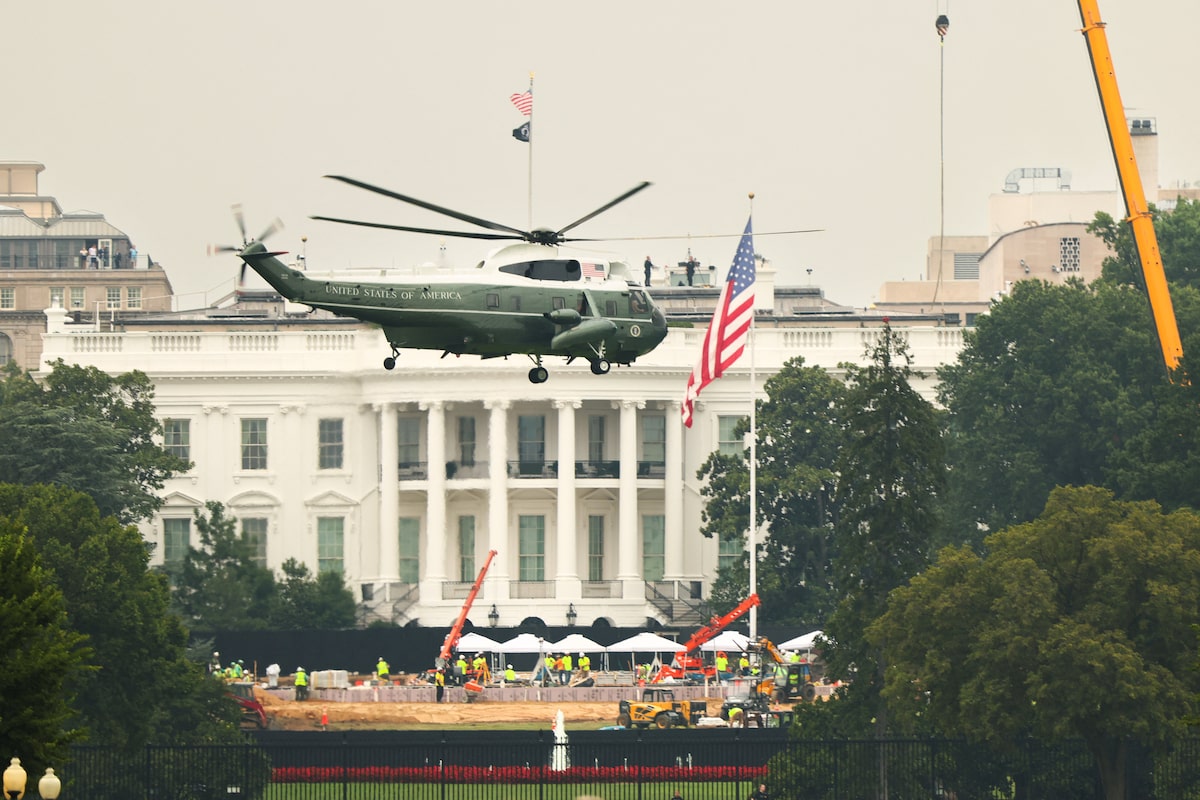
U.S. President Donald Trump departs the White House aboard Marine One last Friday.Kevin Lamarque/Reuters
Own goal
Re “Beijing further tightens exit-and-entry rules” (Report on Business, Aug. 12): It amazes me how autocracies can’t help shooting themselves in the foot by misguided policies.
If I were a bright student in China, I would be looking for ways to study overseas, then stay away from home in order to have a prosperous and fulfilling future. Certainly family would be a big consideration.
Exit-and-entry rules for people and capital only encourage the best, brightest and most entrepreneurial, the people needed to build an economy, to leave, not return and get as much of their money as possible out of the country. No wonder corruption remains a large problem in China, regardless of how many purges Xi Jinping conducts.
Nothing speaks more loudly of repression and failure than a country that forces its people to remain.
Michael Di Paolo Toronto
World stage
Re “Canada must not withdraw from peacekeeping” (Aug. 13): That our peacekeeping contingent has dwindled to a mere handful is regrettable. Canada should start restoring its international reputation by helping the United Nations with the tools it needs to prevent outbreaks, end wars quickly and alleviate widespread human suffering.
Canada used to be a leader not only in peacekeeping, but also major initiatives such as the Mine Ban Treaty and the International Criminal Court. Canada should champion the creation of the long-proposed rapid-reaction UN Emergency Peace Service.
Canada should also join the more than 50 Nobel Prize winners who, in 2021, urgently called for all countries to reduce their military spending by 2 per cent for five years, then spend those savings on more resources to grapple with planetary health and climate emergencies.
Larry Kazdan Vancouver
Data dump
Re “Moneris sale to U.S. owner adds risk to Canada’s data sovereignty, payments industry leaders warn” (Report on Business, Aug. 13): The folks at Royal Bank of Canada and Bank of Montreal can’t read the room, it seems.
This proposed sale is unacceptable to any Canadian opposed to selling out our financial services and digital sovereignty to our untrustworthy neighbour to the south. The Liberals should carefully consider the price they will pay if they allow this.
Many of us are already concerned about the continued backsliding on the Liberal “elbows up” promise. Mark Carney should appreciate how easily a respected statesman can become forevermore a symbol of weakness and failure.
Jeff Andrew Toronto
Around and around
Re “Ottawa weighs proposal on auto tariffs as it presses U.S. for reprieve, sources say” (Aug. 13): If it’s true that we’re prepared to accept unreciprocated auto tariffs, perhaps we can finally get a sense of the Canadian position in Washington: Speak defiantly, capitulate quietly.
We would incentivize automakers to switch to tariff-free American parts so they maintain factories in Canada, even as those factories become increasingly automated and legacy automakers continue to decline. These “Canadian” cars would still be uncompetitive because of tariffs, solving nothing.
Thankfully, the United States would probably renege on any deal shortly after it’s signed, nullifying this latest bout of potential cowardice on our part.
Robert Raskin Toronto
The plan for Canadian and U.S. trade representatives to meet repeatedly, hammer out a detailed agreement and then present it to Donald Trump for approval reminds me of a procedure frequently encountered in automobile showrooms.
A prospective buyer meets repeatedly with a sales representative and they eventually agree on price and options. The salesperson then leaves to get the deal approved by the sales manager, who rejects it.
In my experience, when that happens, the best tactic for the buyer is to get up and head for the door.
Dave Parnas Ottawa
Whose interest?
Re “The national interest in a new bitumen pipeline must be accommodated” (Editorial, Aug. 13): Opposing the construction of pipelines on the basis of its impact on the climate is nonsensical to me, so long as other sources of fossil fuels are available.
The impact on Canada’s economy of building a pipeline cannot be ignored. Only a reduction in the worldwide use of fossil fuels would have an impact on the climate.
I think those who are against pipelines should limit their opposition to the local or economic impact, not the red herring of climate.
J-P. Clark North Vancouver
The Union of British Columbia Indian Chiefs speaks for all of us who are affected by climate change due to emissions from burning fossil fuels.
Climate change is a tragedy of the commons. Every ton of carbon produced by the billions of individuals and organizations globally goes into the atmosphere and largely stays there, increasing the concentration of gases that are changing our climate. In this context, additional emissions from increased oil production that a West Coast pipeline is intended to support would indeed be significant.
Rather than invest in a declining industry, Canada’s economic sovereignty would be more strategically served by a rapid transition to clean energy and investment in the technologies, resources and industries needed in a low-carbon future.
Eve Wyatt Toronto
Foot down
Re “I see e-scooters everywhere – but where are they actually allowed?” (Online, Aug. 9): In Toronto, where e-scooters are banned, the problem is less about unclear rules than unenforced ones. E-scooters here remain commonplace while injuries rise.
If municipal governments are unable to enforce outright bans, then replace the current patchwork with clear provincial frameworks. Motorized micromobility vehicles used in public spaces should be registered, visibly identifiable and covered by liability insurance. Riders should face meaningful penalties for dangerous operation and illegal modification.
Human-powered bicycles need not be treated the same way. But once a motor is added, so are greater speed, weight and potential harm. Accountability should follow.
Peter Rozanec Toronto
Know your stuff
Re “No one wants my stuff and maybe that’s okay” (First Person, Aug. 11): Thanks for bringing this common grievance to light.
I am an antique lover surrounded by old furniture and miscellany inherited, but also sought out and purchased as I watched my predecessors do. My “stuff” is a large part of my past. I grew up with it.
The common thought among my friends is that kids today do not want antiques. There is truth to that, but our “stuff” being of value because of the memories evoked makes such sense. We can instead share our memories with our children, but they don’t have to accept our stuff.
So is there anyone who will want my stuff? What will happen to it?
But, wait, it’s about the memories, not the stuff. True, but hard to swallow.
Mary Lou Reiman Hamilton
Letters to the Editor should be exclusive to The Globe and Mail. Include your name, address and daytime phone number. Keep letters to 150 words or fewer. Letters may be edited for length and clarity. To submit a letter by e-mail, click here: letters@globeandmail.com