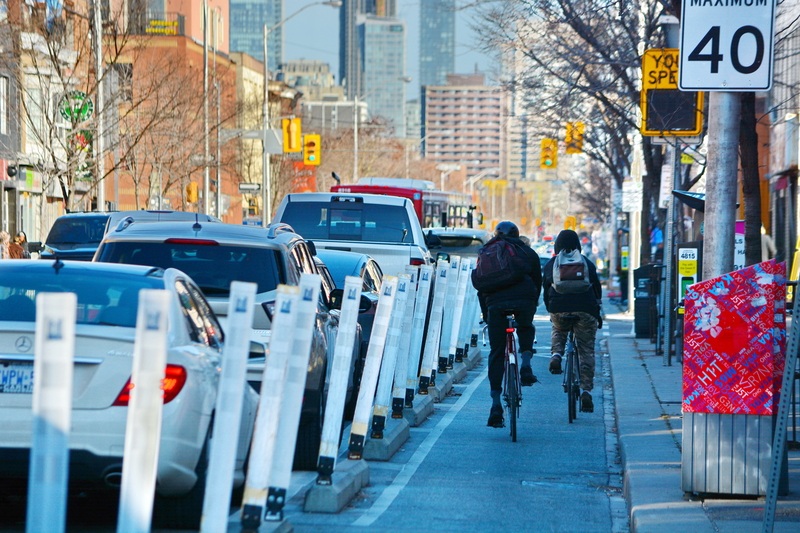
A provincial court in Canada has said the removal of 19km of protected bike lanes from several busy streets in the city of Toronto can go ahead.
The decision by the Ontario Court of Appeal overturns a lower court ruling against allowing the Ontario government to order the city to remove the lanes.
That ruling said that by removing the bike lanes, the city would be exposing cyclists to risks and that cyclists had a constitutional right to safety.
Removing protected bike lanes from heavily trafficked streets has been a political issue for several years.
Motorists have complained of narrower roads and more congestion.
Contentious cycle lanes
The contentious cycle lanes in the court ruling are along Bloor Street, Yonge Street and University Avenue in central Toronto.
The law was challenged by a group of cyclists, including a bike courier and a university student.
They argued that removing the lanes would pose an unconstitutional safety risk.
According to local media, provincial transportation minister Prabmeet Sarkaria welcomed the Ontario Court of Appeal’s decision.
“We’ve always been clear [that] bike lanes should go where they make sense, on secondary roads, not at the expense of vehicle lanes on the busiest streets,” he said.
The cycling group behind the court challenge acknowledged Friday’s ruling as a setback – but insisted the facts on the ground had not changed.
“Bike lanes do not cause traffic congestion. Ripping them out will put people’s lives at risk,” said Michael Longfield, executive director of Cycle Toronto.
Toronto cycling deaths
The cycling group has noted a 2024 Toronto city report that found 28 people had been killed and 380 seriously injured while cycling in Toronto over the past decade.
These were mostly on streets without protected bike lanes.
Late last year, the provincial government passed a bill banning new cycle lanes that reduces the number of vehicle lanes on a road in order to put in a cycle lane.
This means that one of two vehicle lanes in one direction cannot be reconfigured for a cycle lane.
But in its recent Cycling Network Plan update, Toronto noted that it could add more than 20km of cycle lanes by simply narrowing the road lanes.