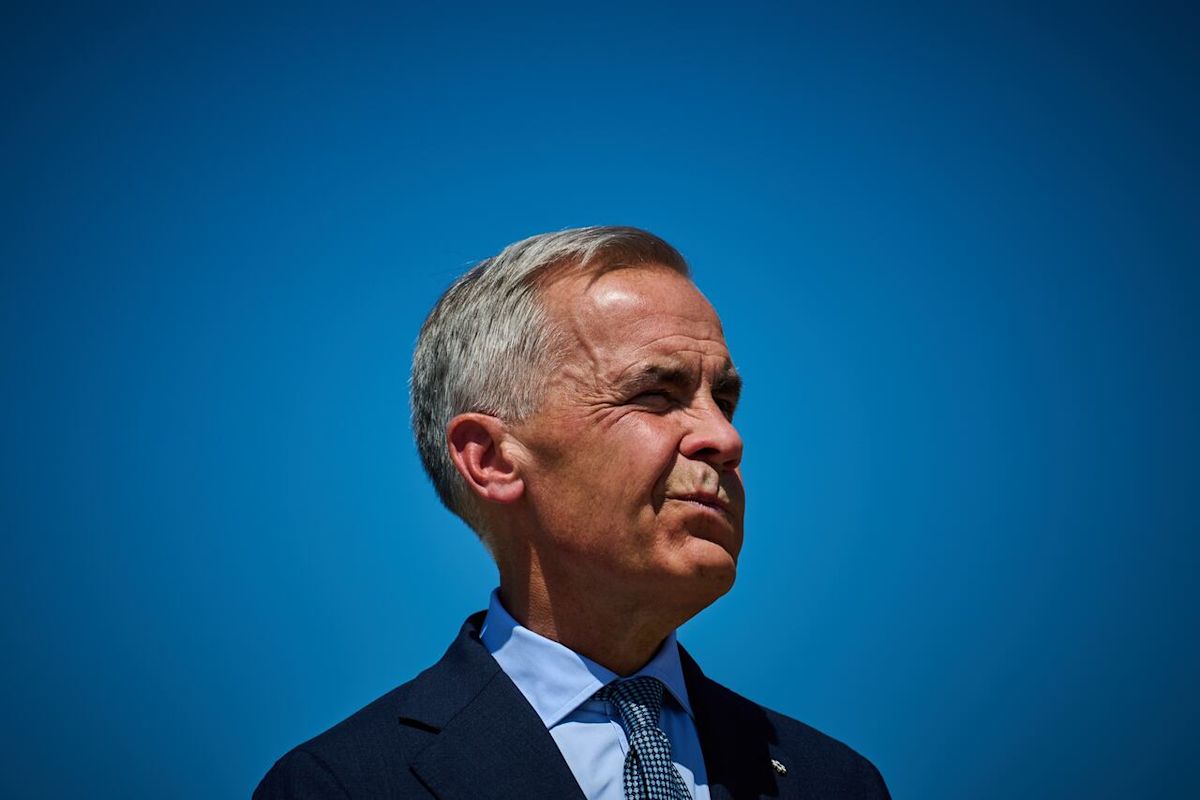
Prime Minister Mark Carney said last-minute negotiations with the U.S. to avoid a fresh batch of tariffs due to take effect this week are “delicate” and “intense,” and he plans to speak to his American counterpart in the next 48 hours to broker a mutually agreeable deal.
Speaking to reporters in St. John’s on Monday, where he announced a landmark hydroelectric deal with Quebec and Newfoundland and Labrador, Carney said he was reluctant to publicly discuss how talks are going to avoid U.S. President Donald Trump’s threatened Section 338 tariffs on billions of dollars’ worth of Canadian goods.
“We are involved in very delicate and intense negotiations, this is not the time to negotiate in public,” Carney said in French.
“We are in the middle of a negotiation, and we are coming into those negotiations from a position of strength.”
Asked if he plans to hit back against Trump if the two sides fail to reach a deal avoiding these new levies, Carney said he is ready for any possible scenario.
“I have plans for any situation that may arise,” Carney said.
Trump and Carney spoke on the phone Monday afternoon about the ongoing trade negotiations, according to Audrey Champoux, a spokesperson for the prime minister. She did not provide further details of the conversation.
Canada-U.S. Trade Minister Dominic LeBlanc and Canada’s chief trade negotiator, Janice Charette, have held a series of talks with U.S. Trade Representative Jamieson Greer over the last three weeks to not only avoid the planned Section 338 tariffs but also lower the existing Section 232 tariffs on industrial products like steel, aluminum, autos and lumber in exchange for some Canadian concessions.
LeBlanc and Charette met with Greer and U.S. Commerce Secretary Howard Lutnick on Monday afternoon for what was their longest meeting so far, clocking in at about an hour and 45 minutes.
A source with direct knowledge of the negotiations said prior to the meeting that it was expected to be the final one at the ministerial level. However, following the meeting, it was unclear whether that remained true.
Another source with direct knowledge of the talks said after the meeting that Canadian officials could see Greer again before Carney and Trump speak ahead of Wednesday’s tariff deadline. But another meeting with Greer is not currently scheduled, the source said.
The source told CBC News that the American negotiating team was going to see Trump after Monday’s meeting with Canadian officials.
CBC News is not identifying the sources because they were not authorized to publicly discuss the talks.
Speaking briefly to reporters outside Greer’s Washington office after the talks, LeBlanc said: “We’re going to continue working; our job is not yet done.”
After the bilateral meeting, a White House official told CBC News that the president has pledged to “put a stop to foreign cheating and put American workers, farmers and businesses first.”
“The administration continues to work with our trading partners towards fair trade arrangements,” the official said.
At issue in these negotiations is just how much Canada can get out of the U.S. in exchange for a series of concessions of its own.
The Americans want U.S. liquor back on the shelves of provincially run stores. The Trump administration is also pushing for Canada’s retaliatory tariffs on U.S. autos removed, and tweaks to how the supply-managed dairy sector allocates quotas.
Canada, in turn, wants Trump to scrap the threatened Section 338 tariffs, which could impose a 50 per cent levy on a whole host of new products as of Aug. 19. Carney’s team is also demanding substantial tariff relief for the hard-hit sectors that have endured Trump’s levies for over a year.
Greer has repeatedly signalled the U.S. is not open to dropping its tariff regime entirely.
Still, in an interview with CBC News, Erin O’Toole, a member of the prime minister’s Canada-U.S. advisory committee, said Canada has made some “progress” with the Americans.
It’s just a question of whether Trump will agree to any lower tariff rates brokered by Greer and if those levies are palatable to the Canadian industries most affected, he said.
“We’re not just gonna take what they throw at us. We have to forge a deal that is fair for Canadian workers and good for our economy,” O’Toole said.
The former Conservative leader said if Trump’s latest 50 per cent tariffs take effect this week as planned, Canada will have no choice but to respond in kind. O’Toole said Canada is already drawing up plans to hit back at this “aggressive act” if it comes to pass.
“What’s so short-sighted about tariffs is it leads to these tit-for-tat wars of response. It hurts both economies and workers. So let’s hope we can avoid that,” he said.