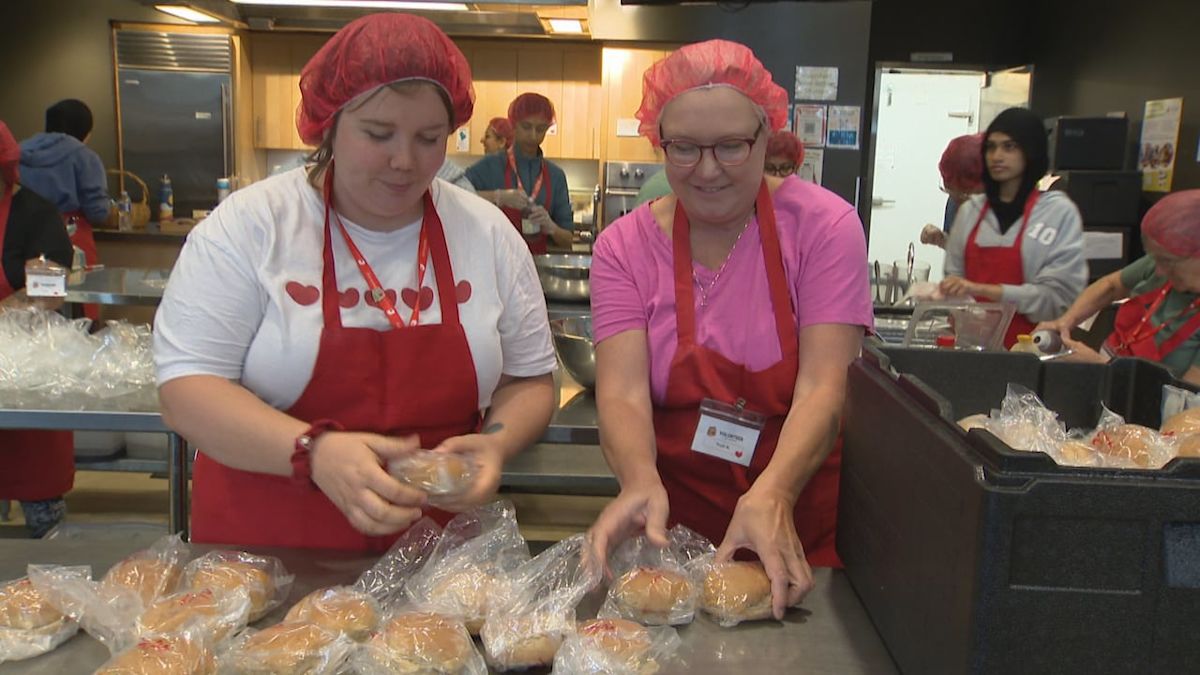
For 35 years, Brown Bagging for Calgary’s Kids (BB4CK) has provided free lunches for kids in Calgary.
As part of a back-to-school campaign, they invited local teachers on Monday to see their operation and meet volunteers, one of many ways they build community to fight food insecurity in the city.
The organization provides lunch for roughly 8,000 kids every day across the city, facilitated by around 700 volunteers a week.
“We work with any school, any school board within the city of Calgary that has students in kindergarten to Grade 12,” said executive director Bethany Ross.
This fall, they expect to deliver to 290 schools as every neighbourhood in the city has students experiencing food insecurity, Ross said.
“Kids need food physically, obviously for their physical growth, but also mental health. Food is a connector socially and so building those social skills and having that ability to be part of a community is really important,” Ross said.
For the volunteers, their experience donating time has the same effect.
“I just love it here so much,” said Patricia Ross, who started volunteering this summer.
“These people are lovely and wonderful, kind, patient, and it’s been so much fun this summer. It’s been a really great experience.”
Bethany Ross said the organization is always looking for donations and volunteers as they are “100 per cent funded by donations” and in the process of moving to a bigger location, which will increase their cold storage capacity and ability to provide more school lunches.
Providing more than lunch
Food insecurity is a complex and pressing issue in Calgary, said Meaghan Edwards, a professor in community health sciences at the University of Calgary.
But she believes the community approach at BB4CK is a model for building long-term solutions.
Alexis Espanioli, a recent graduate of the bachelor of health sciences program at the University of Calgary, started volunteering with BB4CK as a high school student and was struck by the level of collaboration between the organization and the communities they serve.
Earlier this year, when an opportunity arose to work with BB4CK and Edwards on a research project, Espanioli jumped at the chance.
The goal was to understand the types of support beyond immediate food assistance that families need. Edwards said it would not be possible without the level of community connection found at BB4CK.
“We could not do work like this without organizations like BB4CK, who have built amazing relationships with the families and the kids that they serve,” Edwards said.
These relationships take the form of an advisory council made up of people who access BB4CK programs and then advise both the organization and new families accessing these services.
“Families were already involved. They already have the advisory council made up of families. They were the ones that really thought, ‘Oh, we should research this, and how could we do it,'” said Edwards.
With the council’s help, Espanioli developed questions and conducted interviews with families to better understand their needs.
One main takeaway from the study is the importance of social connections.
“Families need to connect with one another, build friendships, and networks of support,” said Edwards.
From here they can work together and tackle the broader factors behind food insecurity, said Edwards.
“Sharing rides to service organizations, sharing information on what to pack in lunches using the resources that they may have, where to find culturally appropriate foods, how to connect with one another to discuss planning for budgeting, and where to find a family doctor that’s accessible by public transit,” Edwards said.
“It’s very easy for research to sit on a shelf,” said Espanioli, but the trusting, strong community focus at BB4CK lets research work with and for those involved.
BB4CK executive director Bethany Ross said that while the organization has changed over 35 years, the community focus has not.
“That foundation of being really driven by community and by identified need and helping to meet that is still strong.”