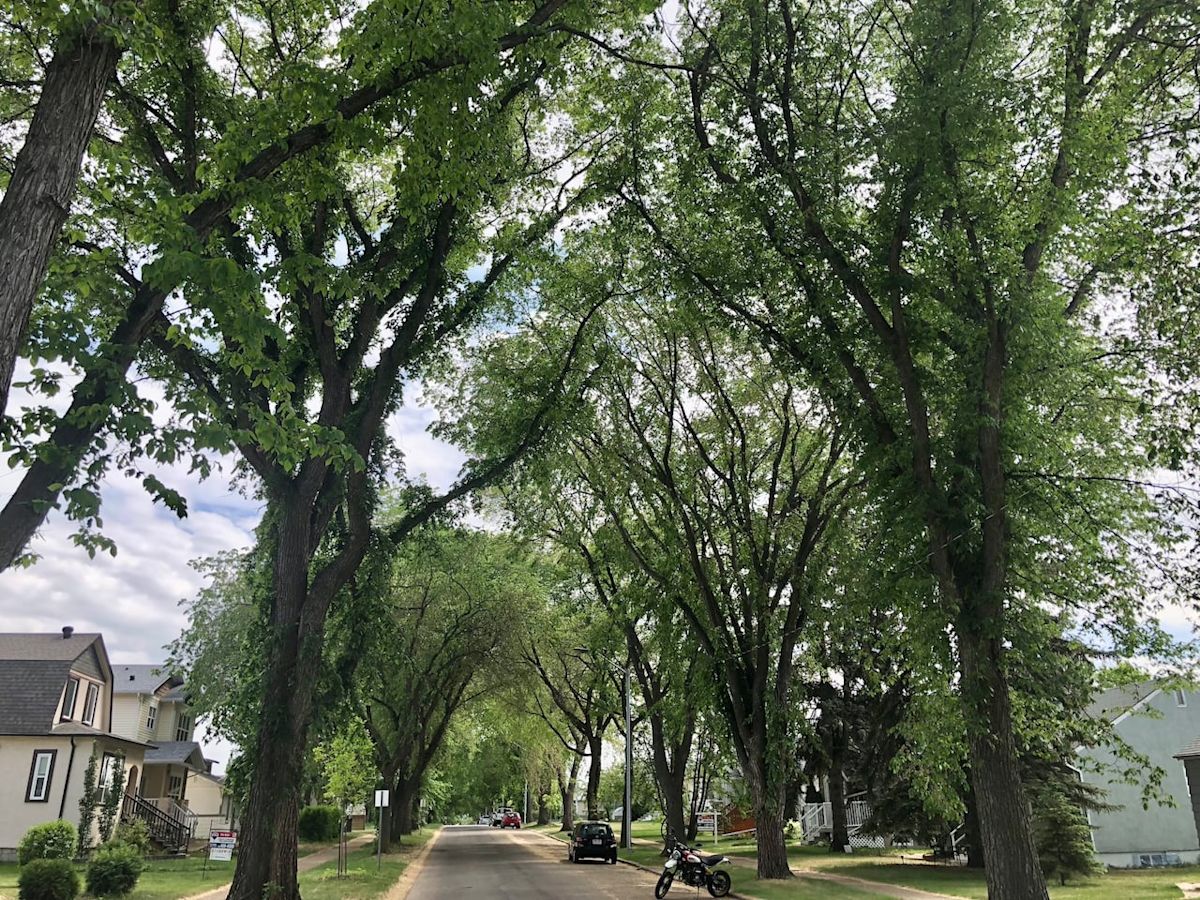
A forest health expert says the City of Edmonton’s current approach to combating Dutch elm disease could cause lasting long-term effects on the city’s tree canopy.
Since 2024, the City of Edmonton has reported 16 cases of Dutch elm disease, including nine cases discovered this year.
Elm trees make up about 22 per cent of Edmonton’s municipal tree canopy, the majority of which are American elm trees.
While not native to Alberta, American elm trees are known for their tall, upright form and cathedral-like canopy, making them popular for city streets.
The disease, which is a fungus carried on the backs of bark beetles, blocks the trees ability to conduct water, causing the tree to wilt and die.
Currently, the City of Edmonton is focused on the removal of infected trees. Due to the risk of spread, elm trees within 20 metres of the infected trees are also being removed, even if they are healthy.
Nadir Erbilgin, a professor of forest health at the University of Alberta, however, believes the city isn’t taking the best approach. He recommends the city introduce trap trees, to combat the disease at the source of infection: the bark beetle.
“If I found an infested tree, I will bait it with a lot of bark beetle pheromones. I will attract a lot of beetles to that tree,” said Erbilgin. “Take those infested trees, cut it, burn it, eliminate it.”
A trap tree approach involves attracting as many disease carrying beetles to the trap as possible. Once the tree is infested, it is then removed and burned, reducing the number of beetles capable of spreading the disease.
He said that the removal approach adopted by many cities throughout North America could end killing far more healthy trees than the disease itself — including trees that may be resistant to the disease.
Mike Jenkins, a senior scientist for the City of Edmonton, said the city’s current approach does result in the removal of healthy trees.
“Unfortunatley, in Rossdale in particular, we had two trees that tested positive,” said Jenkins.
“We wound up taking out about eight trees. Many of which were fantastic huge mature elm trees.”
Jenkins said that the city’s increased surveillance of the issue is allowing them to catch the disease in its early stages, preventing it from spreading further.
“We have crews going out inspecting every city and private elm tree at least once a year,” said Jenkins. “In the zones around where we’ve had detections, they’re checking those trees once a month.”
Jenkins said the city does plan to start adding trap trees to its approach next year, focusing on using Siberian elms.
Jenkins said that the city itself doesn’t have a lot of Siberian elm trees, and the majority of them are found on private property.
“Most of the Siberians are backyard trees,” said Jenkins. “They’re often kind of scratchy, sort of bushes.”
Jenkins said that many Siberian elms are actually resistant to Dutch elm disease and deadwood from them allow the beetles to survive and spread the disease to healthy American elms.
Until the city can implement its trap tree strategy, it plans to focus on pruning as much dead wood from the Siberian elms as possible in the dormant season this fall to prevent the beetles from emerging in the spring, Jenkins said.
Looking forward
While the city continues to try and combat the growing Dutch elm disease problem, residents are being encouraged to do their part.
Sarah Mendonca, sales manager for Trusty Tree Services, said that the best thing residents can do is have a recurring maintenance plan for their elm trees and have their trees inspected every few years.
She added that people can check their elms for wilting leaves, any branch that has a blue tinge at the base from where it came off the tree, or noticeable signs of bark scratches, made by the beetles burrowing into the wood.
Elm tree pruning is prohibited in Edmonton between April 1 and Sept. 30. Jenkins said that full-scale removal of elm trees is still allowed during that period, but noted residents should not store any of the wood.
Elm wood can be disposed of at the Edmonton Waste Management Centre, and any tree suspected to have Dutch elm disease should be reported to the city.