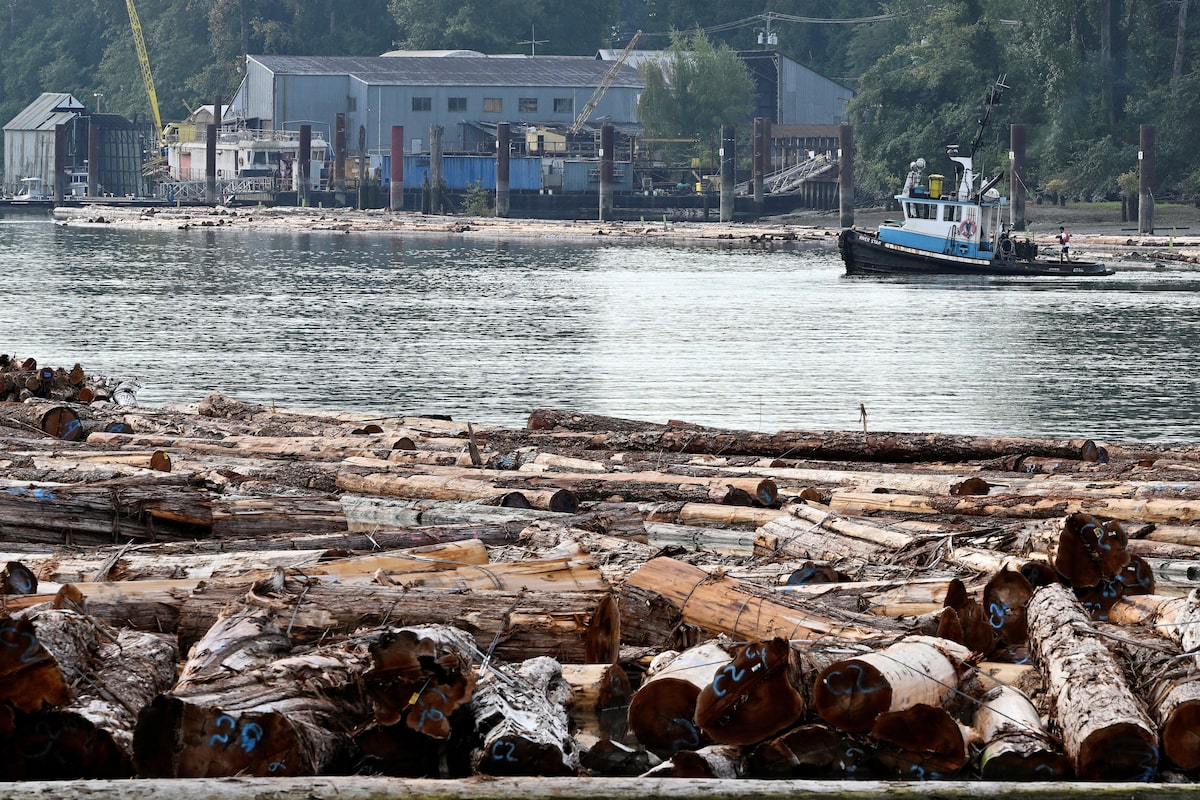
A log boom on the Fraser River, as U.S. President Donald Trump announced a three-day pause on a new round of 50% U.S. tariffs on Canadian goods, in Vancouver on Aug. 19.Jennifer Gauthier/Reuters
Long run
Re “The end of USMCA would have a surprisingly small impact on the Canadian economy” (Report on Business, Aug. 18): Thank you for a sober opinion: Even if there were no relief on U.S. tariffs, it’s not the end for Canada. Far from it.
Only 1.6-per-cent poorer than otherwise by 2035, says the Canadian American Business Council. Such a net reduction would scarcely be noticeable by most citizens a decade forward; those who might notice would be backed by the social safety net of a still wealthy country. Should adjustments to that net be needed, they could well be afforded.
Even without a renewed North American trade deal, Canada would still flourish a decade hence, probably aligned more closely with Europe and Asia (and Mexico) than now which, clearly to me, would not be a bad thing.
L.W. Naylor Founding member, Canadian Chamber of Commerce in Mexico; Stratford, Ont.
Checks out
Re “MPs launch probe into security screening after arrest of alleged NATO spy” (Aug. 18): So we are going to have another probe, this one into how an individual managed to get into the federal government and work in multiple departments after making duplicate applications containing falsehoods.
When I ran a business, we had a one-page application. At the bottom, in clear writing, were the words: “Making a false statement on this application is grounds for immediate dismissal.”
This person lied from the beginning and took our government to court when it ordered she take a course on ethics before accepting a federal public service job within one year, claiming it too harsh. Seriously?
When it was determined at the beginning that she had submitted two different applications, why was she even considered? No probe needed, just accountability from those in charge of the hiring process.
But who is checking the checkers?
Stew Valcour Halifax
Drone on
Re “Canada seeks to acquire long-range strike system widely used in Ukraine war” (Report on Business, Aug. 14): The days of Canada as a peacekeeper, with a military prepared for defensive action, seem over. Without U.S. protection and with Donald Trump’s multiple threats, a total military realignment is required.
Our military of necessity should rapidly reinvent itself. Since we can not possibly defend ourselves from an attack by a superior force, we should be creative.
We should ignore the hype and not waste tens of billions of dollars on sophisticated fighter jets. While glamorous, these jets can be useless against inexpensive drones and hyper-speed missiles, as we’ve seen demonstrated in Ukraine and the Middle East. With our limited military budget, we should focus on deterring any foes by threatening them with a counterattack capability.
We should fully endorse this announcement to adapt Ukraine’s innovative, low-cost, long-range attack drone capabilities. These target-seeking flying bombs are the perfect weapons to deter others from even thinking of attacking us.
J.A. Wayland Frelighsburg, Que.
Time to build
Re “Pipe dream” (Letters, Aug. 14): We may be overinflating Canada’s contribution to global climate change in order to justify the imposition of a damaging anti-investment environment. We may be committing economic suicide with a lack of major private investments, projects, employment and government revenue.
Our focus should be on attracting domestic and foreign investors to create Canadian projects which produce exportable goods and services in high demand. Let’s make good use of the good fortune this country has to be one of the richest natural resource nations in the world.
Let us make full use of the transitional petroleum industry, which produces some of the fewest methane emissions per produced barrel of oil in the world. Let us invite private investors to finance the construction of two pipelines and two terminals for oil and liquefied natural gas in Churchill, Man. Let’s use (or we’ll lose) the Northwest Passage.
Stephen Berbekar Kelowna, B.C.
Re “Business case?” (Letters, Aug. 18): “If a new pipeline was such a good idea, then pipeline companies would be competing for the chance to build it.”
There were multiple companies competing to build pipelines, but all were subject to aggressive regulatory oversight as the Trudeau government put up one road block after another. Companies are still interested, but they need convincing that the government is no longer intent on killing oil extraction altogether.
I believe in climate change and that we need to pursue renewables. I don’t buy the premise that because we’re a small portion of global emissions, we shouldn’t do our part. But given diversified world oil markets, decreasing (or not increasing) the oil we produce would not reduce consumption one iota. It would just shift supply to less responsible regimes.
Meanwhile, altering our oil output would not stop wildfires, but it would make us less able to fund a more effective response.
Darryl Squires Ottawa
Halfway there
Re “How would Canada change if we granted voting rights to children?” (Report on Business, Aug. 18): While no one is advocating for crayon-wielding toddlers to determine the outcome of elections, the notion of parents acting as proxy voters is intriguing but fraught with difficulties.
Proponents of this indirect enfranchisement of our little ones point to research that assures us parents will “cast ballots to advance their child’s interests, rather than their own.”
This setting aside of our own half-baked, sometimes meme-driven, often silly political convictions, for the sake of our children, calls for some formidable mental gymnastics, all within the confines of a tiny voting booth.
Farley Helfant Toronto
China rising
Re “Zhu Rongji was mythical – and also a man who did the work” (Aug. 17): To read this account of former Chinese premier Zhu Rongji is both touching and personal.
I grew up in Shanghai post-Cultural Revolution. China was poor and backward then. Although modernization reform started in 1979, many aspects of daily life were slow to change.
Most key food items were rationed. Long queues at food markets were a fact of life.
When Mr. Zhu came to Shanghai in 1988 to start his tenure as mayor, things started to change quickly. After a few years, food rationing became a thing of the past: Long queues disappeared and basic food items became plentiful and affordable. For ordinary citizens in Shanghai, there was a true sense of optimism about the future.
Today, when people see the gleaming skyscrapers over the Bund and enjoy the modern trappings that prosperous, metropolitan Shanghai has to offer, many feel a sense of gratitude to Zhu Rongji the man.
Wei Ding Calgary
Letters to the Editor should be exclusive to The Globe and Mail. Include your name, address and daytime phone number. Keep letters to 150 words or fewer. Letters may be edited for length and clarity. To submit a letter by e-mail, click here: letters@globeandmail.com