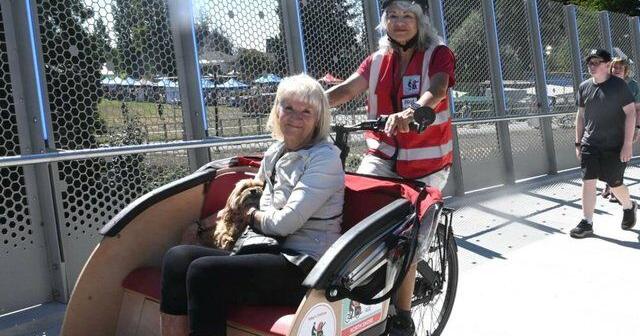
Dozens of cyclists and pedestrians crossed over the Crosscut Bridge for the first time Thursday as it officially opened to the public.
City of North Vancouver Mayor Linda Buchanan, MLA for North Vancouver-Lonsdale and Minister of Infrastructure Bowinn Ma and TransLink’s transportation planner Sabrina Lau Texier gave remarks Thursday before an official name plaque and ribbon unveiling on the bridge.
“This bridge marks the beginning of a new chapter for our city,” Buchanan said. “It will serve thousands of people every year in countless ways, whether it be getting to school, to work, shops or services or simply to recreate.”
Spanning from Loutet Park to the intersection of Casano Drive and Rufus Avenue, it connects the Cedar Village and Loutet neighbourhoods, areas that were previously cut off from one another due to the Trans Canada Highway extension from Mountain Highway to Lynn Valley Road in 1961.
The new overpass includes accessible approach pathways, a 4.5 metre-wide concrete walkway and rolling surface built for users of all ages and abilities, the city said. It also features built-in lighting, safety fencing, hand rails, benches and, coming soon, the planting of native trees and shrubs.
The bridge’s total cost is $17 million, Buchanan said, with funding coming from a variety of sources, including the province pitching in $4 million and $2.5 million from TransLink.
As more external funding applications are being considered to lower the municipality’s capital expenditure on the project, a city spokesperson stated they are unable to share the final cost breakdown at this time. However, the city will share the final cost breakdown, including all partner contributions, once finalized.
A pedestrian overpass in the area has been a long-time coming. Talks about a bridge began in the early 2000s, Buchanan said, and council gave direction in 2014 to get the ball rolling.
Community engagement and design developments were done in 2017, and construction began in March 2025. In February, the bridge’s steel structure was installed, and construction wrapped earlier in August.
Now that it’s open, the mayor said the bridge is helping all sorts of users get across the highway.
“They create safer options for people of all ages and abilities, they improve public health and they remind us that infrastructure should always be designed around people and for people,” she said.
Among the first wave of bridge users Thursday were members of the North Shore chapter of Cycling with Age, a volunteer-run charity that offers trishaw rides for seniors to help break social isolation.
“We are always looking for safe routes that we can ride on a regular basis,” said volunteer Leslie Mak. “Crosscut allows us to take [seniors] somewhere that they wouldn’t normally be able to get to. For us, it’s a huge opening of a new place to ride, and for our passengers it’s exciting.”
The bridge is also a win for cycling advocates. Hub Cycling, a non-profit that helps remove barriers to cycling in Metro Vancouver, helped push for the Crosscut Bridge as part of a larger grassroots effort to improve cycling infrastructure around the region and identify gaps in existing cycling networks.
“In most communities, transportation is either the first or the second biggest expense for households,” said executive director Rose Gardner. “Being able to have options to walk and bike safely where you need to go opens up transportation options for families that are more affordable, healthy, fun and safe.”
“This bridge really represents a critical gap,” she added.
Abby Luciano is the Indigenous and civic affairs reporter for the North Shore News. This reporting beat is made possible by the Local Journalism Initiative.