Both sides are touting progress in marathon trade talks between the US and Canada as concessions emerge ahead of a midnight deadline tonight.
Following a three-day pause announced earlier this week, the teams met Thursday at the offices of the US Trade Representative in Washington, D.C., led by Dominic LeBlanc, a top Canadian negotiator.
He told reporters, “We’re very close, we continue to make progress,” but said talks would continue today.
President Trump has been even more optimistic in public statements as details emerge that could lead to significant tariff relief. The broader deal is aiming to span sectors from automobiles to metals to farm goods if the remaining areas of disagreement are ironed out.
The talks have high economic stakes. The US and Canada are the largest recipients of each other’s exports, with the US accounting for roughly 62% of Canada’s trade. Failure in the talks could see Trump go forward with plans for 50% tariffs on a range of Canadian goods in response to what the US claims are discriminatory trade practices around automobiles, alcohol, and dairy products.
 Dominic LeBlanc, Canada’s minister in charge of US-Canada trade, leaves after meeting at the headquarters of the Office of the US Trade Representative in Washington on Aug. 20. (Mandel Ngan/AFP via Getty Images) · MANDEL NGAN via Getty Images
“We’ve come to a deal with Canada,” Trump told reporters on Wednesday, calling it a fair agreement for both sides with increased market access for the US, subject to the documents being finalized and that he is prepared for the US to “give something.”
Canadians have been less effusive. Prime Minister Mark Carney said his government is still finalizing the deal, even amid visible progress on at least one front: liquor.
Carney has reportedly pushed his provincial governments to end a boycott of US wine and spirits in government-owned liquor stores.
But in a sign of continued hard feelings, Wab Kinew, the premier of Manitoba, said at a news conference that he hadn’t yet agreed to Carney’s request. He also had a pointed message for his constituents when the US liquors “hypothetically” return.
“Don’t buy it, let it sit on the shelf,” Kinew said of US spirits, urging Canadians to send a message that “we don’t like Donald Trump’s approach to trade or his way of treating Canada.”
Read more: 5 ways to tariff-proof your finances
US Trade Representative Jamieson Greer speaks during an appearance in the Oval Office of the White House on Aug. 6. (Alex Wong/Getty Images) · Alex Wong via Getty Images Talks are tenuous but ‘looking good’
For the moment, even with evidence of progress, new tariffs of 50% are set to take effect Saturday morning at 12:01 am EST, per the latest White House executive action.
The key sticking points that appear to remain center on auto tariffs and the Canadian steel, aluminum, and lumber industries, which Trump hit with tariffs of up to 50% last year.
On autos and auto parts, the 25% tariffs Trump imposed last year could reportedly be lowered to 15% in the final deal, providing relief to auto companies that have built production processes that rely on parts crossing the US-Canada border multiple times to make a finished car.
But there are some questions around whether 15% is low enough for an embattled Canadian auto industry that could face existential stakes if auto companies decide tariffs are too high and simply shift more vehicle production to the US.
Read more: What Trump’s tariffs mean for the economy and your wallet
Negotiators also appear to be making progress on metal tariffs.
Kinew said this week that tariff exemptions for at least some Canadian steel under the United States-Mexico-Canada Agreement (USMCA) trade pact could be restored after Trump imposed separate 50% sectoral duties on steel.
“That’s looking good,” Kinew said, adding that his desire is for steel tariffs to be zero.
Trump has described the possible terms differently.
The US may “bring some of the [metal] tariffs down to a level where other countries are because Canada was paying a higher tariff,” Trump said.
Steel tariffs on other trading partners are generally at 25%, and the Trump team’s weighing of the move already generated some pushback in the US.
A statement Friday from the Coalition for a Prosperous America, which represents US steel mills and other metal producers, expressed worry about the concessions.
“National security tariffs on critical sectors are not pawns for negotiation,” the group said.
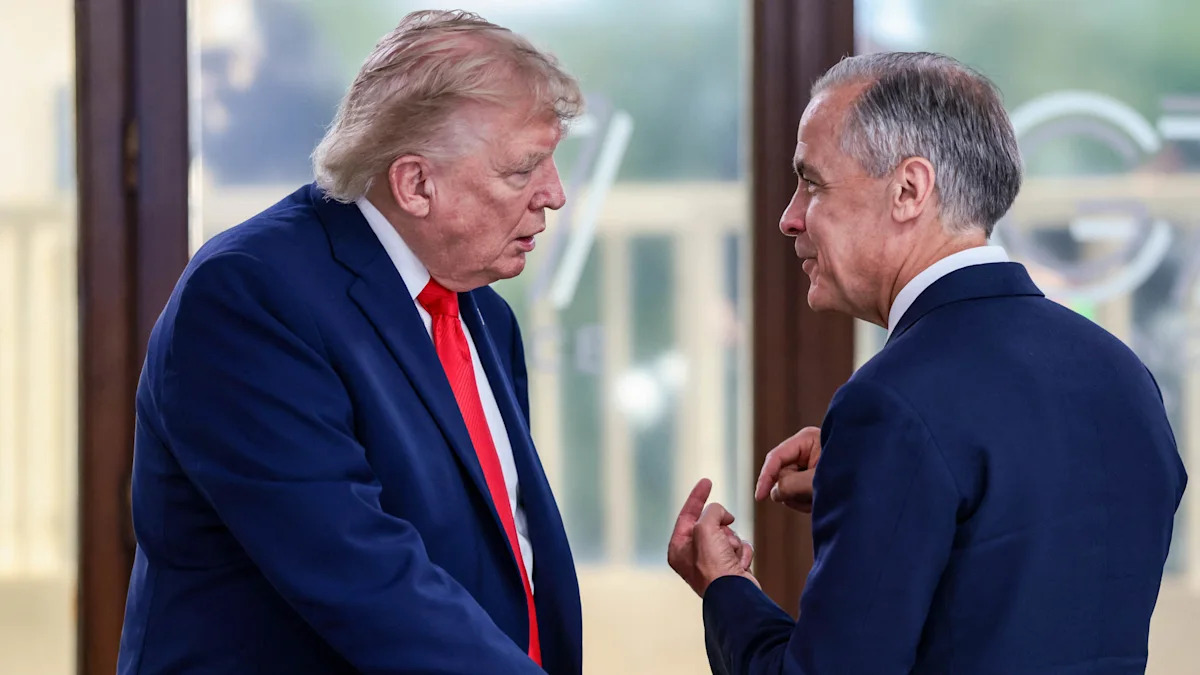
 President Trump speaks with Canadian Prime Minister Mark Carney as part of a G7 summit in France in June. (Evelyn Hockstein/Pool/AFP via Getty Images) · EVELYN HOCKSTEIN via Getty Images
Trump has focused on progress for the US in terms of market access for American farmers.
“Our farmers are going to be thrilled, our manufacturers are going to be thrilled,” he said Wednesday. He claimed the deal would mean “basically we have no tariffs going into Canada anymore.”
Trump’s team has also said that the final deal will include a reduction in Canadian digital services taxes, which have been an irritant to US tech giants but an important source of revenue for Canada.
Trump has also said a deal will include restarting the Keystone XL pipeline, which was halted by former President Joe Biden.
Trump reposted a meme late Thursday night that portrayed him restoring the pipeline that was “buried by Biden.”
Ben Werschkul is a Washington correspondent for Yahoo Finance.
Read the latest financial and business news from Yahoo Finance