
Listen to this article
Estimated 4 minutes
The audio version of this article is generated by AI-based technology. Mispronunciations can occur. We are working with our partners to continually review and improve the results.
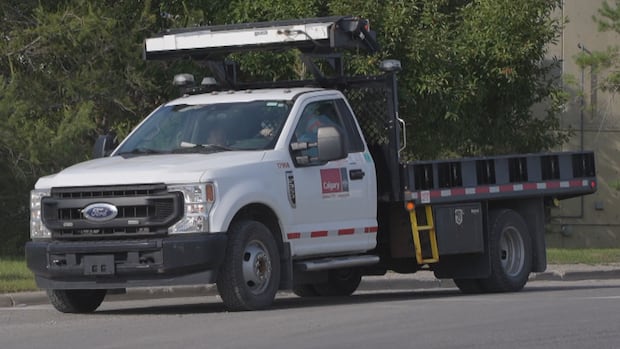
Drivers operating City of Calgary vehicles used to be expected to pay their own fines, but three years ago that changed — leaving taxpayers responsible for almost $120,000 in fines, according to data obtained by CBC News.
“Since April 2023, the city has paid routine on-duty traffic fines issued to employees operating city vehicles or equipment, consistent with grievance and union arbitration settlements adopted by other Alberta municipalities,” said Christy Schaefer, manager of fleet training and compliance, operational services in an email to CBC News.
“This does not apply to gross negligence, impaired driving, dangerous driving, distracted driving, or Criminal Code offences,” Schaefer said.
According to the city, it updated it’s approach to align with other municipalities, specifically Edmonton, following a union arbitration decision involving the City of Edmonton.
CBC News asked several other jurisdictions in the province about their policies. As of Friday afternoon the cities of Lethbridge and Medicine Hat responded, saying in separate emails that their employees are responsible for fines incurred while driving city vehicles.
The total number of tickets issued to City of Calgary vehicles dropped to 96 in 2025 compared to 189 in 2024. In both years the majority of tickets were for speeding or running a red light.
Data provided by the Calgary Police Service show the overall numbers of tickets issued by officers, photo radar or speed-on-green cameras also dropped in this time period, going from roughly 210,000 to just under 100,000.
The city said parking infractions incurred at private lots are also covered. “If it’s an independent parking company, the city would be responsible for paying the infraction, but it’s extremely rare with an average of three to four a year.” City vehicles qualify for free lot and street parking with Calgary Parking.
Who pays matters
The fraction of tickets issued to city vehicles represents a small portion of overall tickets issued in the city.
But in an interview with CBC News, conducted before it was confirmed that the city in fact covers the fines, Ward 13 Coun. Dan McLean said he didn’t like the idea of taxpayers being on the hook.
“What’s concerning is not so much that they’re getting the tickets, it’s who’s paying for them?” said McLean. “Taxpayers shouldn’t be paying for somebody else’s parking ticket or speeding ticket.”
No concerns over safety
Schaefer said employees using city vehicles are trained and qualified before driving for the city and are expected to operate vehicles safely, courteously and professionally.
“The city maintains an established operator qualification, training and compliance program,” she said.
Schaefer also said the Calgary fleet is the largest in Alberta, consisting of roughly 6,000 vehicles travelling over 90 million kilometers per year.
“Given the scale of fleet operations, the city does not consider these numbers indicative of a broader concern and remains committed to safe and responsible vehicle operation,” she said.
Mike Maher, president of the Amalgamated Transit Union Local 583 in Calgary, agreed on that point, but said it may say something about time pressures faced by drivers.
“The schedules on some routes are extremely tight,” he said. “If the schedules were more realistic, I believe that people wouldn’t be as stressed in trying to make all those connections and things that provide service.”
But Calgary Transit said the traffic tickets issued to transit operators occur across the city and at various times of day.
“They are not concentrated on specific routes or peak periods,” the department said in an email to CBC News
“Operators are never expected to compromise safety to maintain schedules and are expected to drive according to road conditions while following defensive driving principles reinforced through training and daily operations.”
Traffic fine revenue collected by the city is shared between the province and municipalities.