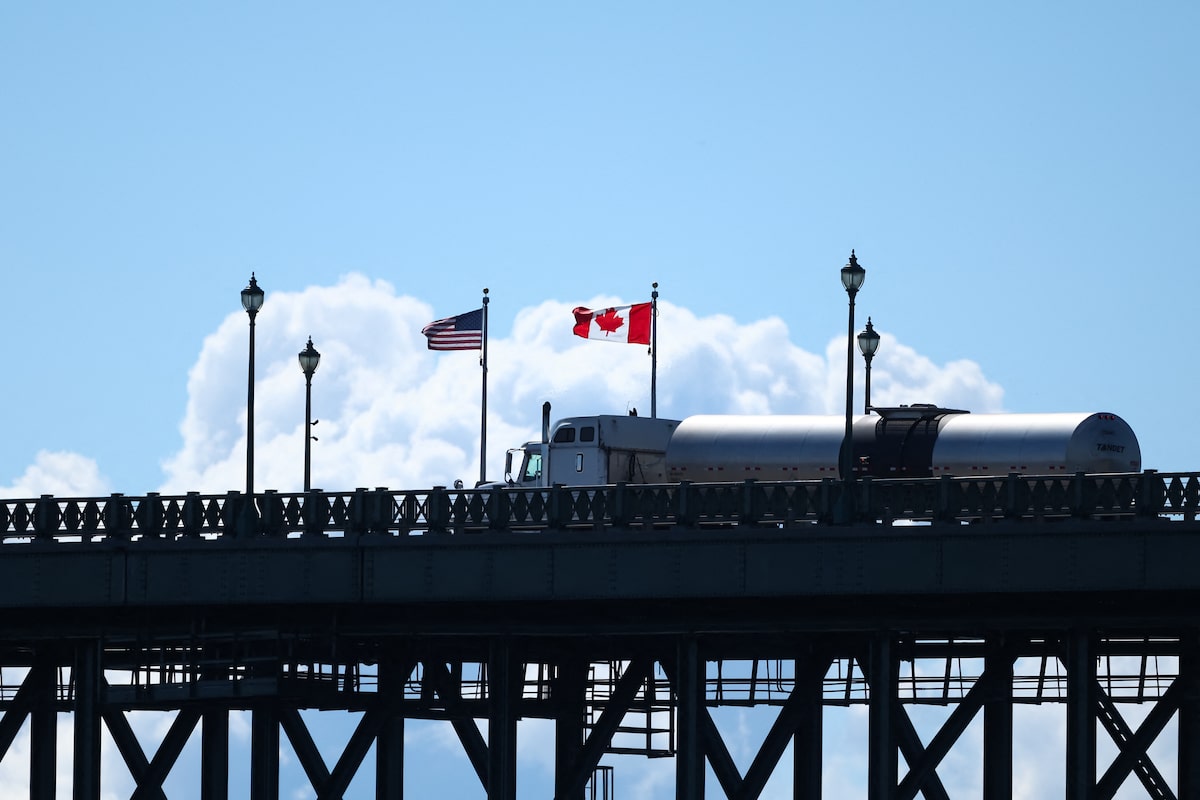
Signing a deal heavily slanted in the U.S.’s direction would have serious implications for Canada’s long-term economic position and how we attract investment.COLE BURSTON/AFP/Getty Images
Steve Verheul was Canada’s chief trade negotiator from 2017-21, leading negotiations that resulted in the United States-Mexico-Canada Agreement.
The breakdown in Canada-U.S. negotiations has left Canada in a difficult position, with uncertain and challenging times ahead. But agreeing to the deal the U.S. was offering on Friday night would have been worse.
Accepting tariffs against key Canadian exports in an integrated North American economy and against the fundamental obligations of our existing free trade agreement would have meant crossing a threshold that would be difficult to unwind. Canadian autos, which faced a reported 15-per-cent tariff under the terms of the proposed deal without an exemption for Canadian content, would have faced the most severe consequences. But that illustrates obstacles that would have also been faced by others.
More broadly, signing a deal heavily slanted in the U.S.’s direction would have serious implications for Canada’s long-term economic position and how we attract investment. On top of this, according to U.S. industry sources, part of the deal on the table was that Canada would match U.S. tariff levels on key products against all trading partners outside North America, including tariff-rate quotas on free-trade partners, a breach of our free trade agreements. That would take us down the path of facing the duelling pressures of a North American economy on terms slanted in the U.S.’s direction, and with our options to find alternative markets constrained.
Canada will retaliate with trade measures on U.S. on Sept. 8, Carney says
The next stages in that scenario would only tighten those reins. If we had given up much of our key leverage for a short-term deal, we would have entered the United States-Mexico-Canada Agreement review negotiations with limited ammunition left. The U.S.’s USMCA agenda is focused on reorienting rules of origin in their favour, greater alignment among the three parties on tariffs against imports from other countries (primarily China) and converging policies on investment screening and export controls. That would further lock us into a North American market with formal trade obligations that are even more tilted in the U.S.’s favour, and further preclude diversification efforts with other countries. The U.S.’s desire to have Canada extend favourable treatment on energy and on critical minerals would have only deepened the hole we’d be in.
So now what?
Canada won’t win a head-to-head trade battle with the U.S. But that’s not really the ground on which this will play out. The outcome of this trade war will be ultimately determined in the U.S., where President Donald Trump’s tariff agenda is far from a success. U.S. manufacturing starts are down, not up. Manufacturing jobs are down. Chaos and uncertainty have stalled investment and long-term planning. The key sectors in which the U.S. is incentivizing production will become less competitive over time and require continuing subsidization; China wins this kind of race, not the U.S.
Outside of the administration, most Americans understand this. Support for renewing the USMCA, including for maintaining duty-free trade, is significant among U.S. businesses. Most Americans believe that the USMCA is positive for the U.S. economy, and most are against Mr. Trump’s tariff policies. These pressures will only increase. In Mr. Trump’s first term, we knew that his position would only become weaker over time, and we eventually got a much better deal in the USMCA than we would have achieved earlier in his mandate.
Analysis: America is really being a bad friend
First, this means we need to focus on cultivating and incentivizing our American allies. Unfortunately, there is no better way to get their attention than to impose retaliatory tariffs. At the same time, we need to keep Mexico on board. They were concerned with some of the directions our discussions were heading with the U.S., and we need their support.
Second, we need to strengthen and better unite Team Canada. Neither industry stakeholders nor provinces were provided with detailed briefings on what was on the table. But understanding what industry and provinces need is far more important than any concerns about the risk of leaks. In years of consulting closely with industry and provinces, I never once had cause to regret it.
Third, we need to support Canadian businesses facing the impact of U.S. tariffs. The loss of jobs and production capacity would be difficult to replace.
Finally, we need to accelerate the already meaningful efforts being taken to improve our competitiveness and diversify our markets. If we are to face continuing tariffs for our largest export market, we will need to offset those barriers with further advantages on our side.
At the end of the day, the U.S. needs to rediscover the lessons learned after the Second World War, when they led the creation of fair and rules-based international trade that made them the economic powerhouse they have become. Trade agreements are only successful and sustainable if they produce win-win outcomes, in which both sides make gains. Trade agreements that aim to weaken your best customers and your largest investors don’t end up being in your interest, either.