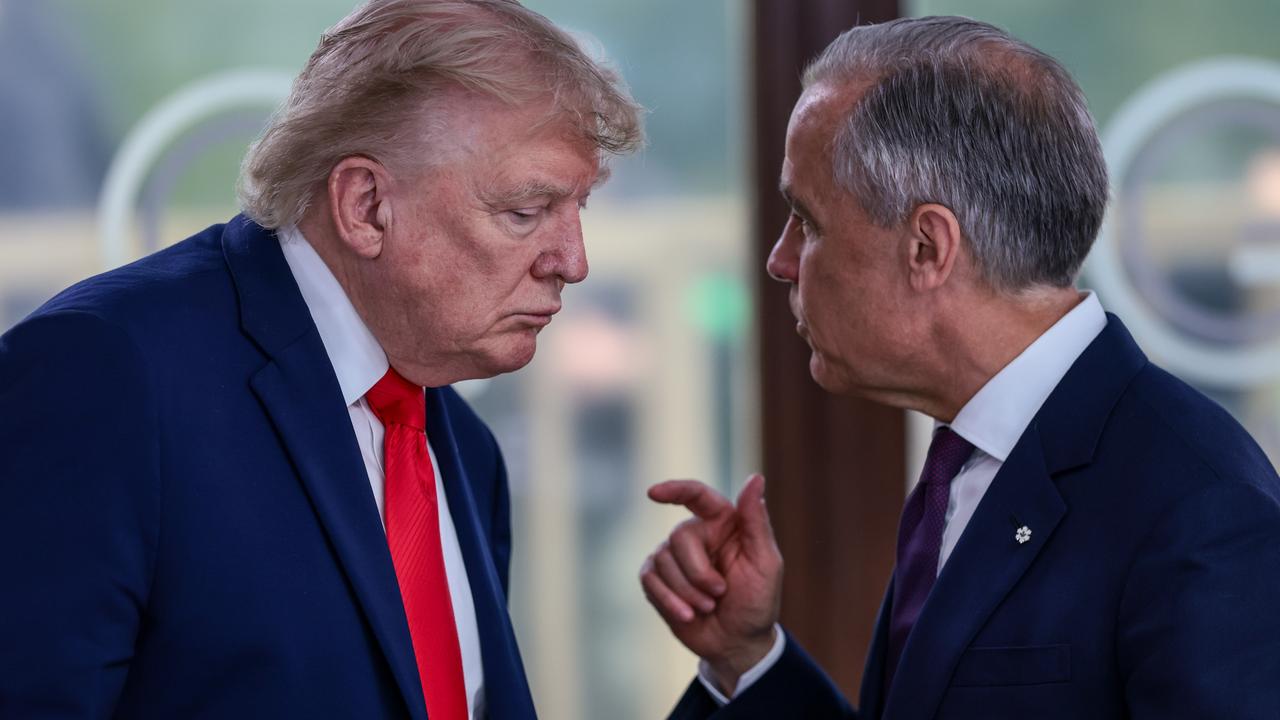
Mr Trump issued his latest tariff threat against Canada last month under Section 338 of the 1930 Tariff Act. The law lets the President impose tariffs up to 50 per cent on countries that discriminate against “commerce of the United States, directly or indirectly” in relation to foreign countries. No previous President has used this power.
Mr Trump set a deadline of midnight on Friday for Canada to reach a deal to avert 50 per cent tariffs on $20 billion of goods. The countries were close to an agreement until, poof, the ceasefire blew up at the last minute with each side blaming the other.
The result: Mr Trump’s threatened tariffs took effect Saturday morning. Canadian Prime Minister Mark Carney threatened to retaliate dollar-for-dollar starting Sept. 8. Both sides could still walk back from the ledge, though Mr Trump’s escalation could make this harder for Mr Carney politically since Canadians don’t like being bullied by Washington.
To justify his new tariffs, Mr Trump said Canada discriminated against the US by retaliating against his national-security tariffs on autos. He also claimed that Canadian provinces had restricted sales of US alcoholic beverages in response to his “emergency” tariffs last year. Yet US distillers begged Mr Trump to hold off on his Section 338 tariffs. They know the longer Canada locks out American booze, the tougher it will be to regain market share.

The President also cited longstanding grievances over how Canada treats US dairy. Press reports say the Trump team raised other issues during recent negotiations, including Canada’s treatment of US tech companies and digital taxes. Most of these issues could have been addressed as part of a renegotiation of the US-Mexico-Canada Agreement.
But Mr Trump doesn’t want to update the deal. He wants to rewrite it unilaterally. As Mr Carney noted Saturday, the President has contrived an array of pretexts — from fentanyl trafficking to trade deficits — to bludgeon Canada with tariffs.
Mr Trump’s complaint about the US trade deficit with Canada is particularly ironic since the latter owes entirely to imports of heavy crude oil that is especially well-suited for US refineries. Exclude Canadian oil, and the US would have a trade surplus. But US refineries would also operate at lower capacity.
In any event, last week the two sides were close to an agreement that would reduce the US auto tariffs on Canada to 15 per cent (the same rate as South Korea and Japan) from 25 per cent, and on steel and aluminium to 25 per cent from 50 per cent. These tariff reductions would help US manufacturers, which have integrated cross-border supply chains.
Prices for steel and aluminium mill products have surged 22.5 per cent and 40.5 per cent, respectively, over the past year. General Motors last month projected a $2.5 billion to $3.5 billion hit this year from tariffs. US auto makers have been lobbying the Administration to reach a truce with Canada.
Mr Carney said Saturday that a major reason the deal blew up is that the Trump team refused to ease tariffs on heavy and medium duty trucks, including those made at Ford’s plant in Ontario. Why is Mr Trump punishing Ford, America’s largest auto producer?
Mr Trump’s latest round of border taxes will hit an array of consumer goods, construction materials and manufacturing components. Republicans are already getting pounded on the campaign trail over his tariffs and inflation. One reason for Mr Trump’s frigid approval rating is that voters believe Mr Trump is waging blunderbuss wars without a strategy, and on trade they’re right.
The Wall St Journal
Read related topics:Donald Trump