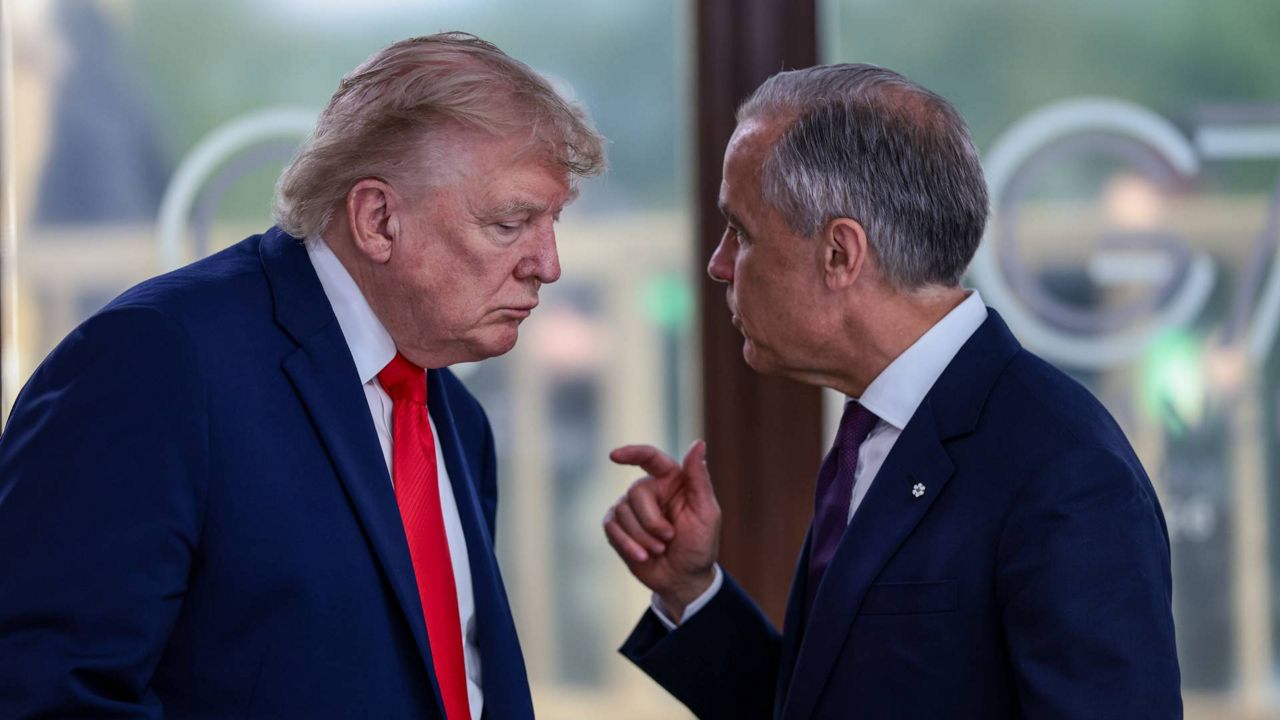
WASHINGTON — Last week, ahead of the 50% tariffs he planned to impose on a wide range of Canadian products, President Donald Trump announced a three-day pause to finalize a deal.
“We had a very good conversation with the prime minister last night, and we’ve come to a deal with Canada,” Trump said Wednesday.
American whiskey producers had hoped an agreement would spur Canadian provinces to put U.S.-made spirits back on the shelves of government liquor stores.
All but two provinces stopped selling American alcohol last year, in retaliation for Trump’s tariffs on Canadian products including steel and aluminum.
But over the weekend, trade talks between the U.S. and Canada collapsed and the president’s 50% tariffs went into effect.
“They asked too much and they offered too little,” said Canadian Prime Minister Mark Carney on Saturday. “Canada will match Washington’s new tariffs, dollar for dollar in order to protect Canadian workers, farmers, families, and businesses.”
Trump posted on social media Monday: “On Trade, and in other ways, also, they are among the worst Nations in the World to deal with. They feel entitled, and yet, WE DON’T NEED CANADA, THEY NEED US!”
The Toasts Not Tariffs Coalition, representing distillers, hospitality workers and others, said in a statement:
“We recognize the Trump administration’s efforts to encourage the Canadian provinces to return American spirits and wine products to store shelves and understand that these retaliatory tariffs are intended to restore market access for U.S. producers. However, a 50% tariff on Canadian spirits, wine and glass bottles will also have consequences for U.S. hospitality businesses.”
Todd Belt, a professor and director of political management at The George Washington University, said tariffs are not spread uniformly across the country.
“Donald Trump is looking at our trade balances and imbalances, punishing certain countries, but one of the things I don’t think he really realizes is that there are certain states, and certain localities that really bear the brunt of some of these decisions he makes, and for Kentucky, the whiskey industry, they export a lot, and this can really hurt them,” said Belt.
After Canadian provinces pulled American alcohol from shelves, U.S. liquor exports to Canada dropped 70% year-over-year from March through December of last year, according to the Distilled Spirits Council of the U.S.
The council, the American Whiskey Association and the Toasts Not Tariffs Coalition are all pushing for the U.S. and Canada to reach a resolution restoring market access for American liquor.