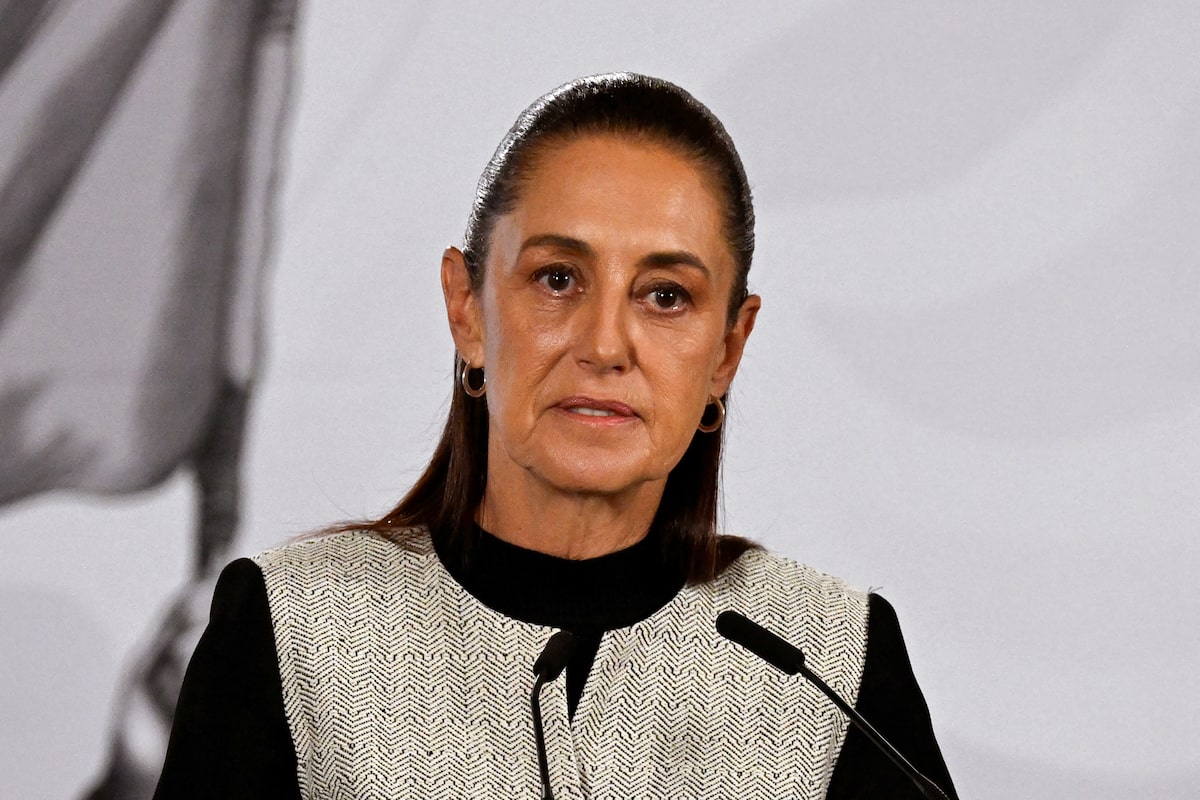
Mexico’s President Claudia Sheinbaum says she is ‘optimistic’ that the U.S. and Mexico can reach a trade agreement.ALFREDO ESTRELLA/AFP/Getty Images
Mexican President Claudia Sheinbaum is playing down the trade dispute between Canada and the United States, describing the breakdown of talks as a “disagreement,” while expressing optimism that Mexico will reach its own deal on tariffs with its northern neighbour.
“I wouldn’t want to call it a rupture,” Ms. Sheinbaum said at her Monday news conference, the first time she has publicly addressed the suspension of the Canada-U.S. trade negotiations, news of which has been overshadowed in Mexico by domestic political drama.
“This misunderstanding, let’s put it that way, this misunderstanding in the talks over the increase on tariffs that the U.S. raised towards Canada,” she continued, before pivoting to comments on her phone call last Thursday with Prime Minister Mark Carney. “When I spoke, it seemed like everything was going to be agreed upon because obviously we have to keep an eye on things.”
Carney calls Trump tariff threat unsurprising, says trade deal remains possible
Trade war casts shadow over Carney’s investment summit
She acknowledged that Mexico had paid close attention to the talks and that Economy Secretary Marcelo Ebrard, the country’s point person on trade, would remain in Washington.
“We hope to reach an agreement with the United States. What does this agreement have to guarantee? The well-being of Mexico and the well-being of the United States from each country’s perspective. And we’ll wait this week to see how things are. I’m optimistic that an agreement can be reached.”
The Canada-U.S. talks collapsed late Friday night when Mr. Carney withdrew Canadian negotiators ahead of a deadline set by U.S. President Donald Trump to impose 50-per-cent tariffs on $28-billion worth of Canadian goods, reportedly because the U.S. side made last-minute demands that Ottawa deemed unacceptable.
From left: U.S. President Donald Trump, Mexican President Claudia Sheinbaum and Prime Minister Mark Carney in July.Dylan Martinez/Reuters
In response, Mr. Trump has vowed to double tariffs on Canadian-made cars from 25 per cent to 50 per cent as of Jan. 1, 2027, and has added auto parts to the scope of the levies.
Analysts say Mexico followed the talks closely with an eye toward rules of origin in the automotive sector. U.S. negotiators had offered to reduce tariffs on Canadian autos to 15 per cent in exchange for Canada agreeing to a list of demands. Mexico’s automotive sector would find it difficult to accept tariffs of more than 12.5 per cent, according to a source familiar with the industry.
The Globe and Mail is not identifying the source because he was not authorized to speak publicly about negotiations.
A Canada-U.S. deal, analysts say, would have provided a template for the continuing Mexico-U.S. talks.
Andrew Coyne: The U.S. isn’t negotiating trade with Canada. This is a shakedown
Campbell Clark: The trade cold war suddenly turns hot again
Mexico has held three rounds of talks to review the United States-Mexico-Canada Agreement. A fourth round is scheduled for early September in Washington.
“We have some of the lowest tariffs of any country in the world,” Ms. Sheinbaum said of Mexico’s trade situation with the U.S. “We’ve achieved this thanks to communication, negotiation and the collaborative work of the team that has been travelling to the United States.”
Ms. Sheinbaum has made a series of major concessions to the Trump administration on a number of non-trade issues in order to keep the U.S. border open to Mexican exports.
Her administration scrapped her predecessor’s conciliatory security policy regarding drug cartels, known as “hugs, not bullets.” Mexico has handed over 92 accused cartel bosses to the U.S. And the country has settled water debts with America, stopped sending oil to Cuba and established a dragnet across its southern states to stop migrants heading toward the U.S. border.
Trade war could affect defence relationship between Canada and U.S., experts warn
Ms. Sheinbaum has also kept her criticisms in check and avoided being seen as forming a common front with Ottawa against the Trump administration.
“Injecting herself into the Canada dispute, even rhetorically, cuts against everything that has protected Mexico’s own file so far, in her view,” said Arturo Sarukhán, a former Mexican ambassador to Washington. “It’s about not letting Canada’s crisis become hers.”
Mexico has said it wants to preserve a trilateral agreement between the three North American countries. But “it’s behaving, in practice, as if Mexico’s fate is fully decoupled from Canada’s,” Mr. Sarukhán said. “Both things can’t be entirely true.”
The ruling Morena party is heavily nationalist but largely deferred to Ms. Sheinbaum’s dealings with Mr. Trump. But the U.S. has indicted 10 Morena officials, including Governor Rubén Rocha Moya of western Sinaloa state, on drug charges, which has rallied the Morena base. Mr. Rocha Moya unexpectedly returned to his office Friday from a leave of absence but stepped down again less than 36 hours later, after Ms. Sheinbaum withheld her approval.
“She walks on eggshells when she speaks about the USMCA,” said Brenda Estefan, a geopolitics professor at the IPADE business school. “Regardless of her ideological background, she knows that Mexico’s vulnerability to the U.S. is extreme.”