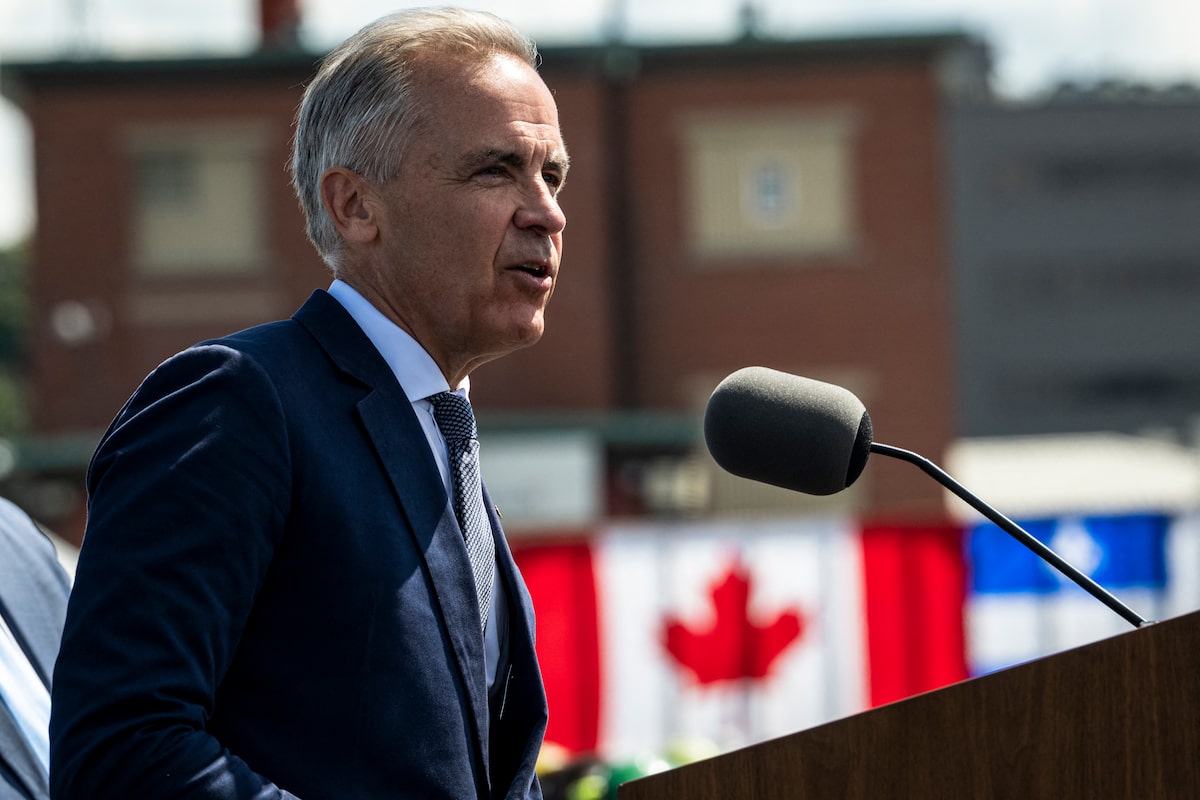
Prime Minister Mark Carney speaks about the trade dispute with the U.S. at the Davie Shipyard in Levis, Que., on Monday.ANDREJ IVANOV/AFP/Getty Images
Most Americans are dozing through the unveiling of the newest, dumbest front in the trade war launched by U.S. President Donald Trump. The majority, in fact, don’t even know they are at war, much less what Mr. Trump and his convoy of obsequious votaries are fighting for.
According to a recent report prepared for the New North American Initiative at the University of Calgary, only 31 per cent of Americans surveyed in the spring believe the bilateral relationship between Canada and the U.S. is negative, compared to 81 per cent of Canadians. Roughly eight per cent of Americans think Canada poses a major economic challenge to the U.S., whereas 77 per cent of Canadians think the U.S. poses a major threat to us.
That was evident in the disparity in coverage of the Friday night breakdown in talks between Canada and the U.S. over Mr. Trump’s then-looming, now-implemented 50-per-cent tariffs. In Canada, the coverage was wall-to-wall, and it included a Saturday morning media address by Prime Minister Mark Carney, who said the Americans “asked too much and offered too little” in negotiations. The Prime Minister said Canada is in a trade war simply because we “got attacked.”
Andrew Coyne: The U.S. isn’t negotiating trade with Canada. This is a shakedown
In the U.S., by contrast, the rupture between the once-closest of allies was just one news story among many. On Sunday, Mr. Trump farted out a Truth Social post about how “Canada wants the benefits of being a State, without being one!!!” and then let another one slip on Monday that threatened to raise auto and steel tariffs to 50 per cent in January (steel tariffs, he should probably know, are already at 50 per cent). The breakdown in talks was a segment on Fox News, but so too was Meghan Markle’s return to Britain and the promise of new developments in the war in Iran. After all, the U.S. still has other, similarly dumb wars to worry about.
Americans aren’t paying attention because they don’t have to. Not yet, anyway. Fifty-per-cent tariffs on $28-billion worth of goods won’t rock their economy on a national scale the same way it will in Canada (though it may be a different story in certain border states). Indeed, they very clearly have the economic upper hand. But Canadians have something equally as valuable, and perhaps, far more enduring: a reason for fighting back. A reason for fighting at all.
This trade war was about sovereignty the moment Mr. Trump mused about making Canada the 51st state – when he threatened to use economic coercion to fulfil his 17th-century imperialist dreams. According to Mr. Carney, American negotiators attempted to slip in unreasonable conditions at the 11th hour of negotiations: language restricting Canada’s ability to sign other trade deals, for example, and French-labelling requirements on products. As reported by the Globe Monday, the U.S. also tried to coerce Canada to drop CanCon requirements for streamers, which is an issue about which Canadians can and should debate. It is not, however, something that foreign powers can demand of Canada in order to avoid punishing and unreasonable tariffs.
Editorial: Canada’s sovereignty is not negotiable
Canada is fighting for its sovereignty. Americans are fighting for… more expensive cans of Coke? (Coca-Cola imports some of its aluminum for its cans from Canada, which is now subject to a 50-per-cent tariff.) Higher-priced groceries? (Though Mr. Trump recently got spooked by the high price of beef and announced he would temporarily lower tariffs, which angered American cattle producers.) Americans are fighting for… Canada to get its fentanyl crisis under control? To stop illegal immigration? To control wildfire smoke? To fix the trade deficit? Americans don’t know, because there is no logical, satisfactory answer. The impetus for all of this is Mr. Trump’s bizarre, lifelong fidelity to the concept of tariffs, which is a silly reason for sacrifice, and a bad reason to fight a war. You can’t rouse a country to coddle one man’s ego.
In spring, when gas prices peaked to around US$4.50 per gallon, Americans became sharply critical of Mr. Trump’s gambit in Iran. The Trump administration had failed to articulate what, exactly, Americans were fighting for (it was to destroy Iran’s nuclear capabilities, they said, but also for oil, and for regime change, and to secure the Strait of Hormuz), and why they should accept higher prices as a result. It is in Canada’s best interest that the same thing happens now, especially before midterm elections in the fall. Because Canadians have something to fight for, and they know why they are fighting. That gives us a reason to endure, which can be a salve in painful times. Many Americans, on the other hand, don’t even realize a war has started. And those who do still won’t know what they are fighting for.