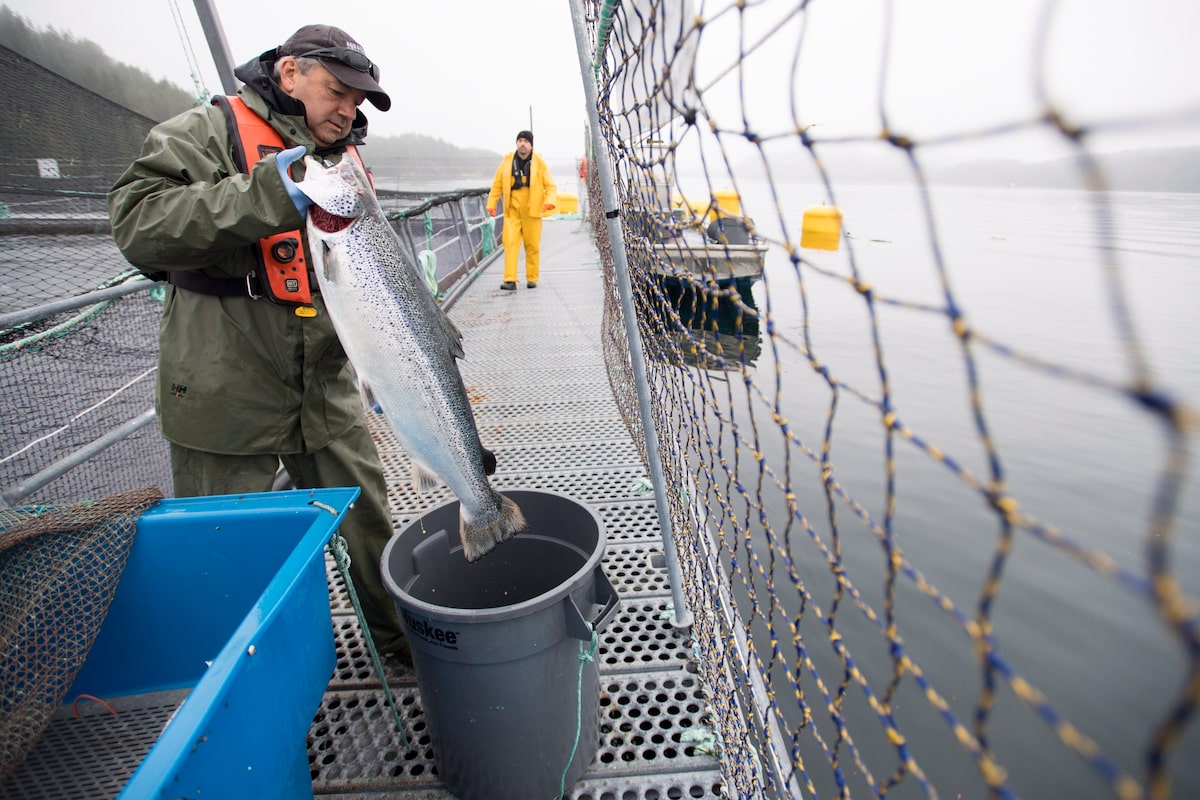
An aquatic science biologist picks a salmon to collect samples from during a Department of Fisheries and Oceans fish health audit at the Okisollo fish farm near Campbell River, B.C., October, 2018.JONATHAN HAYWARD/The Canadian Press
Indigenous groups and conservationists are expressing concern about silence from Ottawa over a plan, proposed by the Trudeau government, to ban salmon farms off the coast of British Columbia.
They fear that Prime Minister Mark Carney’s government may be preparing to roll back on a Liberal commitment to remove the commercial salmon farms from B.C. coastal waters.
In 2024, the Trudeau government released a draft transition plan to phase out by June, 2029, open-net salmon farms in B.C. – where the fish are raised in coastal waters – which Indigenous communities and conservationists argue are harming migrating wild pacific salmon.
“First Nations are extremely concerned about any backtracking on the 2029 ban of open-net pen fish farms. The ban is an outcome of years of government consultations and engagements, and the announced ban directly incorporates the collective voice of First Nations across B.C.,” said Bob (Galagame’) Chamberlin, chair of the First Nation Wild Salmon Alliance.
Some fish farms have already closed in B.C., while others remain open.
B.C., Ottawa announce new fisheries fund to help restore salmon habitat
In a statement, a spokesperson for Innovation, Science and Economic Development Canada said that draft transition plan “served as the basis for consultations and engagement.”
Since then, an interdepartmental task force has engaged with First Nations and other groups with an interest in the future of the fish farms.
“This work has provided a deeper understanding of the industry and regional economy, as well as the diverse views on the transition,” said ISED spokesperson Hans Parmar in a statement.
First Nations chiefs whose territories include such farms want to keep them open and say there is no conclusive scientific evidence that the farmed fish are passing on diseases to wild salmon.
But other Indigenous communities and conservationists say they want reassurances that the Carney government plans to phase out B.C’s remaining ocean-based salmon farms, despite pressure from the commercial salmon-farm industry and some First Nations not to do so.
Aquaculture debris along Newfoundland coast not harming fish, federal government says
They argue that the fish farms are harming migrating wild salmon populations, for example by passing on sea lice, and should be moved to tanks on land. Wild salmon stocks have revived where fish farms have closed, including in B.C’s Discovery Islands, conservationists and some First Nations leaders say.
Earlier this year, the Federal Court of Appeal upheld Ottawa’s decision to phase out open-net salmon farms in B.C.’s Discovery Islands.
The court rejected an appeal from fish farm operator Mowi Canada West, and ruled that former Fisheries and Oceans Canada minister Joyce Murray had acted fairly and reasonably when she refused to renew aquaculture licences there in 2023.
Chief Don Svanvik of Namgis First Nation in B.C., said, “The Namgis are concerned that the Carney Liberal government will not hold up the mandate of the previous Liberal government to ban open-net pen fish farms in B.C. to insure the survival of Pacific wild salmon. They have been silent on the transition plan for far too long.”
B.C.’s fish-farming industry, which includes Norwegian-owned salmon farms, includes open-net pens in Indigenous communities.
With Washington state moving to ban open-net fish farms, B.C. becomes an outlier on the west coast
Brian Kingzett, executive director of the BC Salmon Farmers Association, said in an e-mail that an announcement about the ban is expected soon.
“The sector is fully committed to ensuring that wild salmon are protected by its operations, will make further innovations in the sector, and will support research organizations such as the Centre for Aquatic Health Sciences if there is a favourable decision by the federal government,” he said in an e-mail.
Tony Allard, chair of advocacy group Wild Salmon Forever, which favours moving salmon farms on land, said the cost of phasing out the coastal farms, and possibly retraining employees, may be a factor in the delayed announcement.
“I believe that our Prime Minister knows that wild Pacific salmon are an irreplaceable renewable resource whose ecological, cultural and economic value to British Columbia is beyond calculation,” he said, adding that allowing the farms to continue beyond June, 2029, “would be a moral failure and a serious risk-management mistake.”
“We can’t pretend any longer that we can have both healthy and abundant wild Pacific salmon and industrial scale pens of Atlantic salmon in the Pacific,” he said.
Mr. Allard added in an interview that the draft plan to phase out fish farms may have “too many zeros attached to it.”
“We think DFO [the Department of Fisheries and Oceans] and industry have very successfully attached an unpalatable price to the transition, with the hope that the whole nasty idea will just go away,” he said.
At a news conference in Ottawa in April, chiefs from the Coalition of First Nations for Finfish Stewardship argued that reversing the proposed 2029 open-net ban could attract new foreign direct investment and create jobs.
In the April press statement, they said the next six-year salmon life cycle was due to begin in June, 2026, and without policy clarity, aquaculture companies face the option of proceeding with production “only to cull millions of healthy fish in 2029.” The other option would be to halt the growth cycle, triggering job losses across rural, remote, coastal and Indigenous communities.
Dallas Smith, a member of Tlowitsis First Nation and a spokesperson for the Coalition of First Nations for Finfish Stewardship, said, “Aquaculture is a contributor to the economy, and to food security, in the rural and remote coastal communities that need it most.”
He said in a statement: “The 2029 open-net pen ban policy has already resulted in job losses and economic shrinkage. In the middle of an affordability crisis, and now a trade war, now is not the time to be shutting down food production in Canada.”
“Salmon farming is our natural resource, and as Rightsholder Nations, we are asking this government to reverse the ban and work directly with us to take care of coastal communities, strengthen food security and allow us to steward our territories for future generations.”