Mayor Soraya Martinez Ferrada announced Friday morning, Aug. 21, new measures to strengthen “the feeling of safety” for Montrealers as well as for the police whose job it is to keep them safe.
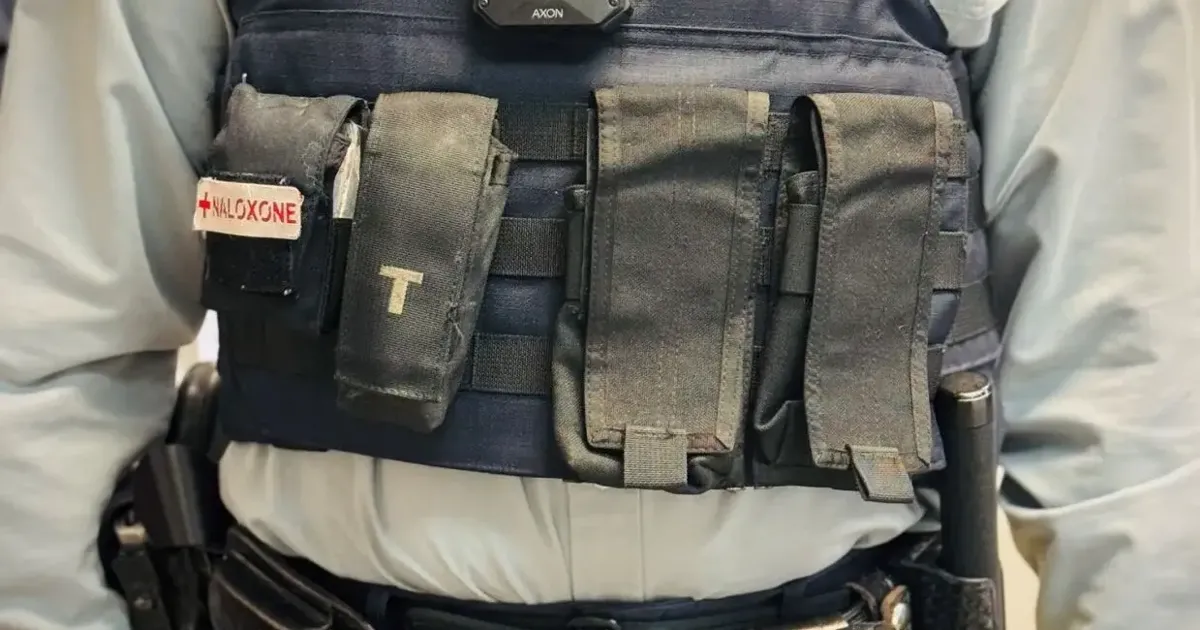
Perhaps the most important measure announced was the implementation of police body cameras within the next year.
The Service de police de la Ville de Montréal (SPVM) has been one of the last holdouts in the country with regard to body cameras, aside from a 2017 pilot project after which then-mayor Valérie Plante deemed body cameras expensive, unwieldy, and ineffective.
The Martinez Ferrada administration made police bodycams a campaign promise, followed through with $40 million in the budget for same, leading to Friday’s announced promise of their implementation.
The announcement follows in the wake of the Montréal-Nord scandal that brought racism within the SPVM to the fore, and the public meeting held earlier this month where the SPVM and Chief Fady Dagher responded to allegations of racism, racial profiling, and hateful acts against racialized groups and individuals from {span}poste de quartier 39 (PDQ 39){/span}.
“Montrealers have every right to be angry,” the mayor said. “They have every right to criticize the city, challenge our decisions, and hold us accountable.”
Dagher was on hand for Friday’s announcement, as was Dimitrios Jim Beis, Executive Committee member responsible for security and prevention, and Yves Francoeur, president of the Fraternité des policiers et policières de Montréal.
The security measures also include adopting regulations “aimed at protecting municipal employees against insults, threats, and intimidation.
“Unfortunately, from 2019 to 2025, situations of incivility, aggression, and harassment towards city personal have gone up by 263 per cent,” the mayor pointed out. “This is unacceptable.” She referred, as an example, to the viral video of the man who verbally attacked a policewoman, spouting viciously misogynistic and degrading insults at her.
“Public safety and public trust must move forward together,” Martinez Ferrada said.
Hence, the measures also include regulations aimed at better protecting municipal employees — including police officers — against insults, threats, and intimidation.
Police officers will be equipped with 3,500 bodycams, and about 600 patrol vehicles with dashboard cameras and automated license plate readers to “improve the safety of police interventions, the quality of digital evidence, and the efficiency of investigations.”
Added to these measures is a mandate for the city’s Public Safety Commission to gather feedback on the criteria, adopted in 2025, for police stops. “It is my responsibility,” Beis said, “to ensure that the measures deliver the results we’re aiming for, that they are effective, that they help police officers do their jobs while ensuring the safety of our residents.”
Ten days earlier, Dagher participated in the public meeting regarding PDQ 39, a meeting he described as “tough” and “very emotional.” He said that Friday’s announcement “hinges on two essential values: transparency and respect.”
Joel DeBellefeuille of The Red Coalition hopes that this is not a one-way requirement. “We cannot create a stronger standard of respect for citizens dealing with police while accepting anything less from police dealing with citizens,” Bellefeuille says. “If we are going to talk about insults, intimidation, respect, and acceptable behaviour during police interactions, then that conversation must go both ways. The law already establishes standards for police officers. We intend to make sure those standards receive the attention and accountability they deserve.” n