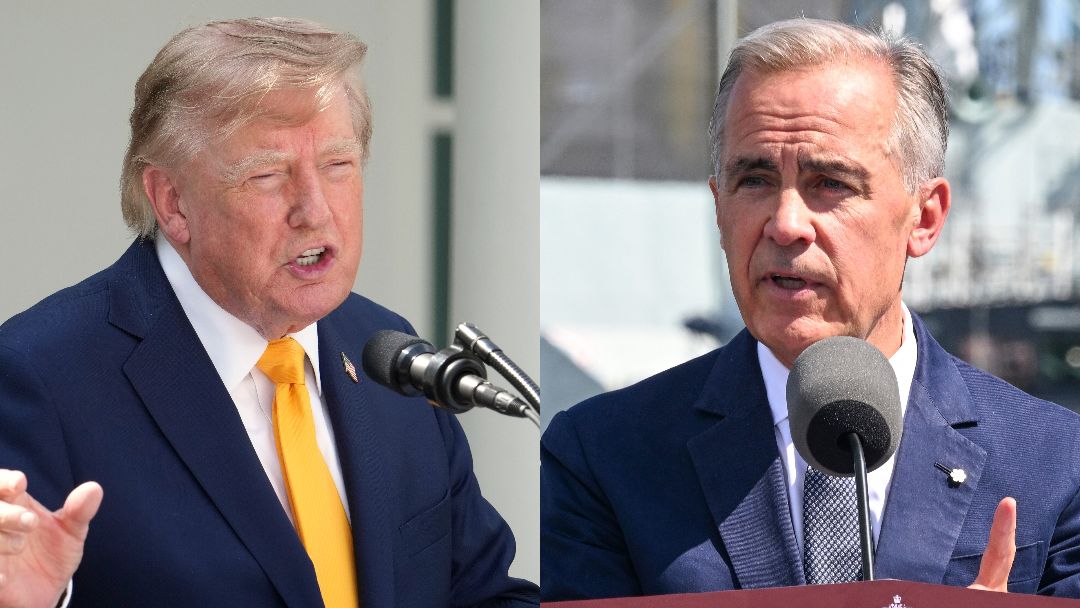
The escalating Canada-U.S. trade war may involve insults, social media posts and even a proposed “Lake America.” But experts warn the war of words shouldn’t be dismissed as just political theatre.
U.S. President Donald Trump and Ontario Premier Doug Ford traded personal attacks Monday. Then, Trump escalated things again Tuesday by suggesting Lake Ontario should be renamed “Lake America.”
The rhetoric comes after Canada-U.S. trade talks collapsed Friday. New tariffs followed, raising the economic stakes for both countries as Canada responded with a “dollar-for-dollar” approach.
While the public attacks may appear separate from the negotiations, experts in politics and global affairs say the two are increasingly connected. They warn that responding to Trump can carry economic risks for Canada. However, staying silent could also signal weakness. Ultimately, both expect economic and political pressure to push the two countries back toward negotiations.
‘There’s no option…that doesn’t involve pain’: Why Canada can’t simply ignore Trump
Akaash Maharaj, a senior fellow at the University of Toronto’s Munk School of Global Affairs and Public Policy, believes Trump’s “Lake America” post was deliberately provocative.
However, he said Canadians may not be its main audience. Maharaj argues that Trump has built much of his political identity around projecting strength to the American people. That makes publicly pushing back against him a potentially risky strategy for Canadian politicians.
Ford has done exactly that. He told Trump to “kiss my a**” Monday and later called the president a “loser,” “bully” and “dictator.”
Maharaj said such responses could further anger Trump and potentially lead to actions that hurt Canadians. Still, he said Canadian politicians have little room to ignore the attacks altogether.
“The alternative of simply remaining silent in the face of a barrage of insults is simply no longer politically feasible,” Maharaj told Yahoo News Canada.
Either approach, he argues, comes with consequences.
“There’s no option for Canada in this trade war that doesn’t involve pain,” Maharaj said.
He believes both governments will now test how much economic and political pressure the other is prepared to withstand. That makes the public messaging part of the wider fight.
“There isn’t really a clean distinction anymore between the political belligerence and the substance of political negotiations,” he said.
‘A really dark place’: Why economic pressure could eventually bring both sides back to the table
Phil Triadafilopoulos, a political science professor at the University of Toronto, also sees risks in allowing the dispute to escalate. He said Canada faces greater economic danger because it is the smaller economy.
“Maybe heading into a really dark place,” Triadafilopoulos said when asked where the relationship between the two neighbouring countries could go from here.
“If the trade war escalates, that’s not gonna be good for either side.”
However, he said the U.S. would not escape the economic fallout.
“The president suggests that the United States doesn’t need anything from Canada. That’s not true,” Triadafilopoulos said.
“And there’s a lot of states in the Union that depend on good trade relations with Canada.”
That dependence could eventually work in Canada’s favour.
“There’s going to be pressure on the White House to resume talks,” he said.
Triadafilopoulos also believes the breakdown in negotiations has made some of each country’s boundaries clearer.
“We now know what some red lines are for both sides,” he said.
Carney said over the weekend that talks broke down over U.S. demands involving auto and truck tariffs, Canadian language rules and restrictions on Canada’s ability to strike trade agreements with other countries.
That could matter if negotiations resume. Triadafilopoulos said the two sides are unlikely to return to the table and simply repeat the approach that led to Friday’s breakdown. Instead, negotiators could focus on areas where there is still room for compromise.
Despite the worsening rhetoric, he doesn’t expect the current standoff to continue indefinitely.
“I think there will be some resolution,” Triadafilopoulos told Yahoo News Canada. “It may not be a long term deal, maybe something more provisional. But that may be the best we can hope for.”